Department of Family and Community Medicine, University of California, San Francisco, CA, USA.
Am J Obstet Gynecol. 2010 Oct;203(4):319.e1-8. doi: 10.1016/j.ajog.2010.05.009. Epub 2010 Jul 2.
Recommendations by health care providers have been found to vary by patient race/ethnicity and socioeconomic status and may contribute to health disparities. This study investigated the effect of these factors on recommendations for contraception.
One of 18 videos depicting patients of varying sociodemographic characteristics was shown to each of 524 health care providers. Providers indicated whether they would recommend levonorgestrel intrauterine contraception to the patient shown in the video.
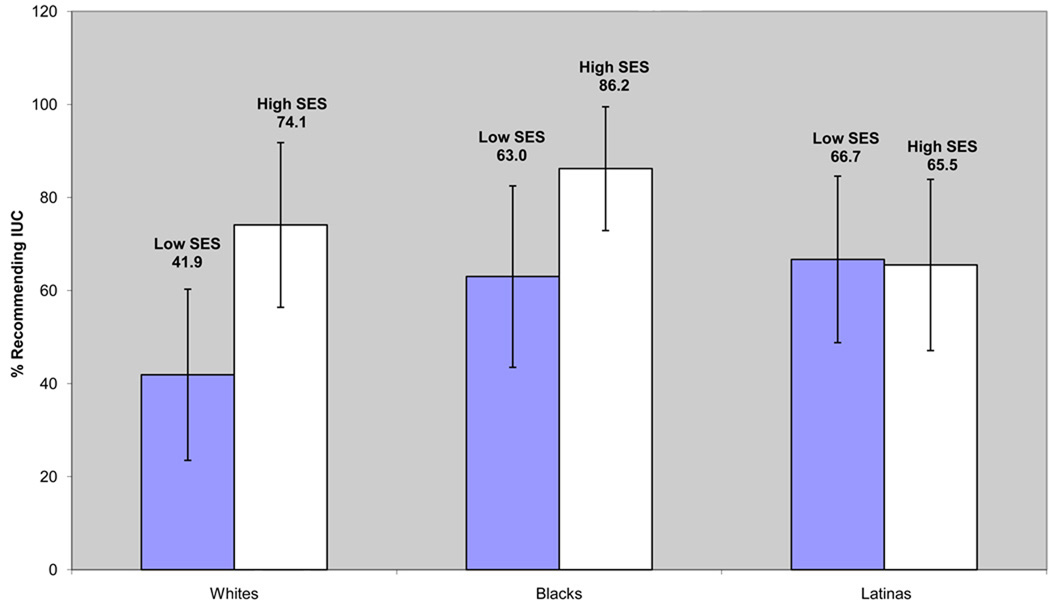
Low socioeconomic status whites were less likely to have intrauterine contraception recommended than high socioeconomic status whites (odds ratio [OR], 0.20; 95% confidence interval [CI], 0.06-0.69); whereas, socioeconomic status had no significant effect among Latinas and blacks. By race/ethnicity, low socioeconomic status Latinas and blacks were more likely to have intrauterine contraception recommended than low socioeconomic status whites (OR, 3.4; and 95% CI, 1.1-10.2 and OR, 3.1; 95% CI, 1.0-9.6, respectively), with no effect of race/ethnicity for high socioeconomic status patients.
Providers may have biases about intrauterine contraception or make assumptions about its use based on patient race/ethnicity and socioeconomic status.
医疗保健提供者的建议因患者的种族/族裔和社会经济地位而异,这些建议可能导致健康差距。本研究调查了这些因素对避孕建议的影响。
向 524 名医疗保健提供者展示了 18 个视频中的一个,这些视频描绘了不同社会人口特征的患者。提供者表示他们是否会向视频中展示的患者推荐左炔诺孕酮宫内节育器。
低社会经济地位的白人推荐宫内节育器的可能性低于高社会经济地位的白人(比值比 [OR],0.20;95%置信区间 [CI],0.06-0.69);然而,社会经济地位在拉丁裔和黑人中没有显著影响。按种族/族裔划分,低社会经济地位的拉丁裔和黑人推荐宫内节育器的可能性高于低社会经济地位的白人(OR,3.4;95% CI,1.1-10.2 和 OR,3.1;95% CI,1.0-9.6),而高社会经济地位患者的种族/族裔没有影响。
提供者可能对宫内节育器存在偏见,或者根据患者的种族/族裔和社会经济地位对其使用做出假设。