Division of Gastroenterology, Hepatology, and Nutrition, Department of Medicine, Vanderbilt University Medical Center, Nashville, Tennessee, USA.
Gastroenterology. 2010 Nov;139(5):1686-98, 1698.e1-6. doi: 10.1053/j.gastro.2010.06.060. Epub 2010 Jul 1.
BACKGROUND & AIMS: Helicobacter pylori-induced immune responses fail to eradicate the bacterium. Nitric oxide (NO) can kill H pylori. However, translation of inducible NO synthase (iNOS) and NO generation by H pylori-stimulated macrophages is inhibited by the polyamine spermine derived from ornithine decarboxylase (ODC), and is dependent on availability of the iNOS substrate L-arginine (L-Arg). We determined if spermine inhibits iNOS-mediated immunity by reducing L-Arg uptake into macrophages.
Levels of the inducible cationic amino acid transporter (CAT)2, ODC, and iNOS were measured in macrophages and H pylori gastritis tissues. L-Arg uptake, iNOS expression, and NO levels were assessed in cells with small interfering RNA knockdown of CAT2 or ODC, and in gastric macrophages. The ODC inhibitor, α-difluoromethylornithine, was administered to H pylori-infected mice for 4 months after inoculation.
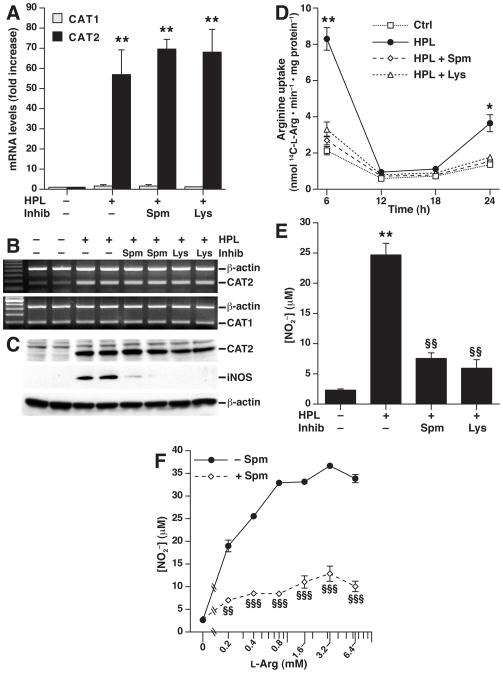
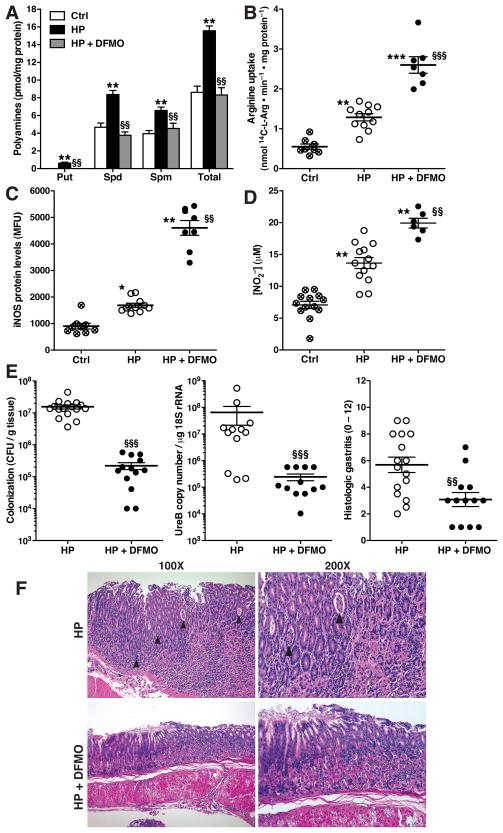
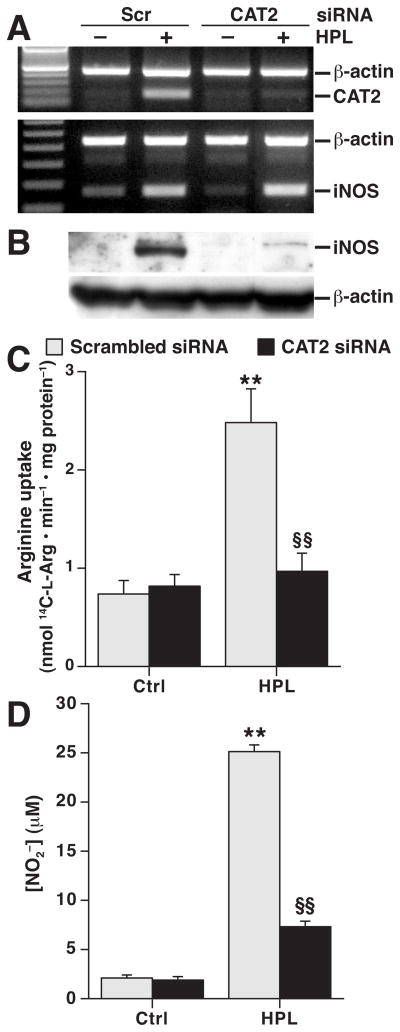
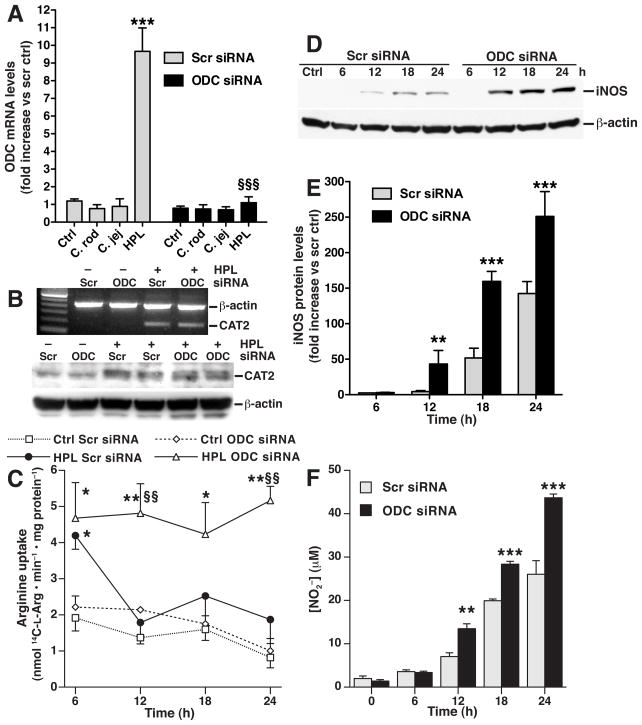
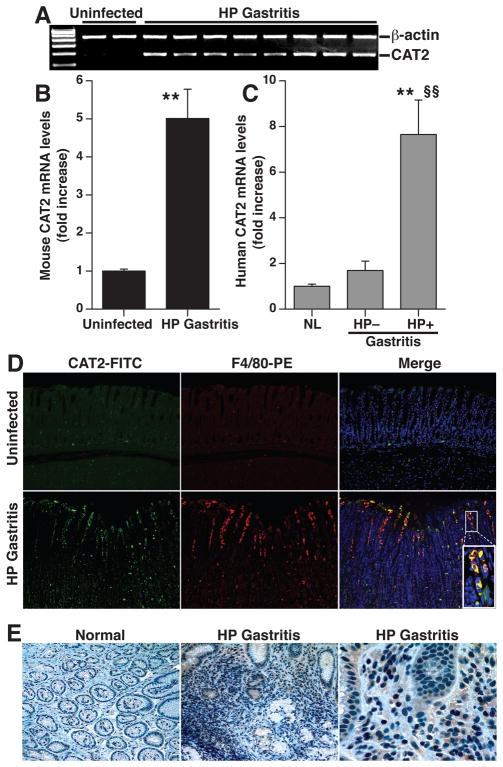
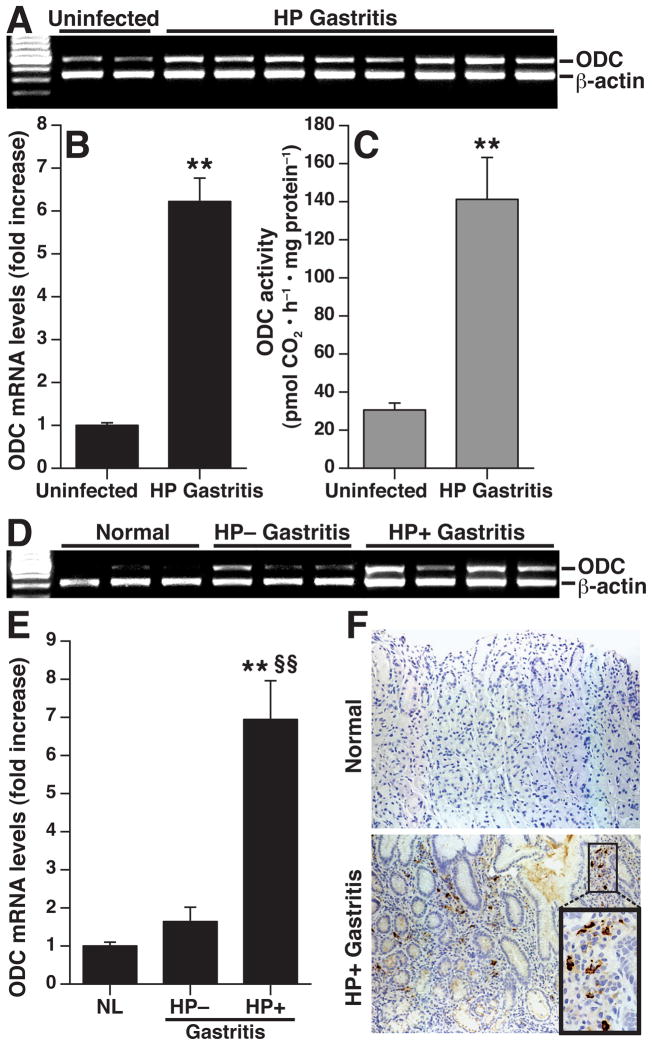
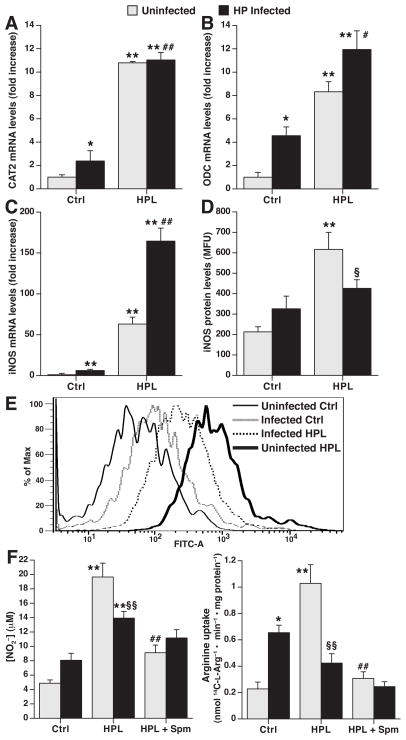
H pylori induced CAT2 and uptake of L-Arg in RAW 264.7 or primary macrophages. Addition of spermine or knockdown of CAT2 inhibited L-Arg uptake, NO production, and iNOS protein levels, whereas knockdown of ODC had the opposite effect. CAT2 and ODC were increased in mouse and human H pylori gastritis tissues and localized to macrophages. Gastric macrophages from H pylori-infected mice showed increased ODC expression, and attenuated iNOS and NO levels upon ex vivo H pylori stimulation versus cells from uninfected mice. α-Difluoromethylornithine treatment of infected mice restored L-Arg uptake, iNOS protein expression, and NO production in gastric macrophages, and significantly reduced both H pylori colonization levels and gastritis severity.
Up-regulation of ODC in gastric macrophages impairs host defense against H pylori by suppressing iNOS-derived NO production.
幽门螺杆菌(H. pylori)诱导的免疫反应未能根除该细菌。一氧化氮(NO)可以杀死 H. pylori。然而,H. pylori 刺激的巨噬细胞中诱导型一氧化氮合酶(iNOS)的翻译和 NO 的产生受到来自鸟氨酸脱羧酶(ODC)的多胺精脒的抑制,并且依赖于 iNOS 底物 L-精氨酸(L-Arg)的可用性。我们确定精脒是否通过减少巨噬细胞摄取 L-Arg 来抑制 iNOS 介导的免疫。
在巨噬细胞和 H. pylori 胃炎组织中测量诱导型阳离子氨基酸转运体(CAT)2、ODC 和 iNOS 的水平。在使用 CAT2 或 ODC 的小干扰 RNA 敲低的细胞以及胃巨噬细胞中评估 L-Arg 摄取、iNOS 表达和 NO 水平。在接种后 4 个月内,将 ODC 抑制剂α-二氟甲基鸟氨酸(α-difluoromethylornithine)施用于 H. pylori 感染的小鼠。
H. pylori 诱导 RAW 264.7 或原代巨噬细胞中的 CAT2 和 L-Arg 摄取。添加精脒或敲低 CAT2 抑制 L-Arg 摄取、NO 产生和 iNOS 蛋白水平,而敲低 ODC 则产生相反的效果。CAT2 和 ODC 在小鼠和人 H. pylori 胃炎组织中增加,并定位于巨噬细胞。与来自未感染小鼠的细胞相比,来自 H. pylori 感染小鼠的胃巨噬细胞显示出 ODC 表达增加,并且在体外 H. pylori 刺激下 iNOS 和 NO 水平降低。用 α-difluoromethylornithine 治疗感染的小鼠可恢复胃巨噬细胞中 L-Arg 的摄取、iNOS 蛋白表达和 NO 产生,并显著降低 H. pylori 定植水平和胃炎严重程度。
胃巨噬细胞中 ODC 的上调通过抑制 iNOS 衍生的 NO 产生来损害宿主对 H. pylori 的防御。