The Laboratory of Chemical Biology and Microbial Pathogenesis, The Rockefeller University, New York, New York, USA.
Nat Chem Biol. 2010 Aug;6(8):610-4. doi: 10.1038/nchembio.405. Epub 2010 Jul 4.
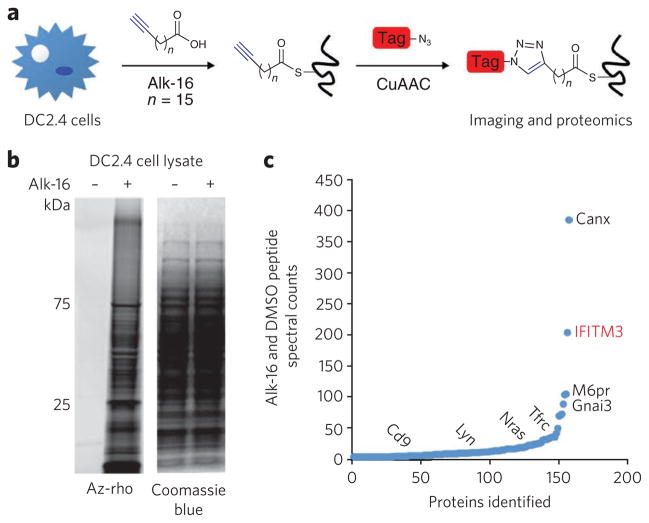
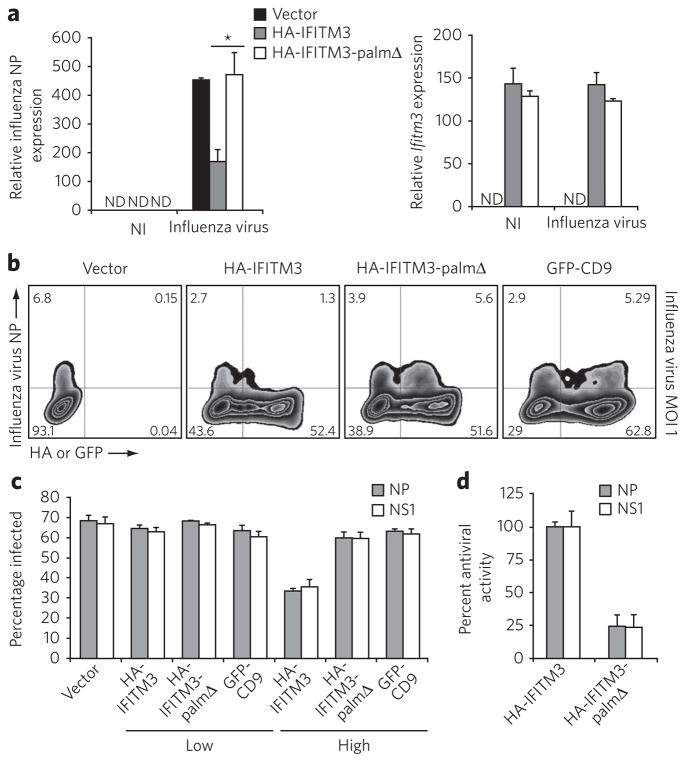
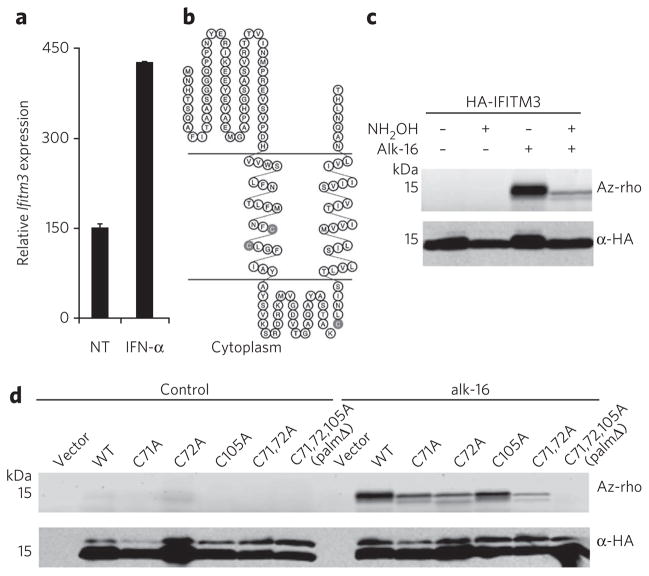
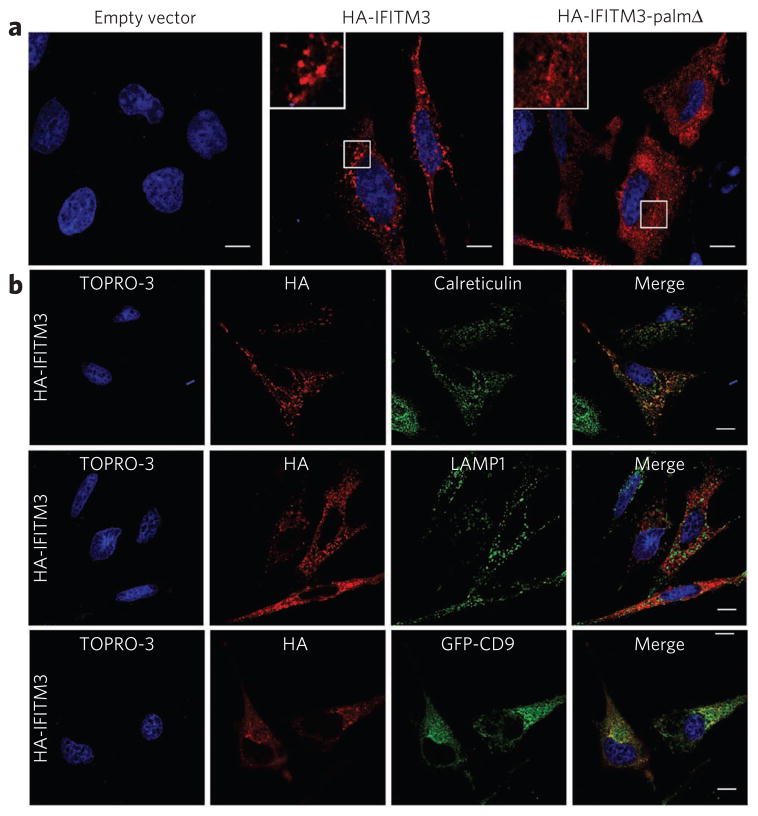
Identification of immune effectors and the post-translational modifications that control their activity is essential for dissecting mechanisms of immunity. Here we demonstrate that the antiviral activity of interferon-induced transmembrane protein 3 (IFITM3) is post-translationally regulated by S-palmitoylation. Large-scale profiling of palmitoylated proteins in a dendritic cell line using a chemical reporter strategy revealed over 150 lipid-modified proteins with diverse cellular functions, including innate immunity. We discovered that S-palmitoylation of IFITM3 on membrane-proximal cysteines controls its clustering in membrane compartments and its antiviral activity against influenza virus. The sites of S-palmitoylation are highly conserved among the IFITM family of proteins in vertebrates, which suggests that S-palmitoylation of these immune effectors may be an ancient post-translational modification that is crucial for host resistance to viral infections. The S-palmitoylation and clustering of IFITM3 will be important for elucidating its mechanism of action and for the design of antiviral therapeutics.
鉴定免疫效应因子及其控制其活性的翻译后修饰对于解析免疫机制至关重要。在这里,我们证明干扰素诱导跨膜蛋白 3(IFITM3)的抗病毒活性受到 S-棕榈酰化的翻译后调控。使用化学报告策略对树突状细胞系中棕榈酰化蛋白进行大规模分析,揭示了 150 多种具有不同细胞功能的脂质修饰蛋白,包括先天免疫。我们发现 IFITM3 上膜近端半胱氨酸的 S-棕榈酰化控制其在膜隔室中的聚集及其对流感病毒的抗病毒活性。在脊椎动物的 IFITM 蛋白家族中,S-棕榈酰化的位点高度保守,这表明这些免疫效应因子的 S-棕榈酰化可能是一种古老的翻译后修饰,对于宿主抵抗病毒感染至关重要。IFITM3 的 S-棕榈酰化和聚类对于阐明其作用机制和设计抗病毒治疗药物将是重要的。