Department of Pathology, Boston University School of Medicine, Boston, Massachusetts 02118, USA.
Shock. 2010 Oct;34(4):369-76. doi: 10.1097/SHK.0b013e3181dc40a8.
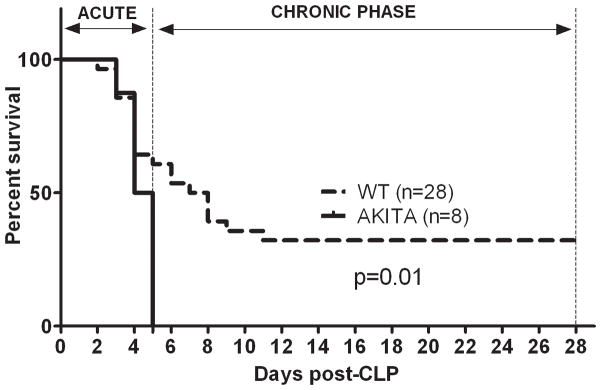
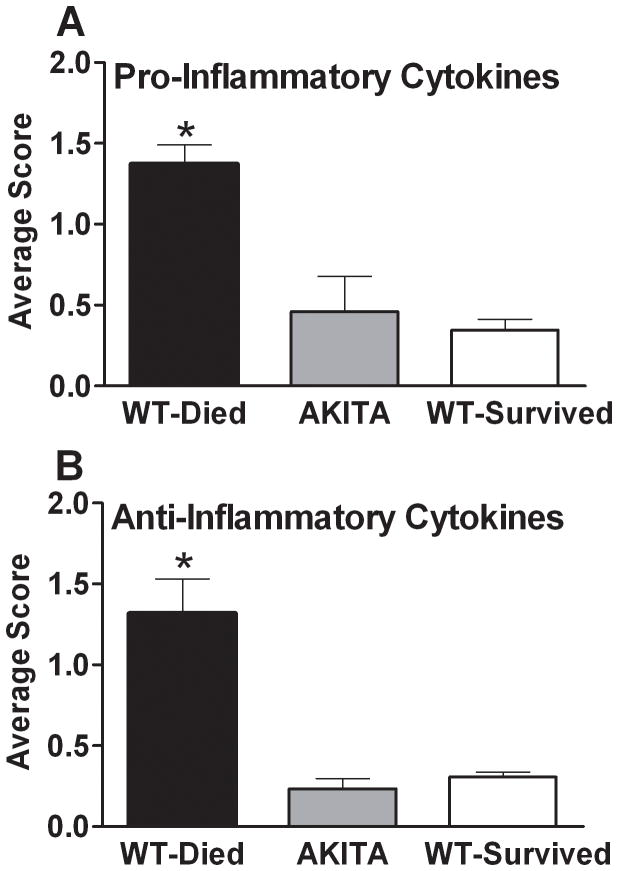
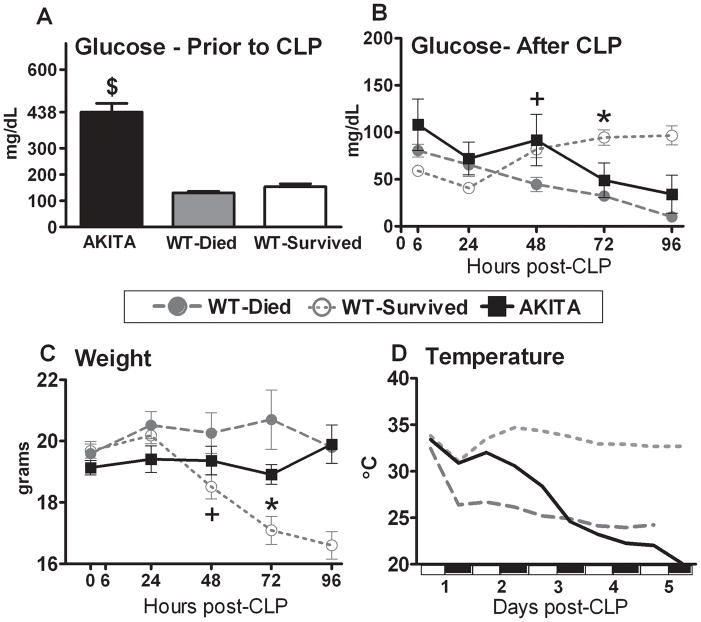
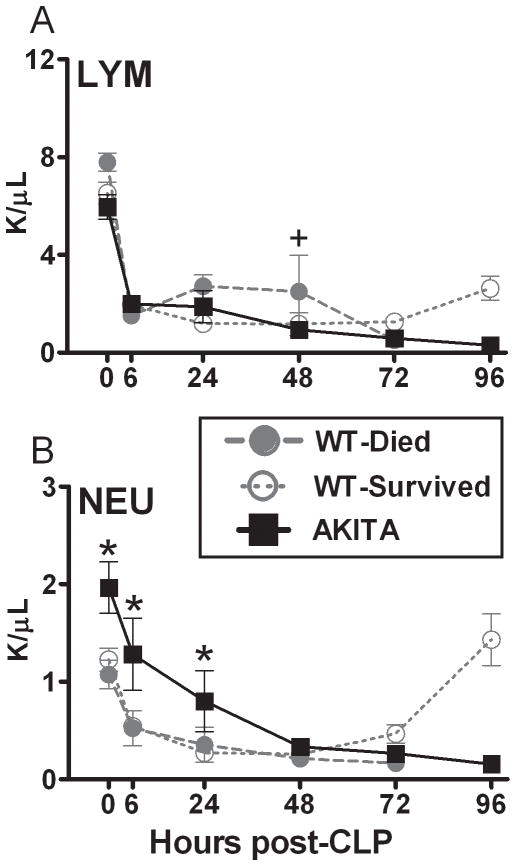
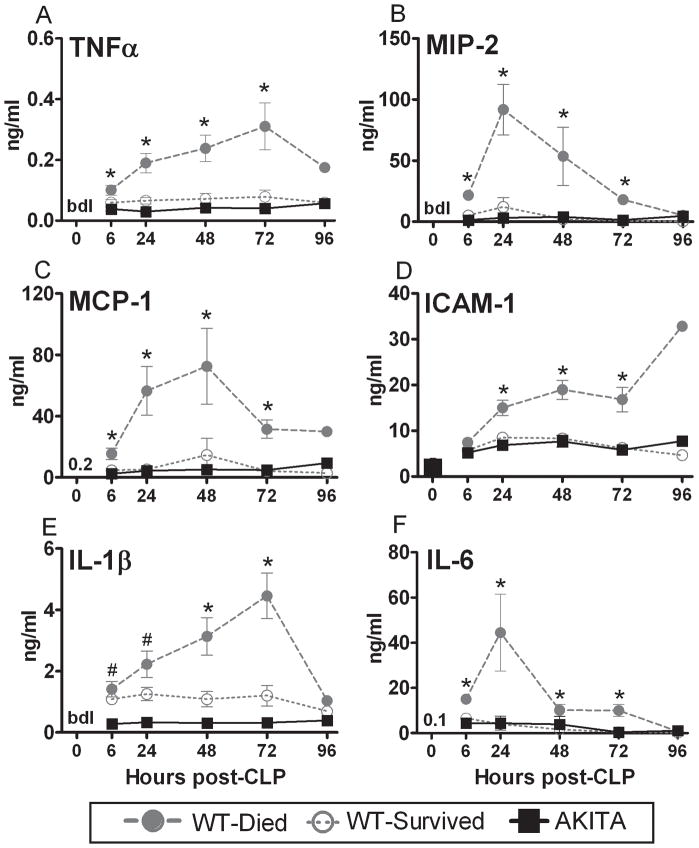
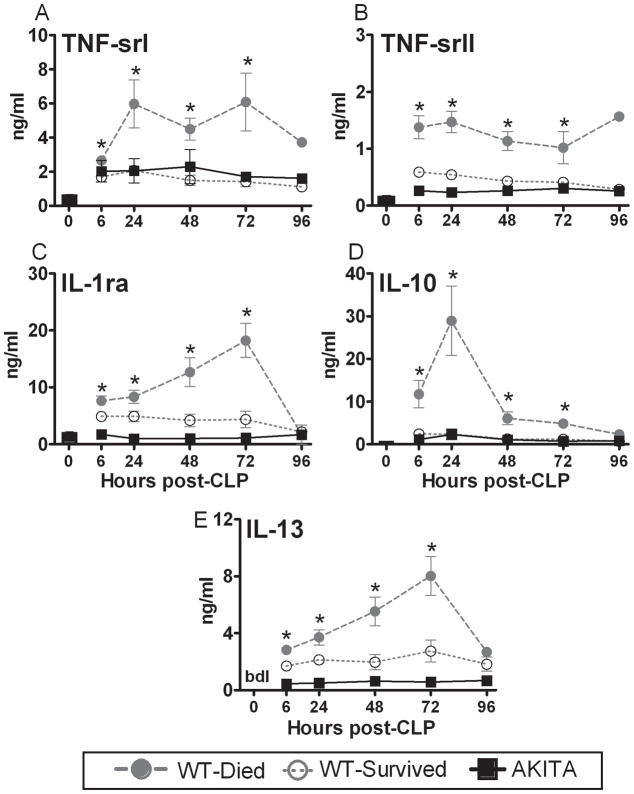
Diabetes mellitus is the leading comorbidity in patients with sepsis, but its impact upon survival and immunoinflammatory signaling in sepsis is undetermined. We investigated the effect of untreated diabetes mellitus upon survival and immunoinflammatory responses in the acute phase (days 1-5) of murine polymicrobial sepsis using the AKITA model of type 1 diabetes. Diabetic female C57BL/6-Ins2 (AKITA) and C57BL/6 wild-type (WT) mice underwent cecal ligation and puncture (CLP), blood (20 μL) was sampled for 5 days, and survival was monitored for 28 days. By day 5, all 8 AKITA mice died compared with 10 of 28 deaths in WT mice. Blood glucose declined post-CLP in all groups (most dramatically in AKITAs by 75%). To compare the evolution of inflammatory profiles, mice were retrospectively divided based on outcome into AKITA, WT-Died, and WT-Survived (within days 1-5). Hypoglycemia developed in all groups, which resolved in WT-Survived (97 mg/dL at 96 h) but intensified in WT-Died and AKITAs (∼30 mg/dL). Dramatic increases in both proinflammatory and anti-inflammatory cytokines were observed in WT-Died (i.e., interleukin 6, 38.2 ± 17.8 ng/mL at 24 h), which contrasted with a lack of prelethal cytokine response in AKITA mice (interleukin 6, 4.3 ± 3.4 ng/mL at 24 h). A prelethal composite cytokine score was calculated on values obtained 24 h before death. This score was 3-fold lower for proinflammatory cytokines and 6-fold lower for anti-inflammatory mediators in the AKITA mice compared with the WT-Died mice but identical to the composite score in WT-Survived. These data demonstrate that untreated type I diabetes mellitus severely exacerbates sepsis mortality without inducing a prelethal release of systemic proinflammatory or anti-inflammatory cytokines.
糖尿病是脓毒症患者的主要合并症,但它对脓毒症患者的生存和免疫炎症信号的影响尚未确定。我们使用 1 型糖尿病 AKITA 模型研究了未经治疗的糖尿病对多微生物脓毒症急性期(第 1-5 天)生存和免疫炎症反应的影响。患有糖尿病的雌性 C57BL/6-Ins2(AKITA)和 C57BL/6 野生型(WT)小鼠接受盲肠结扎和穿刺(CLP),5 天内采集 20 μL 血液,并监测 28 天的生存情况。第 5 天,所有 8 只 AKITA 小鼠死亡,而 WT 小鼠中有 10 只死亡。所有组的血糖在 CLP 后均下降(AKITA 组下降最明显,下降了 75%)。为了比较炎症谱的演变,根据结果将小鼠回顾性地分为 AKITA、WT 死亡和 WT 存活(第 1-5 天内)。所有组均出现低血糖,WT 存活组(96 小时时为 97 mg/dL)缓解,但 WT 死亡组和 AKITA 组加重(约 30 mg/dL)。WT 死亡组(24 小时时为 38.2 ± 17.8 ng/mL)观察到促炎和抗炎细胞因子均显著增加,而 AKITA 小鼠则缺乏致死前细胞因子反应(24 小时时为 4.3 ± 3.4 ng/mL)。在死亡前 24 小时获得的值计算了致死前复合细胞因子评分。与 WT 死亡组相比,AKITA 组的促炎细胞因子评分低 3 倍,抗炎介质评分低 6 倍,但与 WT 存活组的复合评分相同。这些数据表明,未经治疗的 1 型糖尿病使脓毒症死亡率严重恶化,而不会诱导系统促炎或抗炎细胞因子的致死前释放。