Faculty of Sport, Health and Social Care, University of Gloucestershire, Gloucester, UK.
Int J Environ Res Public Health. 2010 Feb;7(2):583-95. doi: 10.3390/ijerph7020583. Epub 2010 Feb 21.
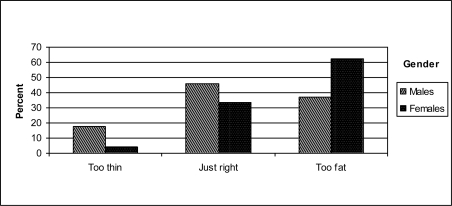
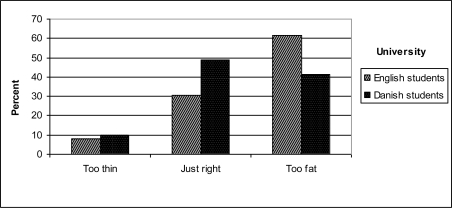
This study examined differences in body image perception between university students in two European countries, United Kingdom and Denmark. A total of 816 British and 548 Danish university students participated in a cross-sectional survey. A self-administered questionnaire assessed socio-demographic information, body image perception (as "too thin", "just right" or "too fat"), and the association of related factors with body image perception (nutrition behaviour, social support, perceived stressors and quality of life). The proportions of students who perceived themselves as "too thin", "just right", or "too fat" were 8.6%, 37.7%, and 53.7% respectively. Multi-factorial logistic regression analysis showed that students who perceived themselves as "too fat" were more likely to be from the British university, to be females, to be older than 30 years, to report stress due to their financial situation and were less likely to have a high quality of life. The findings highlight the need for interventions with focus on healthy food choices whilst acknowledging financial stressors and quality of life.
本研究考察了两个欧洲国家(英国和丹麦)大学生在身体意象感知方面的差异。共有 816 名英国大学生和 548 名丹麦大学生参与了横断面调查。一份自我管理的问卷评估了社会人口统计学信息、身体意象感知(“太瘦”、“刚刚好”或“太胖”),以及相关因素与身体意象感知的关联(营养行为、社会支持、感知压力源和生活质量)。分别有 8.6%、37.7%和 53.7%的学生认为自己“太瘦”、“刚刚好”或“太胖”。多因素逻辑回归分析表明,认为自己“太胖”的学生更有可能来自英国大学,是女性,年龄大于 30 岁,因经济状况而感到压力,生活质量较低。研究结果强调了需要干预措施,重点关注健康的食物选择,同时承认经济压力源和生活质量。