Department of Biochemistry, Boston University School of Medicine, Boston, MA, USA.
Oncogene. 2010 Sep 16;29(37):5204-13. doi: 10.1038/onc.2010.277. Epub 2010 Jul 12.
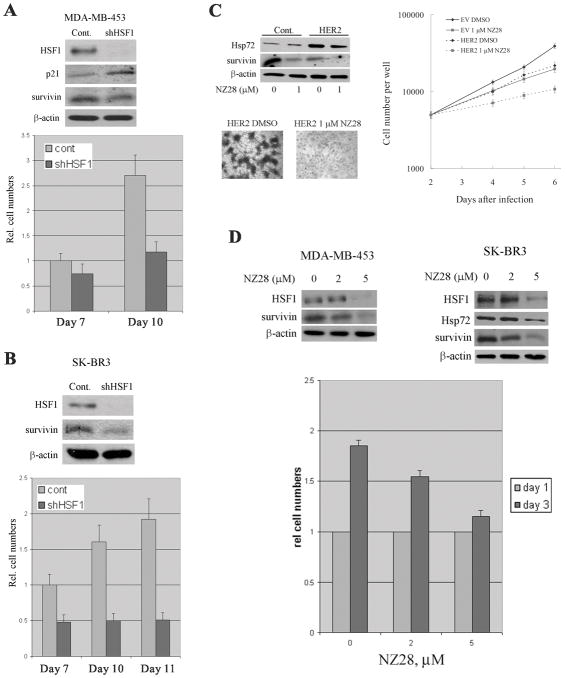
The heat-shock transcription factor HSF1 was recently shown to have a key role in the development of tumors associated with activation of Ras or inactivation of p53. Here, we show that HSF1 is required for the cell transformation and tumorigenesis induced by the human epidermal growth factor receptor-2 (HER2) oncogene responsible for aggressive breast tumors. Upon expression of HER2, untransformed human mammary epithelial MCF-10A cells underwent neoplastic transformation, formed foci in culture and tumors in nude mouse xenografts. However, expression of HER2 in MCF-10A cells with knockdown of HSF1 did not cause either foci formation or tumor growth in xenografts. The antitumorigenic effect of downregulation of HSF1 was associated with HER2-induced accumulation of the cyclin-dependent kinase inhibitor p21 and decrease in the mitotic regulator survivin, which resulted in growth inhibition and cell senescence. In fact, either knockout of p21 or overexpression of survivin alleviated these effects of HSF1 knockdown. The proliferation of certain human HER2-positive breast cancer lines also requires HSF1, as its knockdown led to upregulation of p21 and/or decrease in survivin, precipitating growth arrest. Similar effects were observed with a small-molecular-weight inhibitor of the heat-shock response NZ28. The effects of HSF1 knockdown on the growth arrest and senescence of HER2-expressing cells were associated with downregulation of heat-shock protein (Hsp)72 and Hsp27. Therefore, HSF1 is critical for proliferation of HER2-expressing cells, most likely because it maintains the levels of HSPs, which in turn control regulators of senescence p21 and survivin.
热休克转录因子 HSF1 最近被证明在与 Ras 激活或 p53 失活相关的肿瘤发展中具有关键作用。在这里,我们表明 HSF1 是人类表皮生长因子受体-2(HER2)致癌基因诱导的细胞转化和肿瘤发生所必需的,HER2 负责侵袭性乳腺癌。在表达 HER2 后,未转化的人乳腺上皮 MCF-10A 细胞发生了肿瘤转化,在培养物中形成了焦点,并在裸鼠异种移植中形成了肿瘤。然而,在 MCF-10A 细胞中表达 HER2 并敲低 HSF1 不会导致焦点形成或异种移植中的肿瘤生长。下调 HSF1 的抗肿瘤作用与 HER2 诱导的细胞周期蛋白依赖性激酶抑制剂 p21 的积累和有丝分裂调节剂 survivin 的减少有关,这导致了生长抑制和细胞衰老。事实上,敲除 p21 或过表达 survivin 缓解了 HSF1 敲低的这些作用。某些人 HER2 阳性乳腺癌系的增殖也需要 HSF1,因为其敲低导致 p21 的上调和/或 survivin 的减少,导致生长停滞。用小分子热休克反应抑制剂 NZ28 观察到类似的效果。HSF1 敲低对表达 HER2 的细胞生长停滞和衰老的影响与热休克蛋白(Hsp)72 和 Hsp27 的下调有关。因此,HSF1 对表达 HER2 的细胞的增殖至关重要,最有可能是因为它维持了 HSPs 的水平,而 HSPs 反过来又控制了衰老 p21 和 survivin 的调节剂。