Mills Edward J, Wu Ping, Lockhart Ian, Wilson Kumanan, Ebbert Jon O
Faculty of Health Sciences, University of Ottawa, Ottawa, Canada.
Tob Induc Dis. 2010 Jul 13;8(1):8. doi: 10.1186/1617-9625-8-8.
Nicotine replacement therapy (NRT) is the most common form of smoking cessation pharmacotherapy and has proven efficacy for the treatment of tobacco dependence. Although expectations of mild adverse effects have been observed to be independent predictors of reduced motivation to use NRT, adverse effects associated with NRT have not been precisely quantified.
A systematic review and meta-analysis aimed to identify all randomized clinical trials (RCTs) of NRT versus inert controls and all observational studies to determine the magnitude of reported adverse effects with NRT.
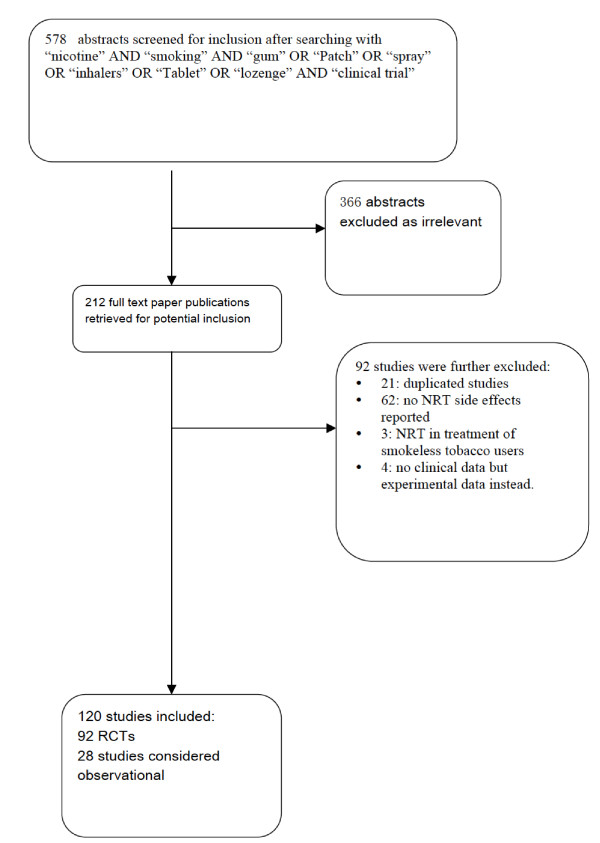
Searches of 10 electronic databases from inception to November 2009 were conducted. Study selection and data extraction were carried out independently in duplicate. RCTs were pooled using a random effects method with Odds Ratio [OR] as the effect measure, while proportions were pooled from observational studies. A meta-regression analysis was applied to examine whether the nicotine patch is associated with different adverse effects from those common to orally administered NRT.
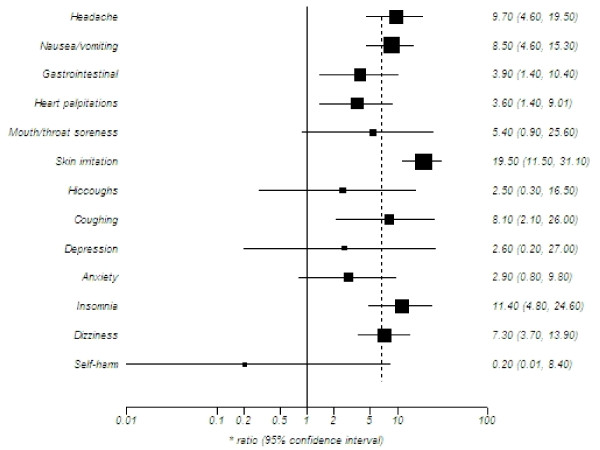
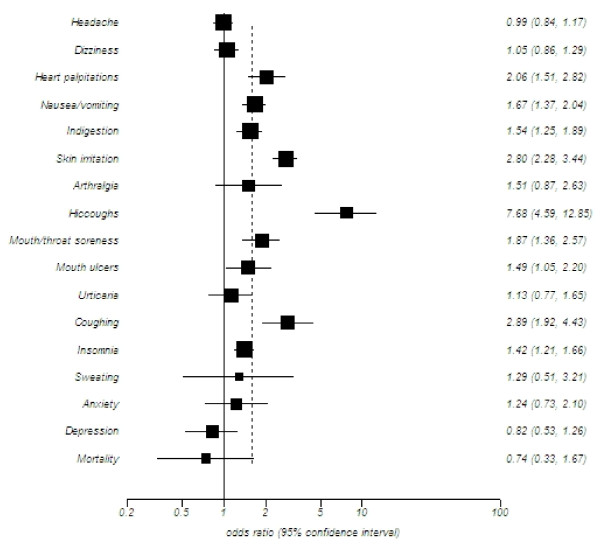
Ninety-two RCTs involving 32,185 participants and 28 observational studies involving 145, 205 participants were identified. Pooled RCT evidence of varying NRT formulations found an increased risk of heart palpitations and chest pains (OR 2.06, 95% Confidence Interval [CI] 1.51-2.82, P < 0.001); nausea and vomiting (OR 1.67, 95% CI 1.37-2.04, P < 0.001); gastrointestinal complaints (OR 1.54, 95% CI, 1.25-1.89, P < 0.001); and insomnia (OR 1.42, 95% CI, 1.21-1.66, P < 0.001). Pooled evidence specific to the NRT patch found an increase in skin irritations (OR 2.80, 95% CO, 2.28-3.24, P < 0.001). Orally administered NRT was associated with mouth and throat soreness (OR 1.87, 95% CI, 1.36-2.57, P < 0.001); mouth ulcers (OR 1.49, 95% CI, 1.05-2.20, P < 0.001); hiccoughs (OR 7.68, 95% CI, 4.59-12.85, P < 0.001) and coughing (OR 2.89, 95% CI, 1.92-4.33, P < 0.001). There was no statistically significant increase in anxiety or depressive symptoms associated with NRT use. Non-comparative observational studies demonstrated the prevalence of these events in a broad population.
The use of NRT is associated with a variety of side effects. In addition to counseling and medical monitoring, clinicians should inform patients of potential side effects which are associated with the use of NRT for the treatment of tobacco dependence.
尼古丁替代疗法(NRT)是戒烟药物治疗最常见的形式,已被证明对治疗烟草依赖有效。尽管对轻微不良反应的预期已被观察到是使用NRT动机降低的独立预测因素,但与NRT相关的不良反应尚未得到精确量化。
进行一项系统评价和荟萃分析,旨在识别所有NRT与惰性对照的随机临床试验(RCT)以及所有观察性研究,以确定报告的NRT不良反应的程度。
检索了从开始到2009年11月的10个电子数据库。研究选择和数据提取由两人独立重复进行。RCT采用随机效应方法合并,以比值比(OR)作为效应量,而观察性研究的数据则进行合并。应用荟萃回归分析来检验尼古丁贴片是否与口服NRT常见的不良反应不同。
确定了92项涉及32185名参与者的RCT和28项涉及145205名参与者的观察性研究。不同NRT制剂的汇总RCT证据表明,心悸和胸痛风险增加(OR 2.06,95%置信区间[CI]1.51 - 2.82,P < 0.001);恶心和呕吐(OR 1.67,95%CI 1.37 - 2.04,P < 0.001);胃肠道不适(OR 1.54,95%CI 1.25 - 1.89,P < 0.001);以及失眠(OR 1.42,95%CI 1.21 - 1.66,P < 0.001)。NRT贴片的汇总证据表明皮肤刺激增加(OR 2.80,95%CI 2.28 - 3.24,P < 0.001)。口服NRT与口腔和喉咙疼痛(OR 1.87,95%CI 1.36 - 2.57,P < 0.001);口腔溃疡(OR 1.49,95%CI 1.05 - 2.20,P < 0.001);打嗝(OR 7.68,95%CI 4.59 - 12.85,P < 0.001)和咳嗽(OR 2.89,95%CI 1.92 - 4.33,P < 0.001)有关。使用NRT与焦虑或抑郁症状无统计学显著增加。非对比观察性研究表明了这些事件在广泛人群中的发生率。
使用NRT与多种副作用相关。除了咨询和医学监测外,临床医生应告知患者与使用NRT治疗烟草依赖相关的潜在副作用。