ARC Centre of Excellence for Coral Reefs Studies and Coral Genomics Group, James Cook University, Townsville, Queensland, Australia.
PLoS One. 2010 Jul 8;5(7):e11490. doi: 10.1371/journal.pone.0011490.
Classical morphological taxonomy places the approximately 1400 recognized species of Scleractinia (hard corals) into 27 families, but many aspects of coral evolution remain unclear despite the application of molecular phylogenetic methods. In part, this may be a consequence of such studies focusing on the reef-building (shallow water and zooxanthellate) Scleractinia, and largely ignoring the large number of deep-sea species. To better understand broad patterns of coral evolution, we generated molecular data for a broad and representative range of deep sea scleractinians collected off New Caledonia and Australia during the last decade, and conducted the most comprehensive molecular phylogenetic analysis to date of the order Scleractinia.
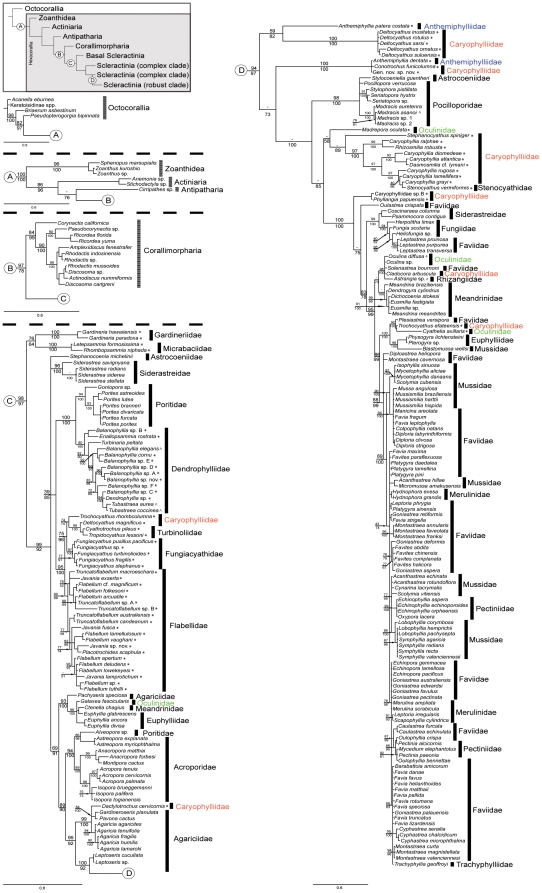
Partial (595 bp) sequences of the mitochondrial cytochrome oxidase subunit 1 (CO1) gene were determined for 65 deep-sea (azooxanthellate) scleractinians and 11 shallow-water species. These new data were aligned with 158 published sequences, generating a 234 taxon dataset representing 25 of the 27 currently recognized scleractinian families.
PRINCIPAL FINDINGS/CONCLUSIONS: There was a striking discrepancy between the taxonomic validity of coral families consisting predominantly of deep-sea or shallow-water species. Most families composed predominantly of deep-sea azooxanthellate species were monophyletic in both maximum likelihood and Bayesian analyses but, by contrast (and consistent with previous studies), most families composed predominantly of shallow-water zooxanthellate taxa were polyphyletic, although Acroporidae, Poritidae, Pocilloporidae, and Fungiidae were exceptions to this general pattern. One factor contributing to this inconsistency may be the greater environmental stability of deep-sea environments, effectively removing taxonomic "noise" contributed by phenotypic plasticity. Our phylogenetic analyses imply that the most basal extant scleractinians are azooxanthellate solitary corals from deep-water, their divergence predating that of the robust and complex corals. Deep-sea corals are likely to be critical to understanding anthozoan evolution and the origins of the Scleractinia.
经典形态分类学将约 1400 种已识别的石珊瑚(硬珊瑚)归入 27 个科,但尽管应用了分子系统发育方法,珊瑚进化的许多方面仍不清楚。部分原因可能是这些研究主要集中在造礁(浅水和共生藻)石珊瑚上,而在很大程度上忽略了大量深海物种。为了更好地了解珊瑚进化的广泛模式,我们在过去十年中从新喀里多尼亚和澳大利亚近海采集了广泛而有代表性的深海石珊瑚,并进行了迄今为止最全面的石珊瑚目分子系统发育分析。
对 65 种深海(无共生藻)石珊瑚和 11 种浅海物种的线粒体细胞色素氧化酶亚基 1(CO1)基因的部分(595 bp)序列进行了测定。这些新数据与 158 个已发表序列对齐,生成了一个包含 25 个当前公认的石珊瑚科的 234 分类群数据集。
主要发现/结论:以深海或浅海物种为主的珊瑚科的分类有效性存在显著差异。大多数主要由深海无共生藻物种组成的科在最大似然法和贝叶斯分析中都是单系的,但与此形成鲜明对比的是(与先前的研究一致),大多数主要由浅海共生藻分类群组成的科是多系的,尽管栉孔扇贝科、鹿角珊瑚科、珍珠贝科和蘑菇珊瑚科是这种一般模式的例外。造成这种不一致的一个因素可能是深海环境的更大稳定性,有效地消除了由表型可塑性贡献的分类“噪声”。我们的系统发育分析表明,现存最基础的石珊瑚是深海无共生藻的独居珊瑚,它们的分化早于坚固而复杂的珊瑚。深海珊瑚对于理解珊瑚动物的进化和石珊瑚的起源可能至关重要。