Fukami Hironobu, Chen Chaolun Allen, Budd Ann F, Collins Allen, Wallace Carden, Chuang Yao-Yang, Chen Chienhsun, Dai Chang-Feng, Iwao Kenji, Sheppard Charles, Knowlton Nancy
Seto Marine Biological Laboratory, Field Science Education and Research Center, Kyoto University, Shirahama, Wakayama, Japan.
PLoS One. 2008 Sep 16;3(9):e3222. doi: 10.1371/journal.pone.0003222.
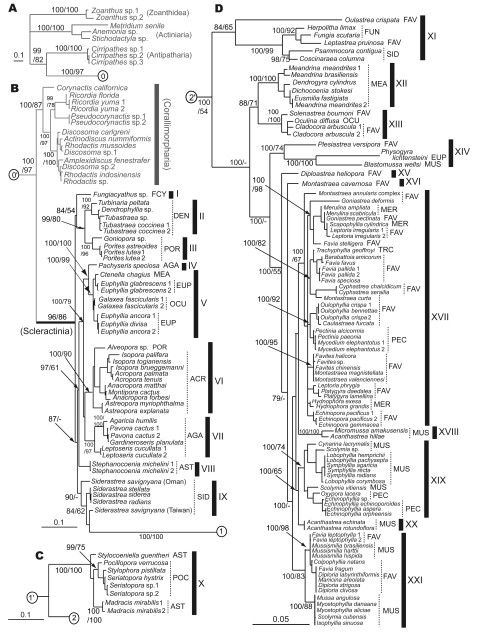
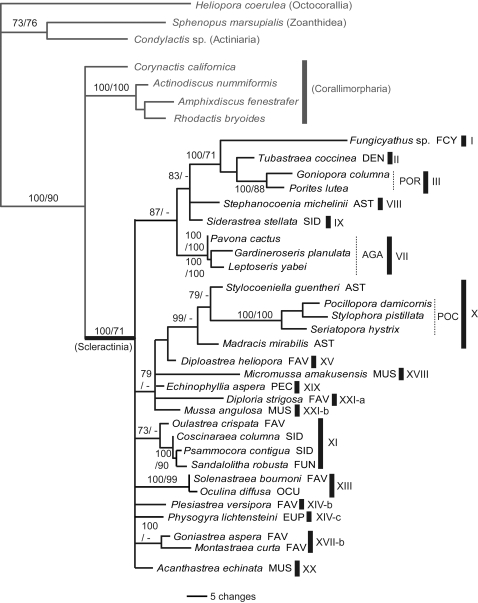
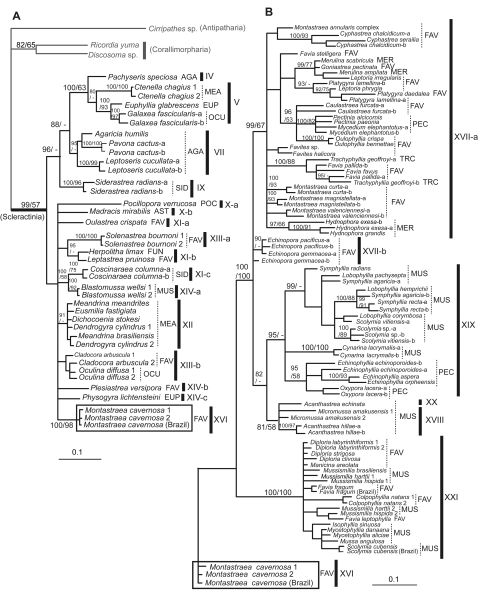
Modern hard corals (Class Hexacorallia; Order Scleractinia) are widely studied because of their fundamental role in reef building and their superb fossil record extending back to the Triassic. Nevertheless, interpretations of their evolutionary relationships have been in flux for over a decade. Recent analyses undermine the legitimacy of traditional suborders, families and genera, and suggest that a non-skeletal sister clade (Order Corallimorpharia) might be imbedded within the stony corals. However, these studies either sampled a relatively limited array of taxa or assembled trees from heterogeneous data sets. Here we provide a more comprehensive analysis of Scleractinia (127 species, 75 genera, 17 families) and various outgroups, based on two mitochondrial genes (cytochrome oxidase I, cytochrome b), with analyses of nuclear genes (ss-tubulin, ribosomal DNA) of a subset of taxa to test unexpected relationships. Eleven of 16 families were found to be polyphyletic. Strikingly, over one third of all families as conventionally defined contain representatives from the highly divergent "robust" and "complex" clades. However, the recent suggestion that corallimorpharians are true corals that have lost their skeletons was not upheld. Relationships were supported not only by mitochondrial and nuclear genes, but also often by morphological characters which had been ignored or never noted previously. The concordance of molecular characters and more carefully examined morphological characters suggests a future of greater taxonomic stability, as well as the potential to trace the evolutionary history of this ecologically important group using fossils.
现代硬珊瑚(六放珊瑚纲;石珊瑚目)因其在珊瑚礁形成中的基础作用以及可追溯至三叠纪的出色化石记录而受到广泛研究。然而,对其进化关系的解释在过去十多年里一直处于变动之中。近期的分析削弱了传统亚目、科和属的合理性,并表明一个无骨骼的姐妹分支(珊瑚藻目)可能嵌入石珊瑚之中。然而,这些研究要么采样的分类单元相对有限,要么从异质数据集中构建系统树。在此,我们基于两个线粒体基因(细胞色素氧化酶I、细胞色素b),对石珊瑚目(127种、75属、17科)及各种外类群进行了更全面的分析,并对一部分分类单元的核基因(ss - 微管蛋白、核糖体DNA)进行分析以检验意外的关系。16个科中有11个被发现是多系的。引人注目的是,按照传统定义,所有科中有超过三分之一包含来自高度分化的“粗壮”和“复杂”分支的代表。然而,最近关于珊瑚藻是失去了骨骼的真正珊瑚的观点并未得到支持。进化关系不仅得到线粒体和核基因的支持,而且常常也得到以前被忽视或从未被注意到的形态特征的支持。分子特征与经过更仔细研究的形态特征的一致性表明,未来分类学将具有更高的稳定性,同时也有利用化石追溯这个生态重要类群进化历史的潜力。