Department of Pediatrics, University of Chicago, Chicago, Illinois, USA.
PLoS Comput Biol. 2010 Jul 8;6(7):e1000846. doi: 10.1371/journal.pcbi.1000846.
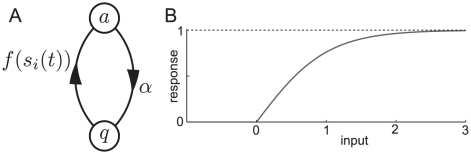
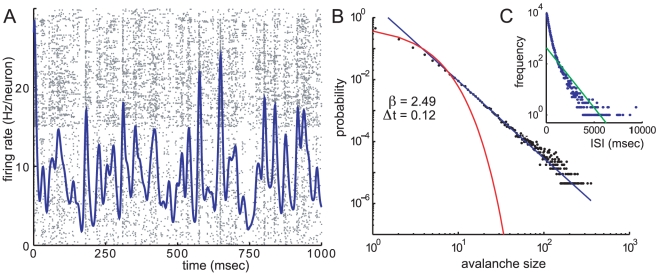
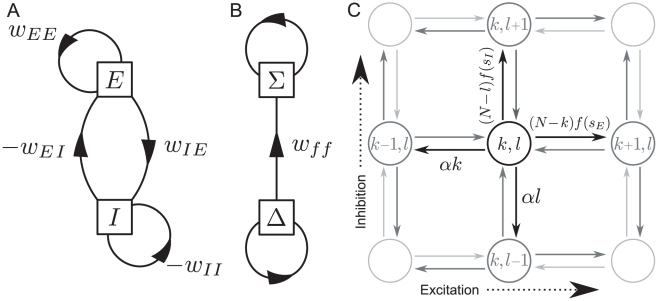
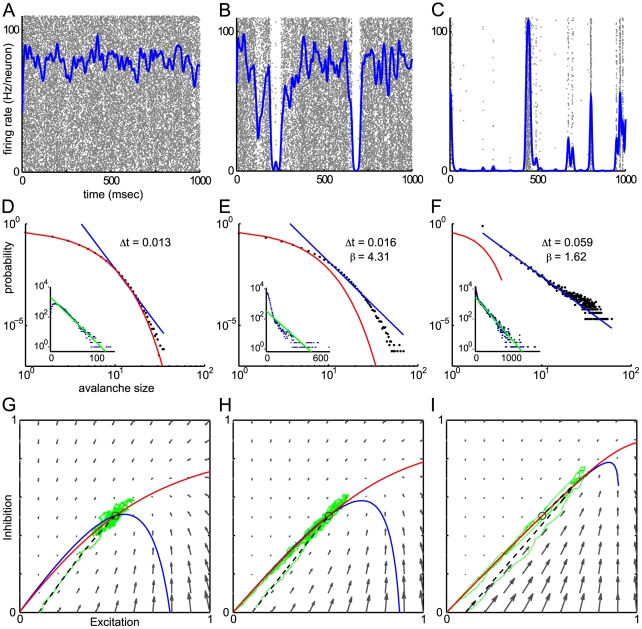
Neuronal avalanches are a form of spontaneous activity widely observed in cortical slices and other types of nervous tissue, both in vivo and in vitro. They are characterized by irregular, isolated population bursts when many neurons fire together, where the number of spikes per burst obeys a power law distribution. We simulate, using the Gillespie algorithm, a model of neuronal avalanches based on stochastic single neurons. The network consists of excitatory and inhibitory neurons, first with all-to-all connectivity and later with random sparse connectivity. Analyzing our model using the system size expansion, we show that the model obeys the standard Wilson-Cowan equations for large network sizes ( neurons). When excitation and inhibition are closely balanced, networks of thousands of neurons exhibit irregular synchronous activity, including the characteristic power law distribution of avalanche size. We show that these avalanches are due to the balanced network having weakly stable functionally feedforward dynamics, which amplifies some small fluctuations into the large population bursts. Balanced networks are thought to underlie a variety of observed network behaviours and have useful computational properties, such as responding quickly to changes in input. Thus, the appearance of avalanches in such functionally feedforward networks indicates that avalanches may be a simple consequence of a widely present network structure, when neuron dynamics are noisy. An important implication is that a network need not be "critical" for the production of avalanches, so experimentally observed power laws in burst size may be a signature of noisy functionally feedforward structure rather than of, for example, self-organized criticality.
神经元爆发是一种自发活动的形式,广泛存在于皮质切片和其他类型的神经组织中,无论是在体内还是在体外。它们的特征是不规则的、孤立的群体爆发,当许多神经元一起放电时,爆发中的尖峰数量服从幂律分布。我们使用 Gillespie 算法模拟了一种基于随机单神经元的神经元爆发模型。该网络由兴奋性和抑制性神经元组成,最初具有全连接,后来具有随机稀疏连接。通过对模型进行系统大小扩展分析,我们表明,当网络大小较大时(神经元数量较多),该模型服从标准的 Wilson-Cowan 方程。当兴奋和抑制平衡时,数千个神经元的网络表现出不规则的同步活动,包括爆发大小的特征幂律分布。我们表明,这些爆发是由于平衡网络具有弱稳定的功能前馈动力学,它将一些小的波动放大为大的群体爆发。平衡网络被认为是各种观察到的网络行为的基础,并具有有用的计算特性,例如对输入变化的快速响应。因此,在这种功能前馈网络中出现爆发表明,当神经元动力学存在噪声时,爆发可能是广泛存在的网络结构的简单结果。一个重要的含义是,网络不一定需要处于“临界状态”才能产生爆发,因此在实验中观察到的爆发大小的幂律可能是噪声功能前馈结构的特征,而不是例如自组织临界性的特征。