FAS Center for Systems Biology, Harvard University, Cambridge, Massachusetts 02138, USA.
Nat Rev Microbiol. 2010 Aug;8(8):600-7. doi: 10.1038/nrmicro2391.
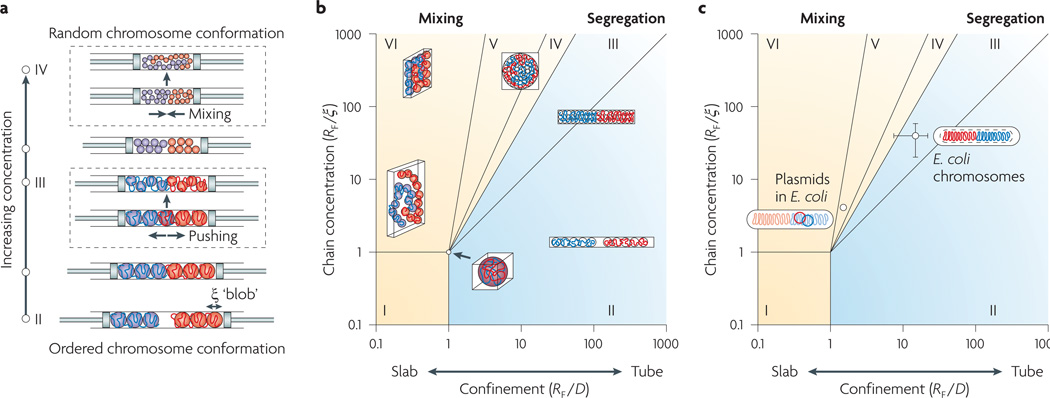
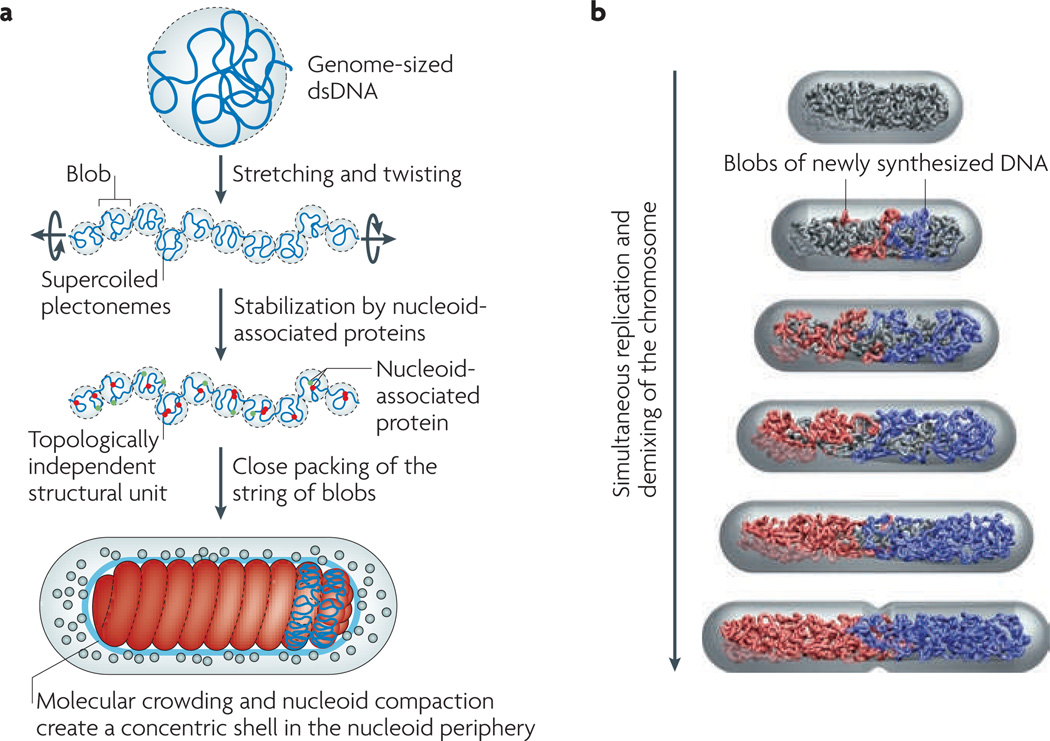
We present a new physical biology approach to understanding the relationship between the organization and segregation of bacterial chromosomes. We posit that replicated Escherichia coli daughter strands will spontaneously demix as a result of entropic forces, despite their strong confinement within the cell; in other words, we propose that entropy can act as a primordial physical force which drives chromosome segregation under the right physical conditions. Furthermore, proteins implicated in the regulation of chromosome structure and segregation may in fact function primarily in supporting such an entropy-driven segregation mechanism by regulating the physical state of chromosomes. We conclude that bacterial chromosome segregation is best understood in terms of spontaneous demixing of daughter strands. Our concept may also have important implications for chromosome segregation in eukaryotes, in which spindle-dependent chromosome movement follows an extended period of sister chromatid demixing and compaction.
我们提出了一种新的物理生物学方法来理解细菌染色体的组织和分离之间的关系。我们假设,尽管大肠杆菌的复制子在细胞内受到强烈的限制,但由于熵力的作用,它们会自发地分离;换句话说,我们提出熵可以作为一种原始的物理力,在适当的物理条件下驱动染色体的分离。此外,参与调节染色体结构和分离的蛋白质实际上可能主要通过调节染色体的物理状态来支持这种熵驱动的分离机制。我们得出的结论是,细菌染色体的分离最好从子链的自发分离来理解。我们的概念对于真核生物中的染色体分离也可能具有重要意义,在真核生物中,纺锤体依赖的染色体运动遵循一个延长的姐妹染色单体分离和浓缩的过程。