School of Nursing, Faculty of Health Sciences, McMaster University, Hamilton, Canada.
Implement Sci. 2010 Jul 19;5:56. doi: 10.1186/1748-5908-5-56.
Policy makers and others often require synthesis of knowledge in an area within six months or less. Traditional systematic reviews typically take at least 12 months to conduct. Rapid reviews streamline traditional systematic review methods in order to synthesize evidence within a shortened timeframe. There is great variation in the process of conducting rapid reviews. This review sought to examine methods used for rapid reviews, as well as implications of methodological streamlining in terms of rigour, bias, and results.
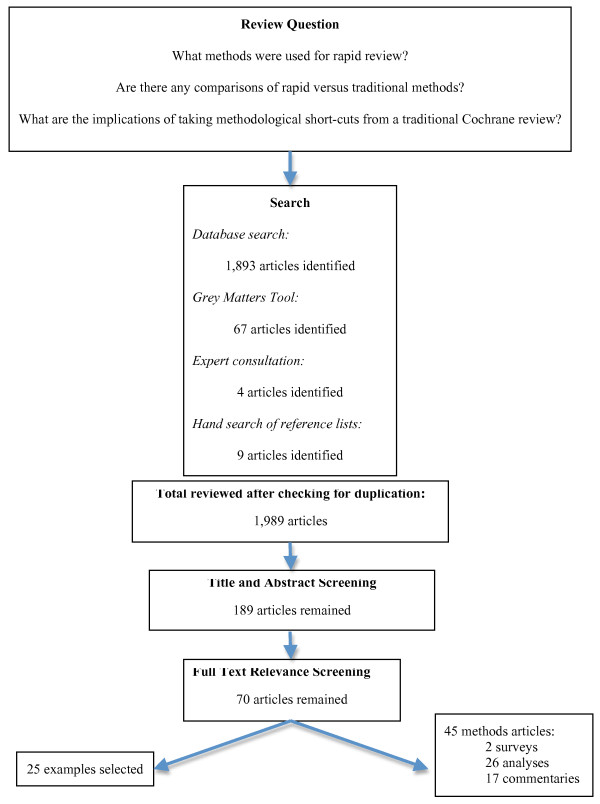
A comprehensive search strategy--including five electronic databases, grey literature, hand searching of relevant journals, and contacting key informants--was undertaken. All titles and abstracts (n = 1,989) were reviewed independently by two reviewers. Relevance criteria included articles published between 1995 and 2009 about conducting rapid reviews or addressing comparisons of rapid reviews versus traditional reviews. Full articles were retrieved for any titles deemed relevant by either reviewer (n = 70). Data were extracted from all relevant methodological articles (n = 45) and from exemplars of rapid review methods (n = 25).
Rapid reviews varied from three weeks to six months; various methods for speeding up the process were employed. Some limited searching by years, databases, language, and sources beyond electronic searches. Several employed one reviewer for title and abstract reviewing, full text review, methodological quality assessment, and/or data extraction phases. Within rapid review studies, accelerating the data extraction process may lead to missing some relevant information. Biases may be introduced due to shortened timeframes for literature searching, article retrieval, and appraisal.
This review examined the continuum between diverse rapid review methods and traditional systematic reviews. It also examines potential implications of streamlined review methods. More of these rapid reviews need to be published in the peer-reviewed literature with an emphasis on articulating methods employed. While one consistent methodological approach may not be optimal or appropriate, it is important that researchers undertaking reviews within the rapid to systematic continuum provide detailed descriptions of methods used and discuss the implications of their chosen methods in terms of potential bias introduced. Further research comparing full systematic reviews with rapid reviews will enhance understanding of the limitations of these methods.
政策制定者和其他人员通常需要在六个月或更短的时间内综合某个领域的知识。传统的系统评价通常需要至少 12 个月的时间来进行。快速评价简化了传统的系统评价方法,以便在更短的时间内综合证据。快速评价的过程存在很大差异。本研究旨在考察快速评价中使用的方法,以及方法简化在严谨性、偏倚和结果方面的影响。
采用全面的检索策略,包括五个电子数据库、灰色文献、相关期刊的手工检索以及联系关键信息提供者。两位评价员分别独立地对所有标题和摘要(n = 1989)进行了评价。纳入标准包括 1995 年至 2009 年间发表的关于进行快速评价或比较快速评价与传统评价的文章。任何被两位评价员认为相关的标题都获取全文(n = 70)。从所有相关方法学文章(n = 45)和快速评价方法实例(n = 25)中提取数据。
快速评价的时间从 3 周到 6 个月不等;采用了各种加速评价过程的方法。有些方法限制了检索年限、数据库、语言和电子检索以外的来源。有些方法仅由一名评价员进行标题和摘要评价、全文评价、方法学质量评估和/或数据提取阶段。在快速评价研究中,加速数据提取过程可能会导致遗漏一些相关信息。由于文献检索、文章检索和评价的时间框架缩短,可能会引入偏倚。
本研究考察了不同快速评价方法与传统系统评价之间的连续体,也考察了简化评价方法的潜在影响。需要更多的这类快速评价在同行评议文献中发表,并强调所使用的方法。虽然一种一致的方法可能不是最佳或最合适的,但在快速到系统连续体中进行评价的研究人员提供所使用方法的详细描述并讨论其选择方法在引入潜在偏倚方面的影响非常重要。比较完整的系统评价与快速评价的进一步研究将增进对这些方法局限性的理解。