Kennedy Institute of Rheumatology Division, Imperial College London, London, UK.
PLoS One. 2010 Jul 13;5(7):e11465. doi: 10.1371/journal.pone.0011465.
Thymocyte expressed molecule involved in selection 1 (Themis1, SwissProt accession number Q8BGW0) is the recently characterised founder member of a novel family of proteins. A second member of this family, Themis2 (Q91YX0), also known as ICB1 (Induced on contact with basement membrane 1), remains unreported at the protein level despite microarray and EST databases reporting Themis2 mRNA expression in B cells and macrophages.
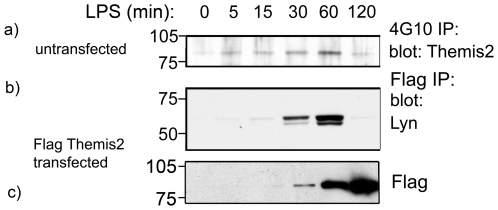
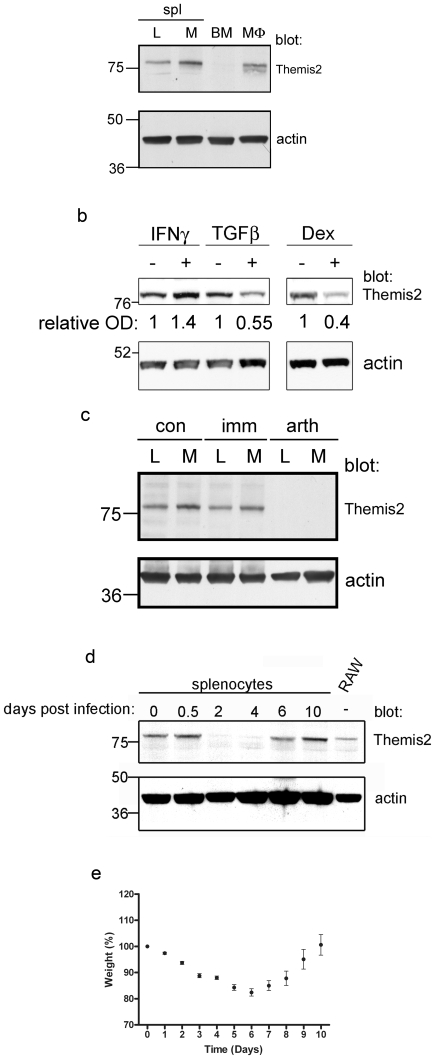
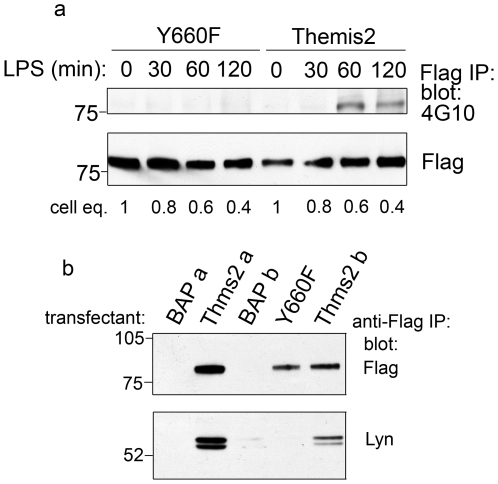
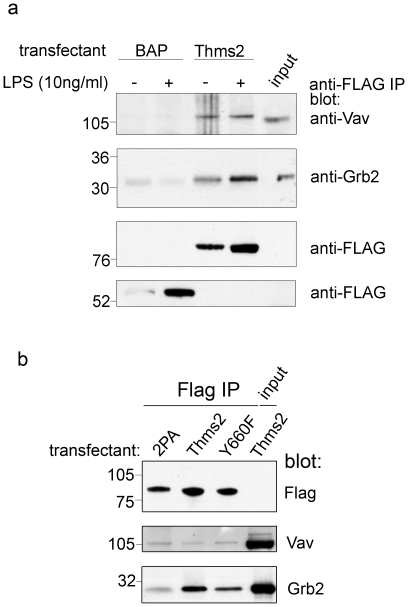
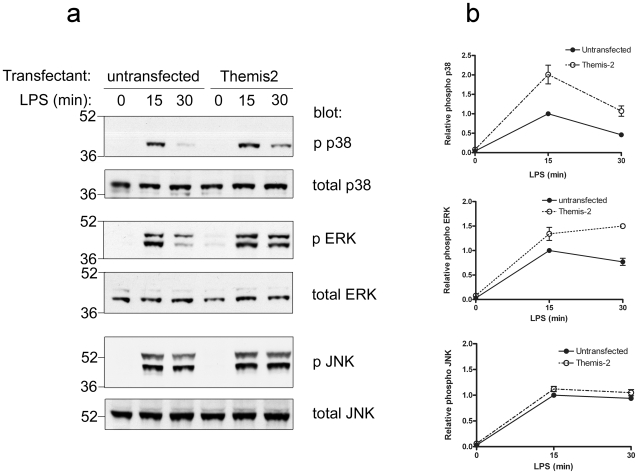
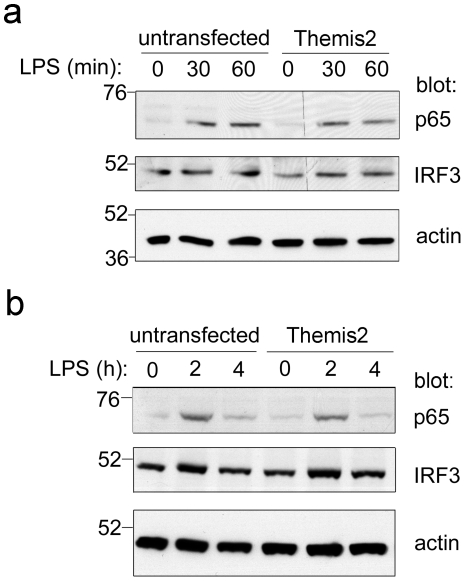
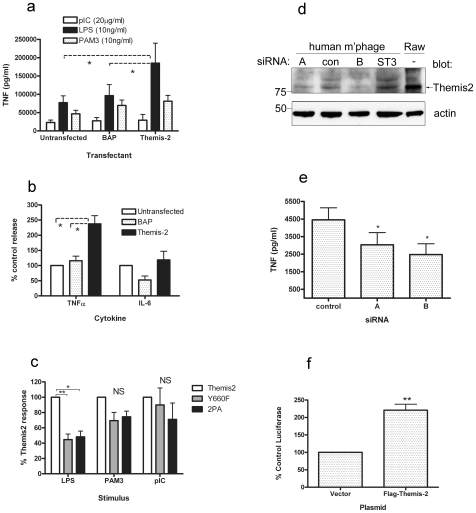
METHODOLOGY/PRINCIPAL FINDINGS: Here we characterise Themis2 protein for the first time and show that it acts as a macrophage signalling scaffold, exerting a receptor-, mediator- and signalling pathway-specific effect on TLR responses in RAW 264.7 macrophages. Themis2 over-expression enhanced the LPS-induced production of TNF but not IL-6 or Cox-2, nor TNF production induced by ligands for TLR2 (PAM3) or TLR3 (poly IratioC). Moreover, LPS-induced activation of the MAP kinases ERK and p38 was enhanced in cells over-expressing Themis2 whereas the activation of JNK, IRF3 or NF-kappaB p65, was unaffected. Depletion of Themis2 protein by RNA inteference inhibited LPS-induced TNF production in primary human macrophages demonstrating a requirement for Themis2 in this event. Themis2 was inducibly tyrosine phosphorylated upon LPS challenge and interacted with Lyn kinase (P25911), the Rho guanine nucleotide exchange factor, Vav (P27870), and the adaptor protein Grb2 (Q60631). Mutation of either tyrosine 660 or a proline-rich sequence (PPPRPPK) simultaneously interrupted this complex and reduced by approximately 50% the capacity of Themis2 to promote LPS-induced TNF production. Finally, Themis2 protein expression was induced during macrophage development from murine bone marrow precursors and was regulated by inflammatory stimuli both in vitro and in vivo.
CONCLUSIONS/SIGNIFICANCE: We hypothesise that Themis2 may constitute a novel, physiological control point in macrophage inflammatory responses.
胸腺细胞表达参与选择 1 的分子(Themis1,SwissProt 注册号 Q8BGW0)是最近被描述的新型蛋白家族的创始成员。该家族的另一个成员 Themis2(Q91YX0),也称为 ICB1(与基底膜接触诱导 1),尽管微阵列和 EST 数据库报告 Themis2 mRNA 在 B 细胞和巨噬细胞中表达,但仍未在蛋白质水平上报道。
方法/主要发现:在这里,我们首次对 Themis2 蛋白进行了表征,并表明它作为巨噬细胞信号支架,对 RAW 264.7 巨噬细胞中的 TLR 反应产生受体、介质和信号通路特异性影响。Themis2 的过表达增强了 LPS 诱导的 TNF 产生,但不增强 IL-6 或 Cox-2 的产生,也不增强 TLR2(PAM3)或 TLR3(poly IratioC)配体诱导的 TNF 产生。此外,在过表达 Themis2 的细胞中,LPS 诱导的 MAP 激酶 ERK 和 p38 的激活增强,而 JNK、IRF3 或 NF-kappaB p65 的激活不受影响。RNA 干扰耗尽 Themis2 蛋白可抑制原代人巨噬细胞中 LPS 诱导的 TNF 产生,证明 Themis2 在这一事件中是必需的。LPS 刺激后 Themis2 可被酪氨酸磷酸化,并与 Lyn 激酶(P25911)、Rho 鸟嘌呤核苷酸交换因子、Vav(P27870)和衔接蛋白 Grb2(Q60631)相互作用。同时突变酪氨酸 660 或富含脯氨酸序列(PPPRPPK),同时中断了这种复合物,并使 Themis2 促进 LPS 诱导的 TNF 产生的能力降低约 50%。最后,在从鼠骨髓前体发育而来的巨噬细胞中诱导表达 Themis2 蛋白,并受体外和体内炎症刺激的调节。
结论/意义:我们假设 Themis2 可能构成巨噬细胞炎症反应中的一个新的、生理控制点。