Amit Ido, Garber Manuel, Chevrier Nicolas, Leite Ana Paula, Donner Yoni, Eisenhaure Thomas, Guttman Mitchell, Grenier Jennifer K, Li Weibo, Zuk Or, Schubert Lisa A, Birditt Brian, Shay Tal, Goren Alon, Zhang Xiaolan, Smith Zachary, Deering Raquel, McDonald Rebecca C, Cabili Moran, Bernstein Bradley E, Rinn John L, Meissner Alex, Root David E, Hacohen Nir, Regev Aviv
Broad Institute of MIT and Harvard, 7 Cambridge Center, Cambridge, MA 02142, USA.
Science. 2009 Oct 9;326(5950):257-63. doi: 10.1126/science.1179050. Epub 2009 Sep 3.
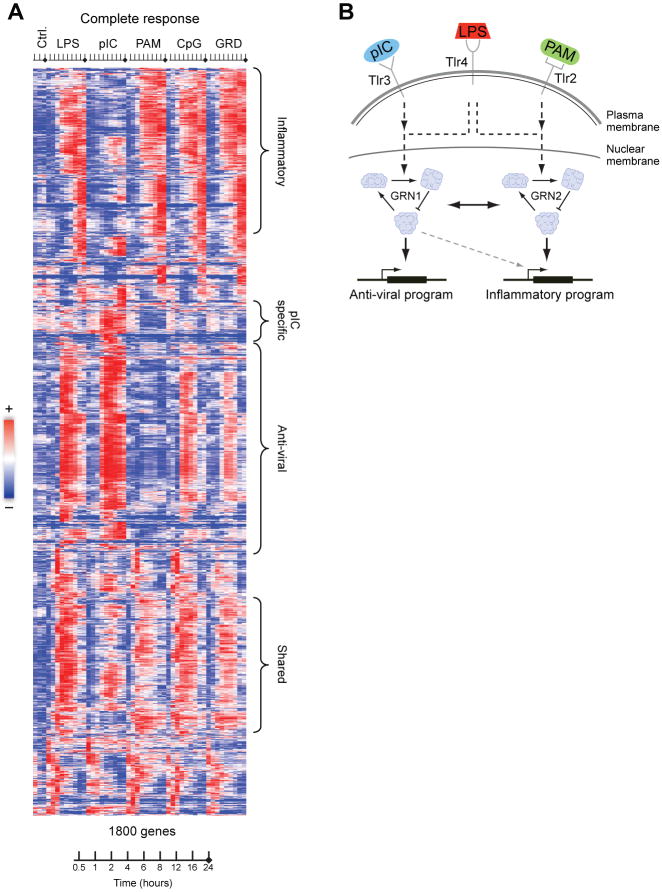
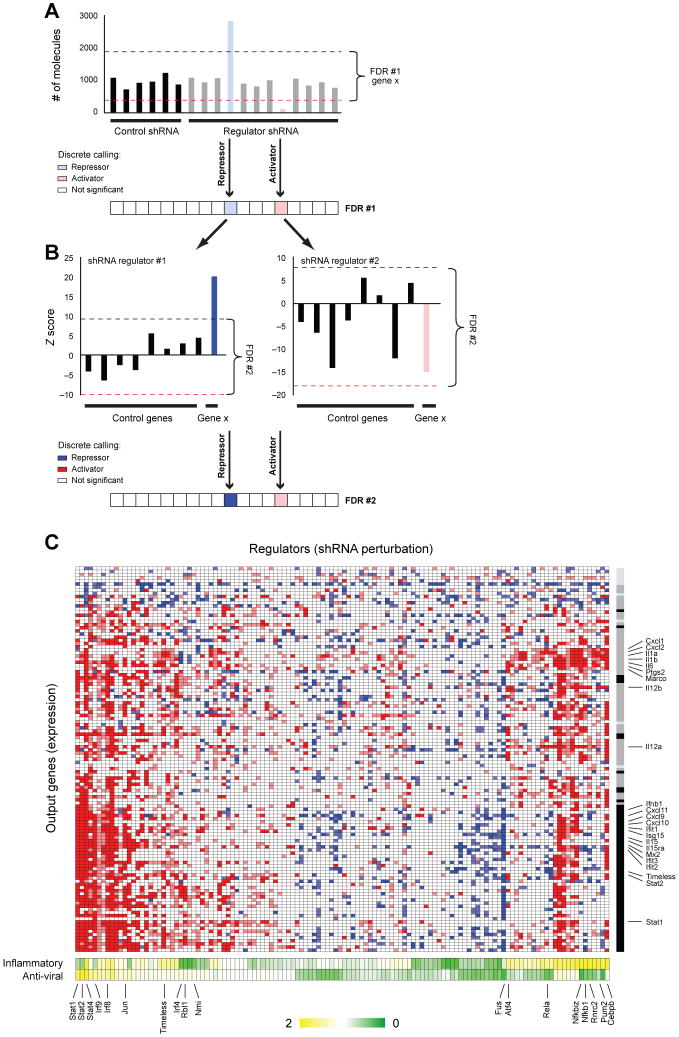
Models of mammalian regulatory networks controlling gene expression have been inferred from genomic data but have largely not been validated. We present an unbiased strategy to systematically perturb candidate regulators and monitor cellular transcriptional responses. We applied this approach to derive regulatory networks that control the transcriptional response of mouse primary dendritic cells to pathogens. Our approach revealed the regulatory functions of 125 transcription factors, chromatin modifiers, and RNA binding proteins, which enabled the construction of a network model consisting of 24 core regulators and 76 fine-tuners that help to explain how pathogen-sensing pathways achieve specificity. This study establishes a broadly applicable, comprehensive, and unbiased approach to reveal the wiring and functions of a regulatory network controlling a major transcriptional response in primary mammalian cells.
控制基因表达的哺乳动物调控网络模型已从基因组数据中推断出来,但大多尚未得到验证。我们提出了一种无偏差策略,用于系统地扰动候选调节因子并监测细胞转录反应。我们应用此方法推导出控制小鼠原代树突状细胞对病原体转录反应的调控网络。我们的方法揭示了125种转录因子、染色质修饰剂和RNA结合蛋白的调控功能,这使得构建一个由24个核心调节因子和76个微调因子组成的网络模型成为可能,该模型有助于解释病原体感应途径如何实现特异性。这项研究建立了一种广泛适用、全面且无偏差的方法,以揭示控制原代哺乳动物细胞主要转录反应的调控网络的连接方式和功能。