Department of Health Studies, University of Chicago, Chicago, IL 60637, USA.
Lancet. 2010 Jul 24;376(9737):252-8. doi: 10.1016/S0140-6736(10)60481-3. Epub 2010 Jun 18.
Millions of people worldwide are chronically exposed to arsenic through drinking water, including 35-77 million people in Bangladesh. The association between arsenic exposure and mortality rate has not been prospectively investigated by use of individual-level data. We therefore prospectively assessed whether chronic and recent changes in arsenic exposure are associated with all-cause and chronic-disease mortalities in a Bangladeshi population.
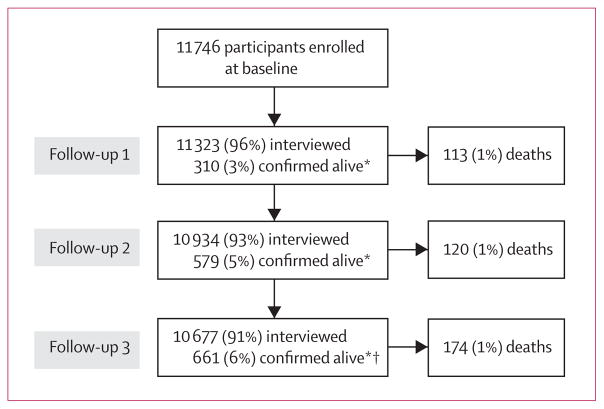
In the prospective cohort Health Effects of Arsenic Longitudinal Study (HEALS), trained physicians unaware of arsenic exposure interviewed in person and clinically assessed 11 746 population-based participants (aged 18-75 years) from Araihazar, Bangladesh. Participants were recruited from October, 2000, to May, 2002, and followed-up biennially. Data for mortality rates were available throughout February, 2009. We used Cox proportional hazards model to estimate hazard ratios (HRs) of mortality, with adjustment for potential confounders, at different doses of arsenic exposure.
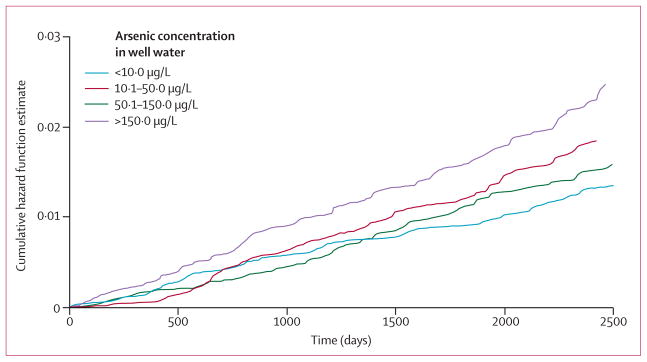
407 deaths were ascertained between October, 2000, and February, 2009. Multivariate adjusted HRs for all-cause mortality in a comparison of arsenic at concentrations of 10.1-50.0 microg/L, 50.1-150.0 microg/L, and 150.1-864.0 microg/L with at least 10.0 microg/L in well water were 1.34 (95% CI 0.99-1.82), 1.09 (0.81-1.47), and 1.68 (1.26-2.23), respectively. Results were similar with daily arsenic dose and total arsenic concentration in urine. Recent change in exposure, measurement of total arsenic concentrations in urine repeated biennially, did not have much effect on the mortality rate.
Chronic arsenic exposure through drinking water was associated with an increase in the mortality rate. Follow-up data from this cohort will be used to assess the long-term effects of arsenic exposure and how they might be affected by changes in exposure. However, solutions and resources are urgently needed to mitigate the resulting health effects of arsenic exposure.
US National Institutes of Health.
全世界数百万人通过饮用水长期接触砷,包括孟加拉国的 3500 万至 7700 万人。使用个体水平数据,砷暴露与死亡率之间的关联尚未进行前瞻性研究。因此,我们前瞻性地评估了在孟加拉国人群中,慢性和近期砷暴露变化是否与全因和慢性疾病死亡率相关。
在前瞻性队列健康影响砷纵向研究(HEALS)中,未经砷暴露培训的医生通过个人访谈和临床评估,从孟加拉国的 Araihazar 招募了 11746 名基于人群的参与者(年龄在 18 至 75 岁之间)。参与者于 2000 年 10 月至 2002 年 5 月招募,并每两年进行一次随访。截至 2009 年 2 月,死亡率数据均可用。我们使用 Cox 比例风险模型估计不同剂量砷暴露下死亡率的风险比(HR),并进行了潜在混杂因素的调整。
在 2000 年 10 月至 2009 年 2 月期间,共确定了 407 例死亡。与井水砷浓度至少为 10.0μg/L 时相比,砷浓度为 10.1-50.0μg/L、50.1-150.0μg/L 和 150.1-864.0μg/L 的多变量调整后全因死亡率的 HR 分别为 1.34(95%CI 0.99-1.82)、1.09(0.81-1.47)和 1.68(1.26-2.23)。每日砷剂量和尿液中总砷浓度的结果相似。暴露的近期变化,即每两年重复测量尿液中总砷浓度,对死亡率的影响不大。
通过饮用水摄入慢性砷与死亡率的增加有关。该队列的随访数据将用于评估砷暴露的长期影响,以及暴露变化如何影响这些影响。然而,迫切需要解决方案和资源来减轻砷暴露造成的健康影响。
美国国立卫生研究院。