Rahman Mahfuzar, Sohel Nazmul, Yunus Mohammad, Chowdhury Mahbub Elahi, Hore Samar Kumar, Zaman Khalequ, Bhuiya Abbas, Streatfield Peter Kim
ICDDRB, 68 Shahid Tajuddin Ahmed Sarani, Mohakhali, Dhaka 1212, Bangladesh.
BMC Public Health. 2014 Feb 18;14:174. doi: 10.1186/1471-2458-14-174.
Arsenic in drinking water causes increased coronary artery disease (CAD) and death from CAD, but its association with stroke is not known.
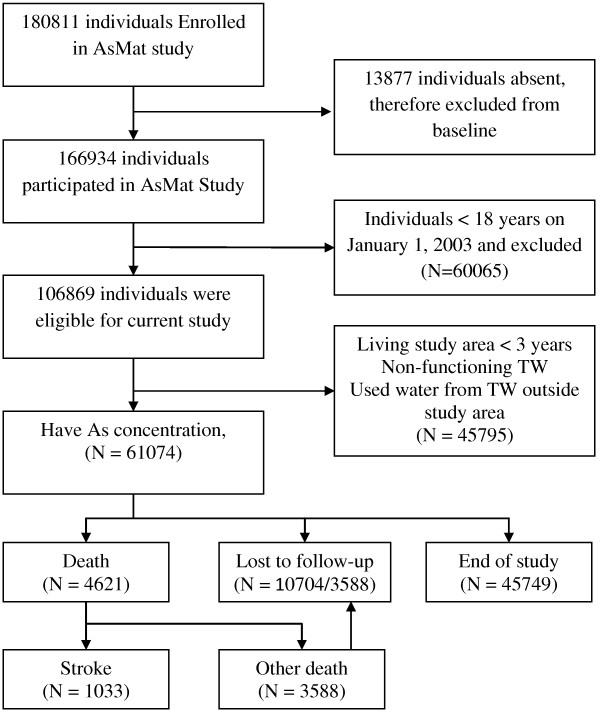
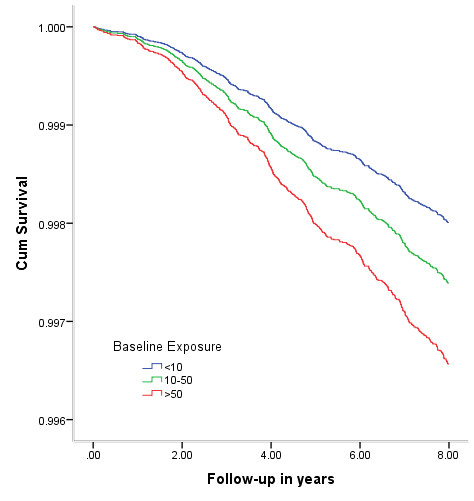
Prospective cohort study with arsenic exposure measured in well water at baseline. 61074 men and women aged 18 years or older on January 2003 were enrolled in 2003. The cohort was actively followed for an average of 7 years (421,754 person-years) through December 2010. Based on arsenic concentration the population was categorized in three groups and stroke mortality HR was compared to the referent. The risk of stroke mortality Hazard Ratio (HR) and 95% Confidence Interval was calculated in relation to arsenic exposure was estimated by Cox proportional hazard models with adjustment for potential confounders.
A total of 1033 people died from stroke during the follow-up period, accounting for 23% of the total deaths. Multivariable adjusted HRs (95% confidence interval) for stroke for well water arsenic concentrations <10, 10-49, and ≥50 μg/L were 1.0 (reference), 1.20 (0.92 to 1.57), and 1.35 (1.04 to 1.75) respectively (Ptrend=0.00058). For men, multivariable adjusted HRs (95%) for well water arsenic concentrations <10, 10-49, and ≥50 μg/L were 1.0 (reference), 1.12 (0.78 to 1.60), and 1.07 (0.75 to 1.51) respectively (Ptrend=0.45) and for women 1.0 (reference),1.31 (0.87 to 1.98), and 1.72 (1.15 to 2.57) respectively (Ptrend=0.00004).
The result suggests that arsenic exposure was associated with increased stroke mortality risk in this population, and was more significant in women compared to men.
饮用水中的砷会导致冠状动脉疾病(CAD)增加以及死于CAD,但它与中风的关联尚不清楚。
进行前瞻性队列研究,在基线时测量井水中的砷暴露量。2003年纳入了61074名年龄在18岁及以上的男性和女性。该队列从2003年1月至2010年12月被积极随访,平均随访7年(421754人年)。根据砷浓度将人群分为三组,并将中风死亡率HR与参照组进行比较。通过Cox比例风险模型计算中风死亡风险比(HR)和95%置信区间,并对潜在混杂因素进行调整来估计与砷暴露的关系。
在随访期间共有1033人死于中风,占总死亡人数的23%。井水砷浓度<10、10 - 49和≥50μg/L时,多变量调整后的中风HR(95%置信区间)分别为1.0(参照)、1.20(0.92至1.57)和1.35(1.04至1.75)(P趋势 = 0.00058)。对于男性,井水砷浓度<10、10 - 49和≥50μg/L时,多变量调整后的HR(95%)分别为1.0(参照)、1.12(0.78至1.60)和1.07(0.75至1.51)(P趋势 = 0.45);对于女性,分别为1.0(参照)、1.31(0.87至1.98)和1.72(从1.15至2.57)(P趋势 = 0.00004)。
结果表明,该人群中砷暴露与中风死亡风险增加有关,且女性比男性更显著。