Unidad de Tecnología en Producción Animal, CITA, Zaragoza, Spain.
BMC Vet Res. 2010 Jul 22;6:40. doi: 10.1186/1746-6148-6-40.
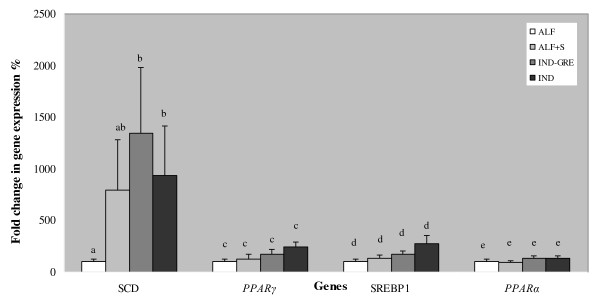
Conjugated linoleic acids (CLAs) are receiving increasing attention because of their beneficial effects on human health, with milk and meat products derived from ruminants as important sources of CLA in the human diet. SCD gene is responsible for some of the variation in CLA concentration in adipose tissues, and PPARgamma, PPARalpha and SREBP1 genes are regulator of SCD gene. The aim of this work was to evaluate the effect of the feeding system on fatty acid composition, CLA content and relative gene expression of Delta9-desaturase (SCD), Peroxisome Proliferator-Activated Receptor Gamma (PPARgamma), Peroxisome Proliferator-Activated Receptor Alpha, (PPARalpha) and Sterol Regulatory Element Binding Protein (SREBP1) in Rasa Aragonesa light lambs in semitendinous muscle. Forty-four single-born male lambs were used to evaluate the effect of the feeding system, varying on an intensity gradient according to the use of concentrates: 1. grazing alfalfa, 2. grazing alfalfa with a supplement for lambs, 3. indoor lambs with grazing ewes and 4. drylot.
Both grazing systems resulted in a higher concentration of vaccenic acid (VA), CLA, CLA/VA acid ratio, and a lower oleic content, oleic acid (C18:1)/stearic acid (C18:0) ratio, PUFA n-6/n-3 ratio and SCD expression compared to other diets. In addition feeding system affected the fatty acid composition and SCD expression, possibly due to CLA concentration or the PUFA n-6/n-3 ratio. Both expression of the SCD gene and the feeding system were important factors affecting CLA concentration in the animal's semitendinous muscle. PPARgamma, PPARalpha and SREBP1 expression seemed to be unaffected by the feeding system. Although no significant results were found, PPARgamma, PPARalpha and SREBP1 showed similar expression pattern as SCD. Moreover, the correlation results between SCD expression and PPARgamma (p < 0.01), as well as SREBP1 (p < 0.01) expression, may suggest that these genes were affecting SCD expression in a different way.
The data indicated that the feeding system is the main factor affecting the fatty acid composition and SCD gene expression, which is also affected by CLA and possibly by n-6/n-3 PUFAs.
共轭亚油酸(CLA)因其对人体健康的有益作用而受到越来越多的关注,反刍动物来源的牛奶和肉类产品是人类饮食中 CLA 的重要来源。SCD 基因负责脂肪组织中 CLA 浓度的一些变化,而 PPARγ、PPARα 和 SREBP1 基因是 SCD 基因的调节剂。本研究的目的是评估饲养系统对脂肪酸组成、CLA 含量和 Delta9-去饱和酶(SCD)、过氧化物酶体增殖物激活受体γ(PPARγ)、过氧化物酶体增殖物激活受体α(PPARα)和固醇调节元件结合蛋白(SREBP1)相对基因表达的影响在 Rasa Aragonesa 羔羊半腱肌中。使用 44 只单胎雄性羔羊来评估饲养系统的影响,该系统根据浓缩物的使用强度梯度变化:1. 放牧紫花苜蓿,2. 放牧紫花苜蓿加羔羊补充料,3. 室内母羊放牧羔羊和 4. 干料。
与其他日粮相比,两种放牧系统均导致更高的瘤胃酸(VA)、CLA、CLA/VA 酸比和更低的油酸含量、油酸(C18:1)/硬脂酸(C18:0)比、PUFA n-6/n-3 比和 SCD 表达。此外,饲养系统还影响脂肪酸组成和 SCD 表达,这可能是由于 CLA 浓度或 PUFA n-6/n-3 比的原因。SCD 基因的表达和饲养系统都是影响动物半腱肌中 CLA 浓度的重要因素。PPARγ、PPARα 和 SREBP1 的表达似乎不受饲养系统的影响。尽管没有发现显著结果,但 PPARγ、PPARα 和 SREBP1 的表达模式与 SCD 相似。此外,SCD 表达与 PPARγ(p < 0.01)以及 SREBP1(p < 0.01)表达之间的相关性结果表明,这些基因以不同的方式影响 SCD 表达。
数据表明,饲养系统是影响脂肪酸组成和 SCD 基因表达的主要因素,CLA 和可能的 n-6/n-3 PUFA 也会影响 SCD 基因表达。