Executive Office, Taiwan Center for Disease Control, Taipei, Taiwan.
Int J Infect Dis. 2010 Aug;14(8):e693-7. doi: 10.1016/j.ijid.2009.12.010. Epub 2010 Jun 19.
This study aimed to examine the epidemiological trends in dengue infection and the impact of imported cases and airport fever screening on community transmission in Taiwan, a dengue non-endemic island.
All of the dengue case data were obtained from the surveillance system of the Taiwan Center for Disease Control and were analyzed by Pearson correlations, linear regression, and geographical information system (GIS)-based mapping. The impact of implementing airport fever screening was evaluated using the Student's t-test and two-way analysis of variance.
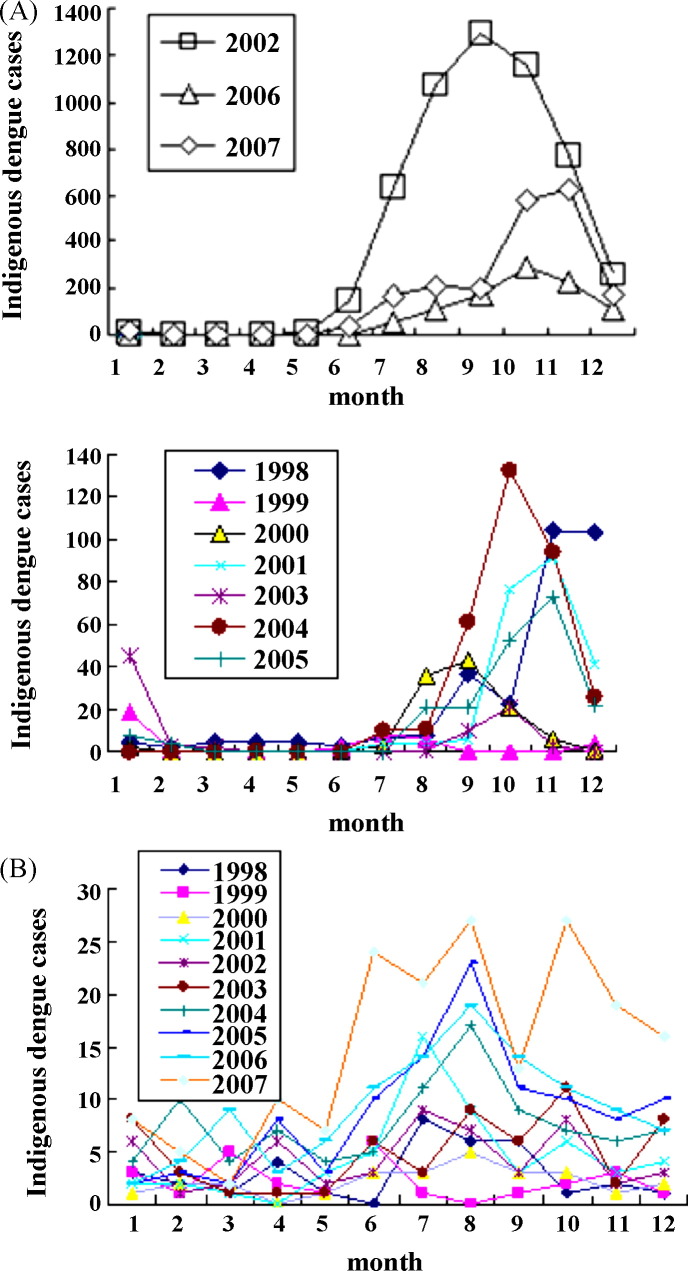
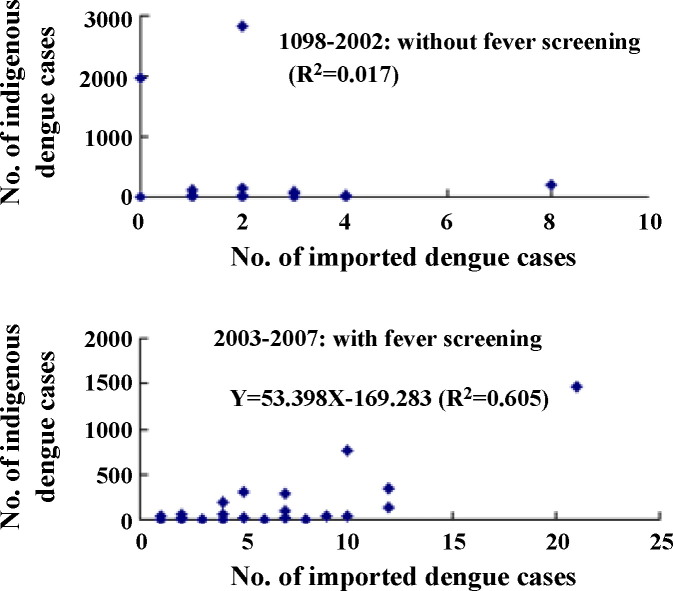
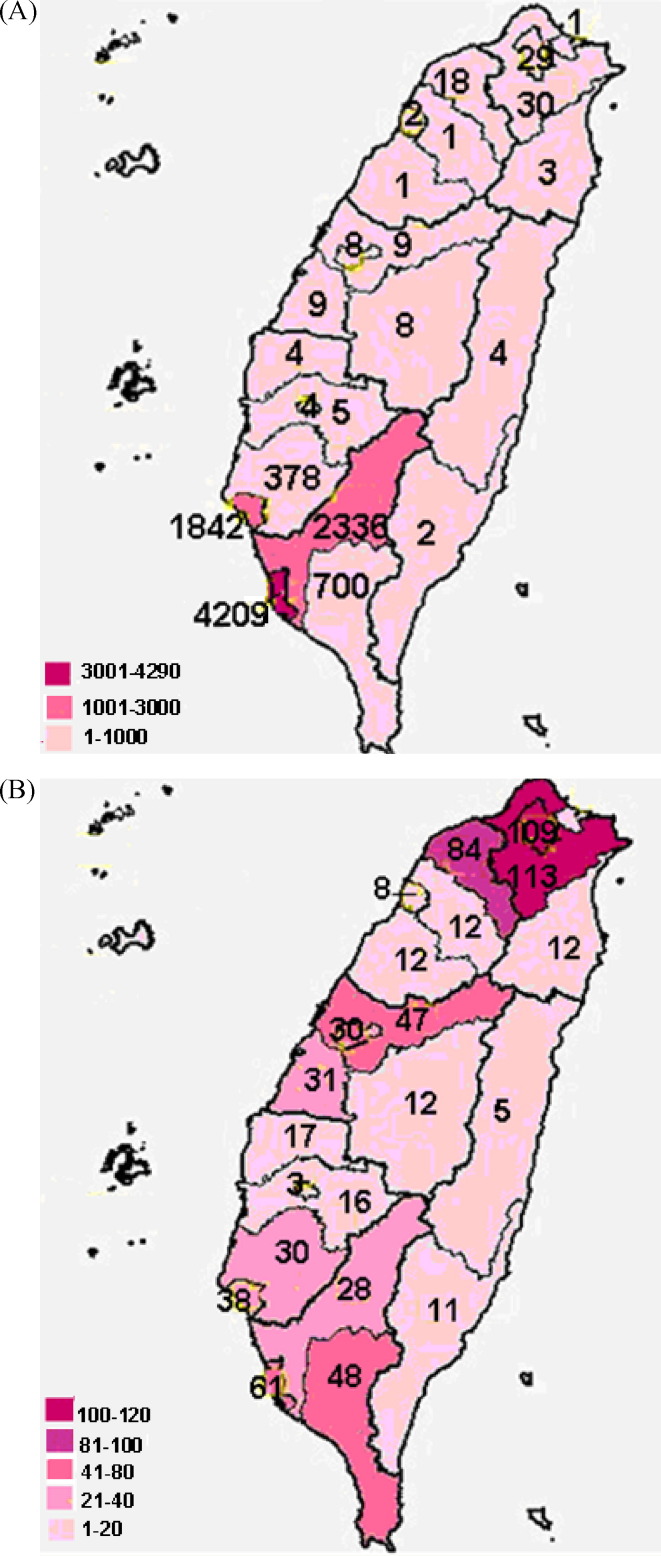
A total of 10 351 dengue cases, including 7.1% of imported cases were investigated between 1998 and 2007. The majority of indigenous dengue cases (98.5%) were significantly clustered in southern Taiwan; 62.9% occurred in the metropolitan areas. The seasonality of dengue cases showed a peak from September to November. Airport fever screening was successful in identifying 45% (244/542 ; 95% confidence interval 33.1-57.8%) of imported dengue cases with fever. However, no statistical difference was found regarding the impact on community transmission when comparing the presence and absence of airport fever screening.
Our results show that airport fever screening had a positive effect on partially blocking the local transmission of imported dengue cases, while those undetected cases due to latent or asymptomatic infection would be the source of new dengue outbreaks each year.
本研究旨在探讨台湾登革热感染的流行病学趋势,以及输入病例和机场发热筛查对社区传播的影响,台湾是一个非登革热流行岛屿。
所有登革热病例数据均来自台湾疾病管制中心的监测系统,并通过 Pearson 相关性分析、线性回归和基于地理信息系统(GIS)的绘图进行分析。采用学生 t 检验和双向方差分析评估实施机场发热筛查的效果。
1998 年至 2007 年间共调查了 10351 例登革热病例,其中 7.1%为输入性病例。大多数本地登革热病例(98.5%)明显集中在台湾南部;62.9%发生在都会区。登革热病例的季节性呈 9 月至 11 月高峰。机场发热筛查成功识别出 45%(244/542;95%置信区间 33.1-57.8%)有发热症状的输入性登革热病例。然而,在比较有无机场发热筛查时,未发现对社区传播的影响有统计学差异。
我们的结果表明,机场发热筛查对部分阻断输入性登革热病例的本地传播有积极作用,而那些因潜伏或无症状感染而未被发现的病例每年都会成为新的登革热爆发的源头。