Mier-Y-Teran-Romero Luis, Tatem Andrew J, Johansson Michael A
Dengue Branch, Division of Vector-Borne Diseases, Centers for Disease Control and Prevention, San Juan, PR.
WorldPop, Department of Geography and Environment, University of Southampton, Southampton, United Kingdom.
PLoS Negl Trop Dis. 2017 Jul 3;11(7):e0005683. doi: 10.1371/journal.pntd.0005683. eCollection 2017 Jul.
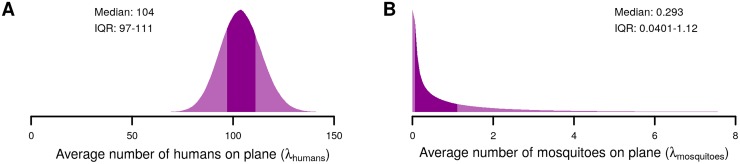
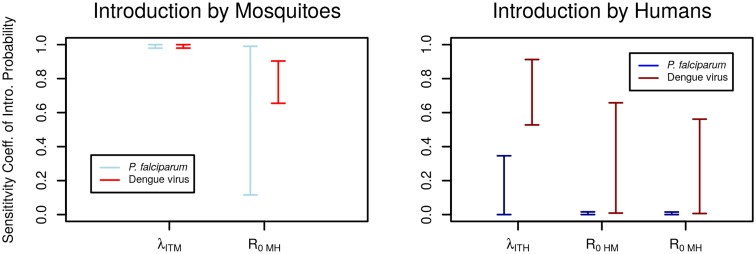
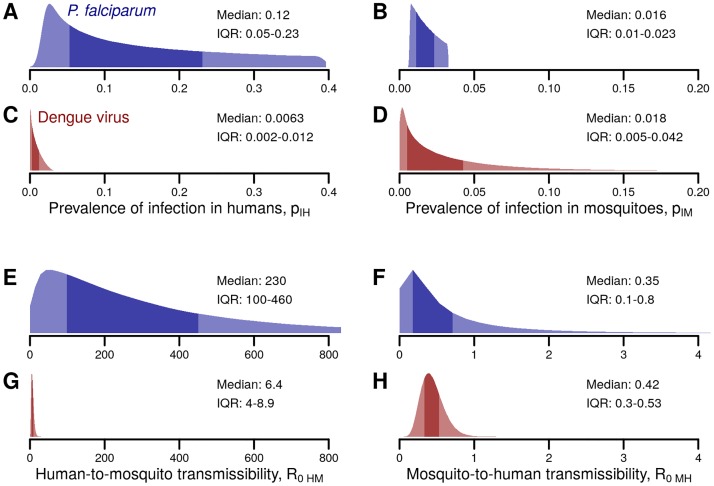
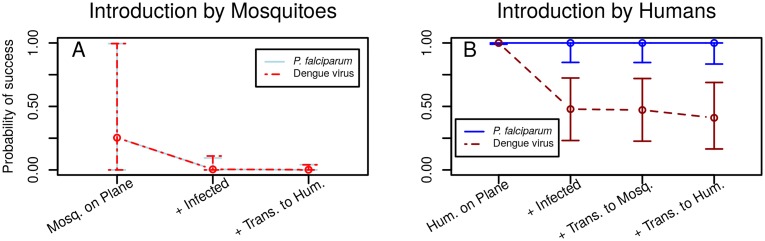
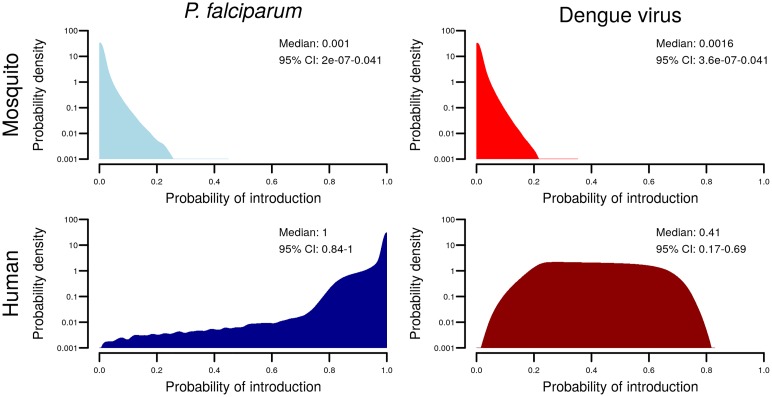
Mosquito-borne diseases are increasingly being recognized as global threats, with increased air travel accelerating their occurrence in travelers and their spread to new locations. Since the early days of aviation, concern over the possible transportation of infected mosquitoes has led to recommendations to disinsect aircraft. Despite rare reports of mosquitoes, most likely transported on aircraft, infecting people far from endemics areas, it is unclear how important the role of incidentally transported mosquitoes is compared to the role of traveling humans. We used data for Plasmodium falciparum and dengue viruses to estimate the probability of introduction of these pathogens by mosquitoes and by humans via aircraft under ideal conditions. The probability of introduction of either pathogen by mosquitoes is low due to few mosquitoes being found on aircraft, low infection prevalence among mosquitoes, and high mortality. Even without disinsection, introduction via infected human travelers was far more likely than introduction by infected mosquitoes; more than 1000 times more likely for P. falciparum and more than 200 times more likely for dengue viruses. Even in the absence of disinsection and under the most favorable conditions, introduction of mosquito-borne pathogens via air travel is far more likely to occur as a result of an infected human travelling rather than the incidental transportation of infected mosquitoes. Thus, while disinsection may serve a role in preventing the spread of vector species and other invasive insects, it is unlikely to impact the spread of mosquito-borne pathogens.
蚊媒疾病日益被视为全球威胁,航空旅行的增加加速了这些疾病在旅行者中的发生及其向新地点的传播。自航空业早期以来,对受感染蚊子可能被运输的担忧导致了对飞机进行灭虫处理的建议。尽管有罕见报告称蚊子很可能是通过飞机运输的,且感染了远离流行地区的人,但与旅行者相比,偶然运输的蚊子的作用有多重要尚不清楚。我们使用恶性疟原虫和登革病毒的数据,来估计在理想条件下这些病原体通过蚊子和人类经由飞机传入的概率。由于在飞机上发现的蚊子数量很少、蚊子的感染率低以及死亡率高,蚊子传入任何一种病原体的概率都很低。即使不进行灭虫处理,受感染的旅行者传入病原体的可能性也远比受感染的蚊子传入要高得多;恶性疟原虫的可能性要高出1000多倍,登革病毒的可能性要高出200多倍。即使在不进行灭虫处理且在最有利的条件下,通过航空旅行传入蚊媒病原体的情况更有可能是由于受感染的人类旅行,而不是受感染蚊子的偶然运输。因此,虽然灭虫处理可能有助于防止病媒物种和其他入侵昆虫的传播,但它不太可能影响蚊媒病原体的传播。