Wilkinson L S, Perry I J, Shinton R A, Beevers D G
University Department of Medicine, Dudley Road Hospital, Birmingham.
J R Coll Physicians Lond. 1991 Apr;25(2):116-9.
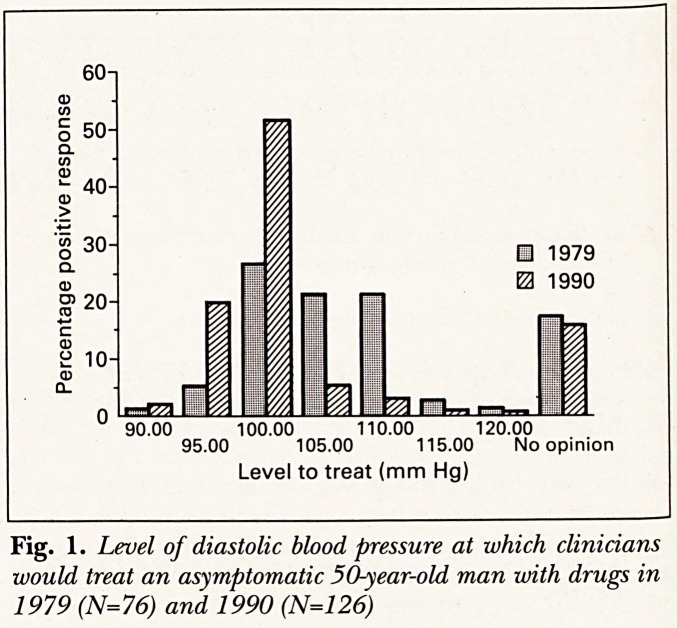
In 1986 and 1989 the British Hypertension Society published its recommendations on the techniques for the measurement of blood pressure and the level of pressure requiring drug therapy. In order to assess the impact of these recommendations on clinical practice among non-members of the society, we have conducted a survey using a self-reported questionnaire among 196 hospital-based clinicians, and compared our findings with a similar survey conducted in 1979. The response rate to the 1990 survey was 64% (126 respondents). Over one-third (37%) of respondents reported that they usually record the diastolic blood pressure at the fourth Korotkoff phase (muffling of sounds), 52% reported that they use the fifth phase (disappearance of sounds), and 10% reported that they record both the fourth and fifth phase. They also disagreed considerably on a number of other basic issues, including whether blood pressure should be routinely measured in the sitting or lying position, and whether readings should be taken to the nearest 2, 5 or 10 mmHg. A clear majority of clinicians indicated that they would prescribe antihypertensive drugs if the diastolic blood pressure was consistently over 100 mmHg. This represents a marked shift from the opinions expressed in 1979 and is in line with the British Hypertension Society's recommendations. However, many clinicians still measure blood pressure in a manner contrary to the society's guidelines.
1986年和1989年,英国高血压协会发布了关于血压测量技术以及药物治疗所需血压水平的建议。为了评估这些建议对协会非会员临床实践的影响,我们使用自填式问卷对196名医院临床医生进行了一项调查,并将我们的调查结果与1979年进行的类似调查进行了比较。1990年调查的回复率为64%(126名受访者)。超过三分之一(37%)的受访者表示,他们通常在柯氏音第四期(声音减弱)记录舒张压,52%的受访者表示他们使用第五期(声音消失),10%的受访者表示他们同时记录第四期和第五期。他们在其他一些基本问题上也存在很大分歧,包括血压是否应常规在坐位或卧位测量,以及读数是否应精确到最接近的2、5或10 mmHg。绝大多数临床医生表示,如果舒张压持续超过100 mmHg,他们会开抗高血压药物。这与1979年表达的意见有明显转变,并且与英国高血压协会的建议一致。然而,许多临床医生测量血压的方式仍然与协会的指南相悖。