UCL Institute of Neurology, Queen Square, London, UK.
Neuron. 2010 Jul 29;67(2):308-20. doi: 10.1016/j.neuron.2010.06.019.
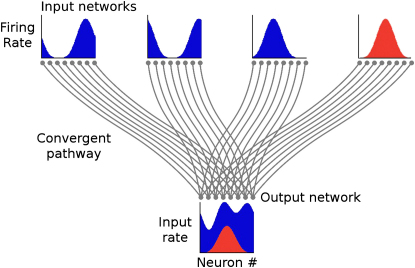
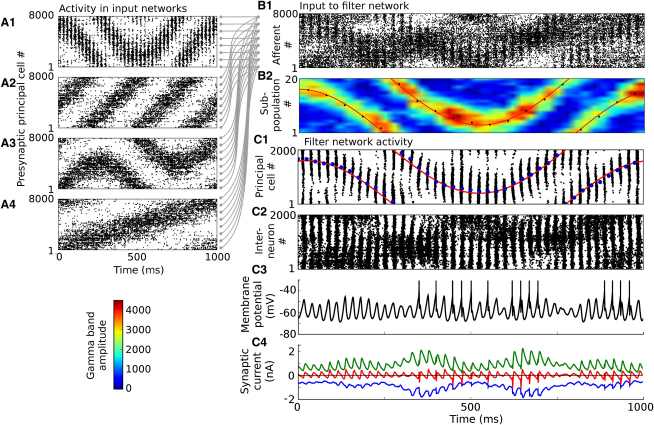
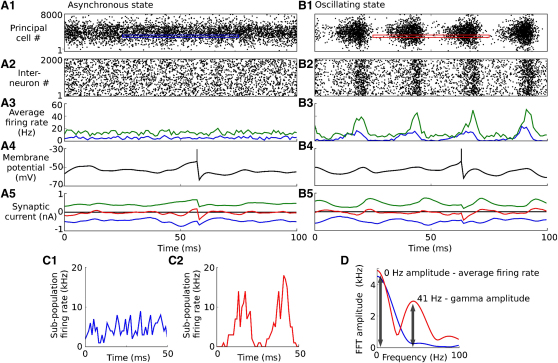
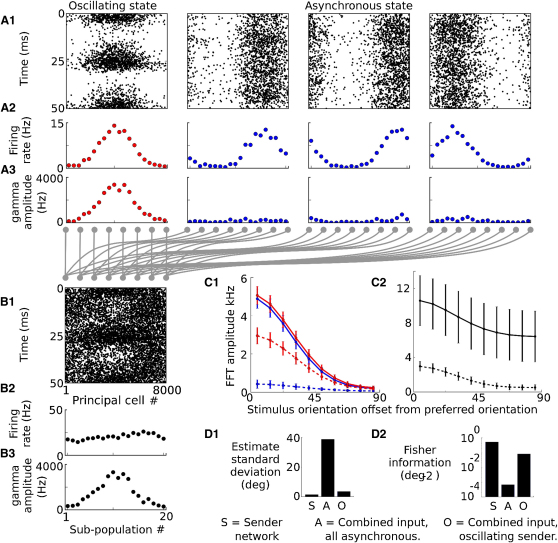
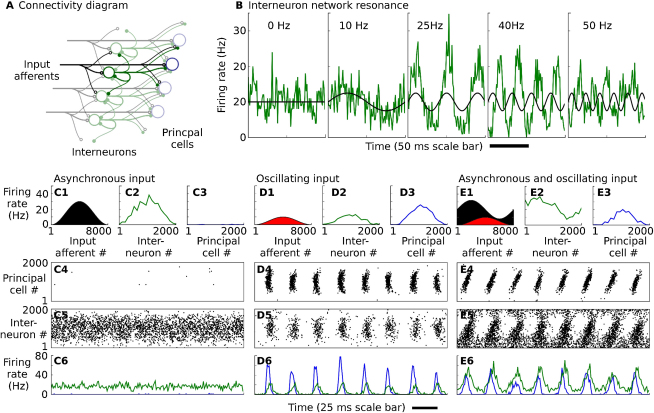
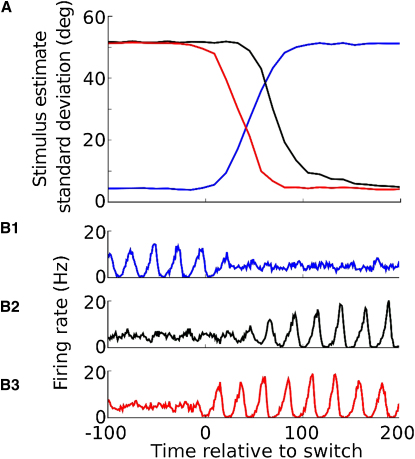
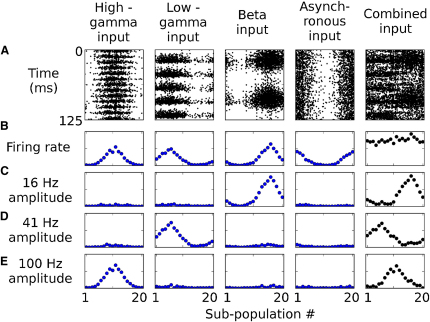
The mammalian brain exhibits profuse interregional connectivity. How information flow is rapidly and flexibly switched among connected areas remains poorly understood. Task-dependent changes in the power and interregion coherence of network oscillations suggest that such oscillations play a role in signal routing. We show that switching one of several convergent pathways from an asynchronous to an oscillatory state allows accurate selective transmission of population-coded information, which can be extracted even when other convergent pathways fire asynchronously at comparable rates. We further show that the band-pass filtering required to perform this information extraction can be implemented in a simple spiking network model with a single feed-forward interneuron layer. This constitutes a mechanism for flexible signal routing in neural circuits, which exploits sparsely synchronized network oscillations and temporal filtering by feed-forward inhibition.
哺乳动物的大脑表现出丰富的区域间连接。信息如何在连接的区域之间快速灵活地切换仍知之甚少。网络振荡的功率和区域间相干性的任务依赖性变化表明,这种振荡在信号路由中起作用。我们表明,将几个会聚通路中的一个从异步状态切换到振荡状态,允许对群体编码信息进行准确的选择性传输,即使其他会聚通路以可比的速率异步发射,也可以提取该信息。我们进一步表明,执行这种信息提取所需的带通滤波可以在具有单个前馈中间神经元层的简单尖峰网络模型中实现。这构成了神经回路中灵活信号路由的一种机制,它利用稀疏同步的网络振荡和前馈抑制的时间滤波。