Institute of Human Movement Sciences and Sport, ETH Zurich, Zurich, Switzerland.
BMC Cancer. 2010 Aug 4;10:406. doi: 10.1186/1471-2407-10-406.
Cancer patients may benefit from physical exercise programs. It is unclear, however, how sustained levels of physical activity are best achieved in this population. A systematic review was performed to summarize the current evidence of the effect of physical activity interventions on daily walking activity enhancement in cancer survivors, and to review the literature for its methodological quality.
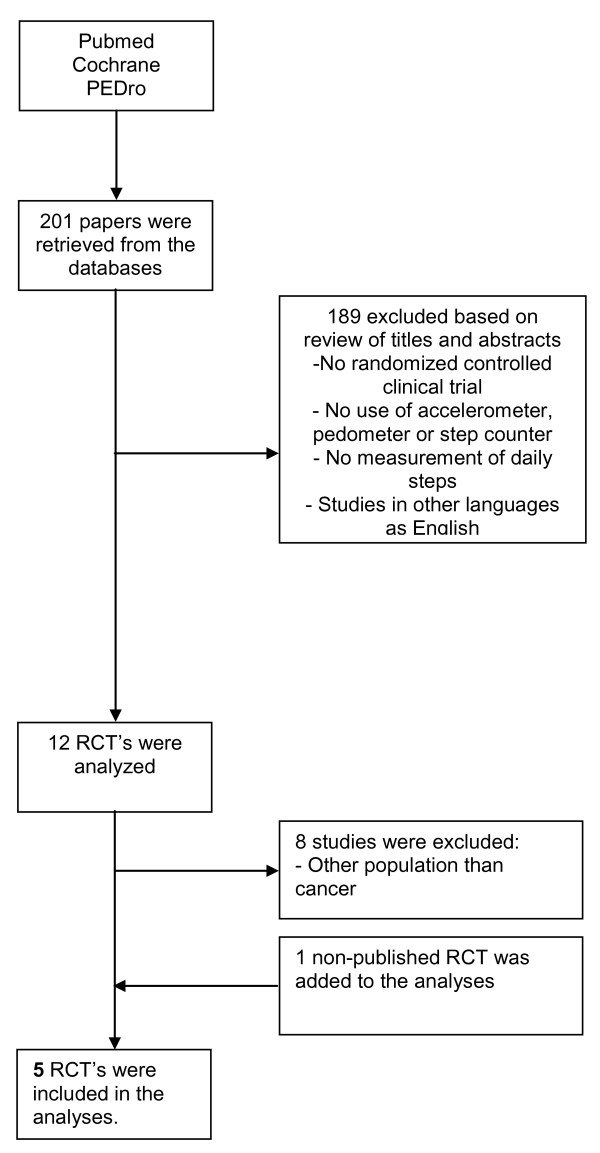
A search in Medline, PEDro and the Cochrane databases was performed for English literature citations (randomized controlled trials; 'RCTs'). In a first step, one reviewer abstracted data from the included studies on patients, physical activity interventions and outcomes. Two independent reviewers reviewed the methodological quality of these studies. Data were pooled using random-effects calculations.
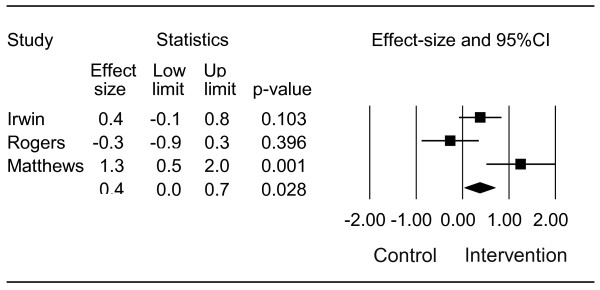
Our search identified 201 citations. Five RCTs that reported changes in daily step activity over time were identified, and were reviewed for methodological quality and substantive results. The median score across studies for methodological quality based on the PEDro criteria was 8. These 5 RCTs evaluated 660 participants with a mean age of 53.6 (SD 4.2) years. The mean change in daily step activity for patients with a physical exercise intervention was 526 daily steps (SD 537), with a range from -92 to 1299 daily steps. The data of three studies reporting the effect of combined physical activity and counseling on daily walking activity in breast cancer survivors were pooled, however; the I(2) was 79%, indicating statistical heterogeneity between the three trials.
The 5 RCTs reviewed were of good methodological quality. Together they suggest that combined physical activity and counseling improves daily step activity in (breast) cancer survivors. Studies that define a step goal appear to be more effective in improving daily walking activity than studies that do not do so. However, the current results should be interpreted with caution because of the observed clinical and statistical heterogeneity. Future studies are warranted to evaluate the effects of goal targeted physical activity, with or without counseling, on daily walking in various cancer populations.
癌症患者可能从体育锻炼计划中受益。然而,在这一人群中,如何实现持续的身体活动水平尚不清楚。系统评价旨在总结目前关于体育活动干预对癌症幸存者日常步行活动增强效果的证据,并对文献进行方法学质量评估。
在 Medline、PEDro 和 Cochrane 数据库中进行了英语文献检索(随机对照试验;'RCTs')。在第一步中,一位审阅者从纳入研究中提取了患者、体育活动干预和结局的数据。两位独立审阅者评估了这些研究的方法学质量。使用随机效应计算汇总数据。
我们的搜索共确定了 201 条引文。确定了 5 项报告随时间推移日常步数变化的 RCT,并对其进行了方法学质量和实质性结果的评估。基于 PEDro 标准,这些研究的方法学质量中位数得分为 8 分。这 5 项 RCT 共评估了 660 名参与者,平均年龄为 53.6(SD 4.2)岁。接受体育锻炼干预的患者日常步数平均变化为 526 步(SD 537),范围为-92 至 1299 步。然而,有三项研究报告了综合体育活动和咨询对乳腺癌幸存者日常步行活动的影响,对这些数据进行了汇总;I(2)为 79%,表明这三项试验之间存在统计学异质性。
综述的 5 项 RCT 具有良好的方法学质量。综合来看,它们表明综合体育活动和咨询可提高(乳腺癌)癌症幸存者的日常步数。与未设定目标的研究相比,设定目标的研究似乎更能有效提高日常步行活动量。然而,由于观察到的临床和统计学异质性,目前的结果应谨慎解释。未来的研究有必要评估针对目标的体力活动,无论是否辅以咨询,对不同癌症人群的日常步行活动的影响。