Department Physical Therapy, University of Granada, Granada, Spain.
Trials. 2013 Jun 22;14:187. doi: 10.1186/1745-6215-14-187.
Breast cancer survivors suffer physical impairment after oncology treatment. This impairment reduces quality of life (QoL) and increase the prevalence of handicaps associated to unhealthy lifestyle (for example, decreased aerobic capacity and strength, weight gain, and fatigue). Recent work has shown that exercise adapted to individual characteristics of patients is related to improved overall and disease-free survival. Nowadays, technological support using telerehabilitation systems is a promising strategy with great advantage of a quick and efficient contact with the health professional. It is not known the role of telerehabilitation through therapeutic exercise as a support tool to implement an active lifestyle which has been shown as an effective resource to improve fitness and reduce musculoskeletal disorders of these women.
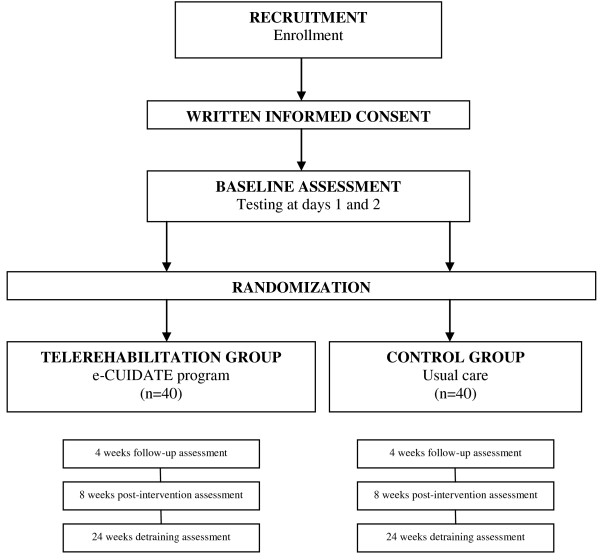
METHODS / DESIGN: This study will use a two-arm, assessor blinded, parallel randomized controlled trial design. People will be eligible if: their diagnosis is of stages I, II, or IIIA breast cancer; they are without chronic disease or orthopedic issues that would interfere with ability to participate in a physical activity program; they had access to the Internet and basic knowledge of computer use or living with a relative who has this knowledge; they had completed adjuvant therapy except for hormone therapy and not have a history of cancer recurrence; and they have an interest in improving lifestyle. Participants will be randomized into e-CUIDATE or usual care groups. E-CUIDATE give participants access to a range of contents: planning exercise arranged in series with breathing exercises, mobility, strength, and stretching. All of these exercises will be assigned to women in the telerehabilitation group according to perceived needs. The control group will be asked to maintain their usual routine. Study endpoints will be assessed after 8 weeks (immediate effects) and after 6 months. The primary outcome will be QoL measured by The European Organization for Research and Treatment of Cancer Quality of Life Questionnaire Core 30 version 3.0 and breast module called The European Organization for Research and Treatment of Cancer Breast Cancer-Specific Quality of Life questionnaire. The secondary outcomes: pain (algometry, Visual Analogue Scale, Brief Pain Inventory short form); body composition; physical measurement (abdominal test, handgrip strength, back muscle strength, and multiple sit-to-stand test); cardiorespiratory fitness (International Fitness Scale, 6-minute walk test, International Physical Activity Questionnaire-Short Form); fatigue (Piper Fatigue Scale and Borg Fatigue Scale); anxiety and depression (Hospital Anxiety and Depression Scale); cognitive function (Trail Making Test and Auditory Consonant Trigram); accelerometry; lymphedema; and anthropometric perimeters.
This study investigates the feasibility and effectiveness of a telerehabilitation system during adjuvant treatment of patients with breast cancer. If this treatment option is effective, telehealth systems could offer a choice of supportive care to cancer patients during the survivorship phase.
ClinicalTrials.gov Identifier: NCT01801527.
乳腺癌患者在肿瘤治疗后会出现身体功能障碍。这种障碍会降低生活质量(QoL),并增加与不健康生活方式相关的残疾发生率(例如,有氧能力和力量下降、体重增加和疲劳)。最近的研究表明,针对患者个体特征的运动适应与整体和无病生存率的提高有关。如今,使用远程康复系统的技术支持是一种很有前途的策略,具有与卫生专业人员快速高效联系的巨大优势。尚不清楚远程康复通过治疗性运动作为一种支持工具来实施积极生活方式的作用,这种生活方式已被证明是改善健康和减少这些女性肌肉骨骼疾病的有效资源。
方法/设计:本研究将采用两臂、评估者盲法、平行随机对照试验设计。如果符合以下条件,患者将有资格参加:诊断为 I 期、II 期或 IIIA 期乳腺癌;无慢性病或影响参与体育活动计划能力的骨科问题;能够访问互联网和基本的计算机使用知识,或者与具有这些知识的亲属一起生活;已完成辅助治疗(除激素治疗外)且无癌症复发史;并对改善生活方式感兴趣。参与者将被随机分为电子 CUIDATE 或常规护理组。电子 CUIDATE 为参与者提供一系列内容:计划运动,包括呼吸练习、活动能力、力量和伸展运动。远程康复组的所有这些练习都将根据感知需求分配给女性。对照组将被要求保持其常规程序。在 8 周后(即刻效应)和 6 个月后评估研究终点。主要结局将通过欧洲癌症研究与治疗组织生活质量问卷核心 30 版本 3.0 和欧洲癌症研究与治疗组织乳腺癌特定生活质量问卷来衡量生活质量。次要结局:疼痛(触诊、视觉模拟量表、简短疼痛量表);身体成分;身体测量(腹部测试、手握力、背肌力量和多次坐立测试);心肺功能(国际体能量表、6 分钟步行测试、国际体力活动问卷-简短形式);疲劳(Piper 疲劳量表和 Borg 疲劳量表);焦虑和抑郁(医院焦虑和抑郁量表);认知功能(走迷宫测试和听觉辅音字母测试);加速度计;淋巴水肿;和人体测量周长。
本研究调查了远程康复系统在乳腺癌患者辅助治疗期间的可行性和有效性。如果这种治疗方法有效,远程医疗系统可以为癌症患者在生存阶段提供一种支持性护理选择。
ClinicalTrials.gov 标识符:NCT01801527。
