Department of Neurology, Columbia University Medical Center, New York, New York, United States of America.
PLoS One. 2010 Jul 30;5(7):e11897. doi: 10.1371/journal.pone.0011897.
Coenzyme Q(10) (CoQ(10)) and its analogs are used therapeutically by virtue of their functions as electron carriers, antioxidant compounds, or both. However, published studies suggest that different ubiquinone analogs may produce divergent effects on oxidative phosphorylation and oxidative stress.
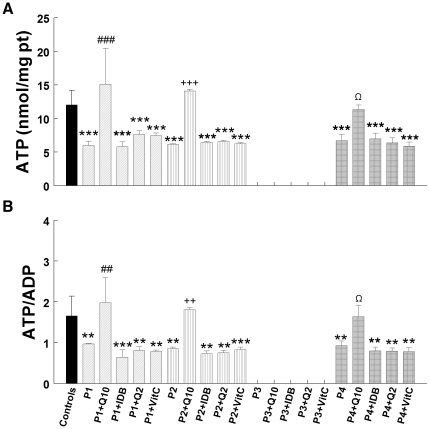
METHODOLOGY/PRINCIPAL FINDINGS: To test these concepts, we have evaluated the effects of CoQ(10), coenzyme Q(2) (CoQ(2)), idebenone, and vitamin C on bioenergetics and oxidative stress in human skin fibroblasts with primary CoQ(10) deficiency. A final concentration of 5 microM of each compound was chosen to approximate the plasma concentration of CoQ(10) of patients treated with oral ubiquinone. CoQ(10) supplementation for one week but not for 24 hours doubled ATP levels and ATP/ADP ratio in CoQ(10) deficient fibroblasts therein normalizing the bioenergetics status of the cells. Other compounds did not affect cellular bioenergetics. In COQ2 mutant fibroblasts, increased superoxide anion production and oxidative stress-induced cell death were normalized by all supplements.
CONCLUSIONS/SIGNIFICANCE: THESE RESULTS INDICATE THAT: 1) pharmacokinetics of CoQ(10) in reaching the mitochondrial respiratory chain is delayed; 2) short-tail ubiquinone analogs cannot replace CoQ(10) in the mitochondrial respiratory chain under conditions of CoQ(10) deficiency; and 3) oxidative stress and cell death can be counteracted by administration of lipophilic or hydrophilic antioxidants. The results of our in vitro experiments suggest that primary CoQ(10) deficiencies should be treated with CoQ(10) supplementation but not with short-tail ubiquinone analogs, such as idebenone or CoQ(2). Complementary administration of antioxidants with high bioavailability should be considered if oxidative stress is present.
辅酶 Q(10)(CoQ(10))及其类似物因其作为电子载体、抗氧化化合物或两者兼具的功能而被用于治疗。然而,已发表的研究表明,不同的泛醌类似物可能对氧化磷酸化和氧化应激产生不同的影响。
方法/主要发现:为了检验这些概念,我们评估了 CoQ(10)、辅酶 Q(2)(CoQ(2))、艾地苯醌和维生素 C 对原发性 CoQ(10)缺乏的人皮肤成纤维细胞的生物能量学和氧化应激的影响。每种化合物的终浓度选择为 5μM,以近似于口服泛醌治疗患者的 CoQ(10)血浆浓度。CoQ(10) 补充剂治疗一周而非 24 小时可使 CoQ(10)缺乏的成纤维细胞中的 ATP 水平和 ATP/ADP 比值增加一倍,从而使细胞的生物能量状态正常化。其他化合物则不影响细胞的生物能量学。在 COQ2 突变型成纤维细胞中,所有补充剂均可使超氧阴离子产生增加和氧化应激诱导的细胞死亡正常化。
结论/意义:这些结果表明:1)CoQ(10)到达线粒体呼吸链的药代动力学是延迟的;2)在 CoQ(10)缺乏的情况下,短尾泛醌类似物不能替代线粒体呼吸链中的 CoQ(10);3)可以通过给予亲脂性或亲水性抗氧化剂来对抗氧化应激和细胞死亡。我们的体外实验结果表明,原发性 CoQ(10)缺乏症应采用 CoQ(10)补充剂治疗,而不是采用短尾泛醌类似物(如艾地苯醌或 CoQ(2))治疗。如果存在氧化应激,应考虑给予具有高生物利用度的抗氧化剂进行补充治疗。