University of Texas at Austin, 78712-0187, USA.
Depress Anxiety. 2010 Aug;27(8):746-51. doi: 10.1002/da.20708.
Biased attention for emotional stimuli reflects vulnerability or resilience to emotional disorders. The current study examines whether the 5-HTTLPR polymorphism is associated with attentional biases for negative word stimuli.
Unmedicated, young adults with low current depression and anxiety symptoms (N=106) were genotyped for the 5-HTTLPR, including the single nucleotide polymorphism (SNP) rs25531 in the long allele of the 5-HTTLPR. Participants then completed a standard dot-probe task that measured attentional bias toward anxiety, dysphoric, and self-esteem words.
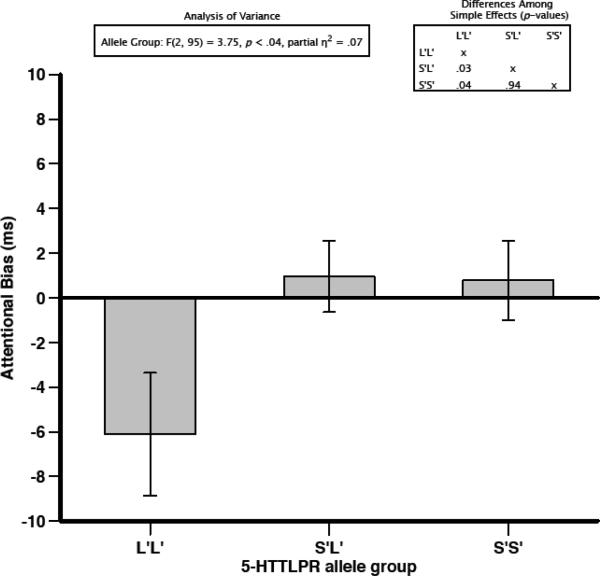
The L(A)L(A) allele group demonstrated an attentional bias away from negative word stimuli. This attentional bias was absent among the S/L(G) carriers.
These findings replicate previous work and suggest that 5-HTTLPR L(A) homozygotes possess a protective attentional bias that may decrease susceptibility to depression and anxiety.
对情绪刺激的偏见反映了对情绪障碍的脆弱性或适应能力。本研究考察了 5-HTTLPR 多态性是否与对负面词刺激的注意偏向有关。
未用药的、当前抑郁和焦虑症状较轻的年轻成年人(N=106)进行了 5-HTTLPR 的基因分型,包括 5-HTTLPR 长等位基因中的单核苷酸多态性(SNP)rs25531。然后,参与者完成了一个标准的点探测任务,该任务测量了对焦虑、抑郁和自尊词的注意偏向。
L(A)L(A)等位基因组表现出对负面词刺激的注意偏向。S/L(G)携带者则不存在这种注意偏向。
这些发现复制了以前的工作,并表明 5-HTTLPR L(A)纯合子具有保护性的注意偏向,可能降低对抑郁和焦虑的易感性。