Basal Ganglia Pathophysiology Unit, Department of Experimental Medical Science, Lund University, Lund, Sweden.
Prog Brain Res. 2010;183:209-33. doi: 10.1016/S0079-6123(10)83011-0.
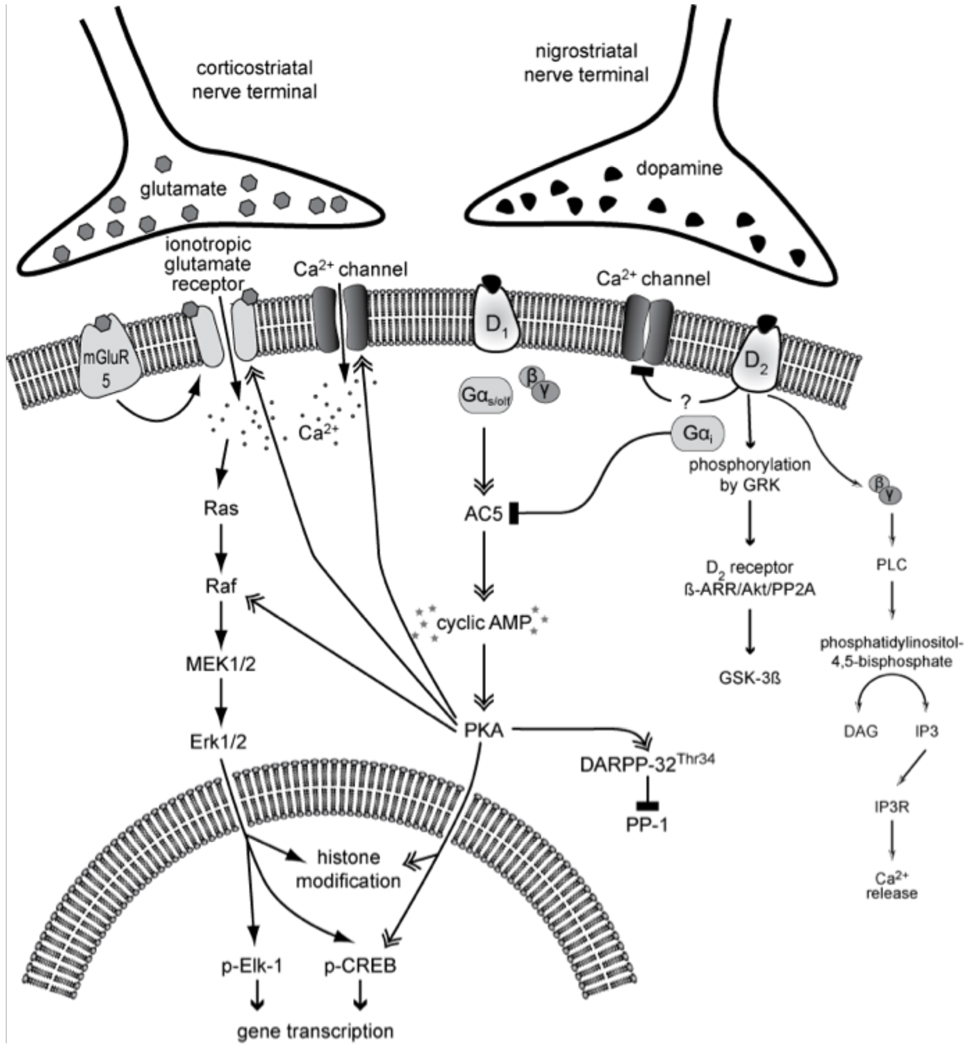
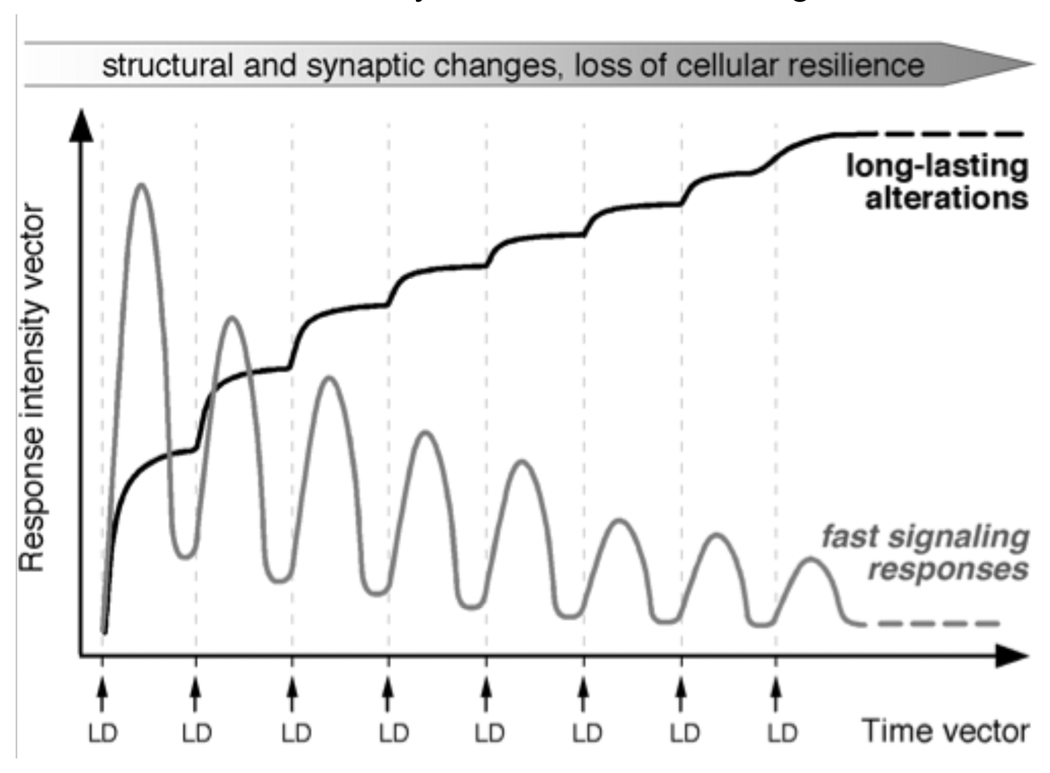
Dopamine (DA) replacement therapy with l-DOPA remains the most effective treatment for Parkinson's disease, but causes dyskinesia (abnormal involuntary movements) in the vast majority of the patients. The basic mechanisms of l-DOPA-induced dyskinesia (LID) have become the object of intense research focusing on neurochemical and molecular adaptations in the striatum. Here we review this vast literature and highlight trends that converge into a unifying pathophysiological interpretation. We propose that the core molecular alteration of striatal neurons in LID consists in an inability to turn down supersensitive signaling responses downstream of DA D1 receptors (where supersensitivity is primarily caused by DA denervation). The sustained activation of intracellular signaling pathways induced by each dose of l-DOPA leads to abnormal cellular plasticity and high bioenergetic expenditure. The over-exploitation of signaling pathways and energy reserves during treatment impairs the ability of striatal neurons to dynamically gate cortically driven motor commands. LID thus exemplifies a disorder where 'too much' molecular plasticity leads to plasticity failure in the striatum.
左旋多巴(L-DOPA)替代疗法仍然是治疗帕金森病最有效的方法,但会导致绝大多数患者出现运动障碍(异常不自主运动)。L-DOPA 诱导的运动障碍(LID)的基本机制已成为神经化学和分子适应的焦点,这些适应发生在纹状体中。在这里,我们回顾了这一大量的文献,并强调了汇聚成统一病理生理学解释的趋势。我们提出,LID 中纹状体神经元的核心分子改变是无法降低多巴胺 D1 受体下游超敏信号反应的能力(其中超敏反应主要是由多巴胺去神经支配引起的)。每次给予 L-DOPA 都会诱导细胞内信号通路的持续激活,从而导致异常的细胞可塑性和高能量消耗。在治疗过程中,信号通路和能量储备的过度利用会损害纹状体神经元动态门控皮质驱动运动指令的能力。因此,LID 是一种“过多”分子可塑性导致纹状体可塑性失败的疾病。