Department of Neuroscience, Physiology and Pharmacology, University College London, London WC1E 6BT, UK.
Neuron. 2010 Aug 12;67(3):435-51. doi: 10.1016/j.neuron.2010.06.028.
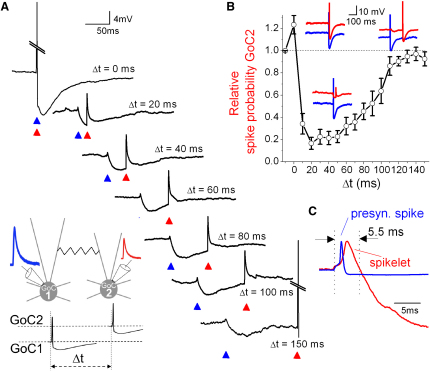
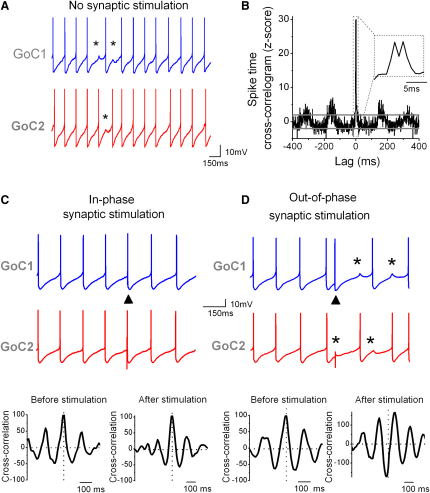
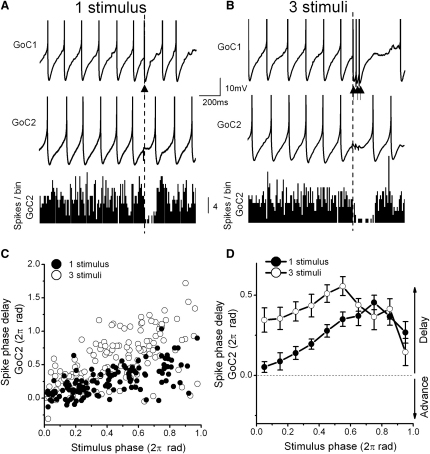
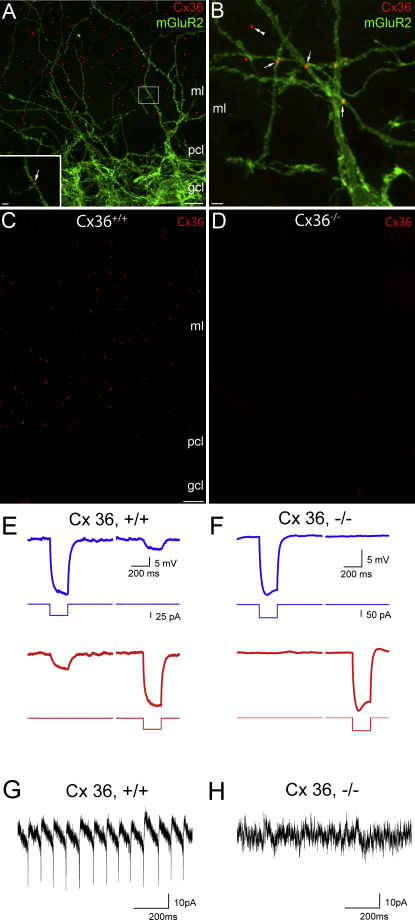
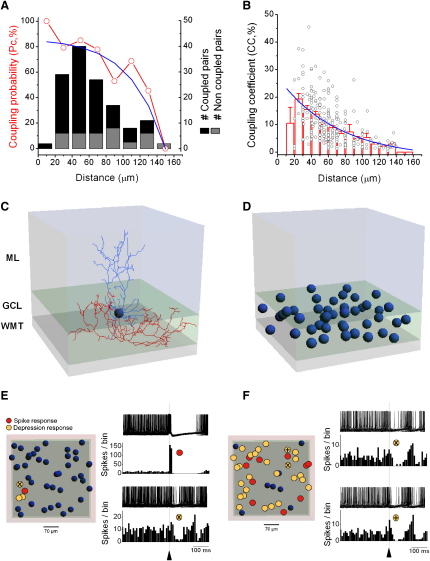
Electrical synapses between interneurons contribute to synchronized firing and network oscillations in the brain. However, little is known about how such networks respond to excitatory synaptic input. To investigate this, we studied electrically coupled Golgi cells (GoC) in the cerebellar input layer. We show with immunohistochemistry, electron microscopy, and electrophysiology that Connexin-36 is necessary for functional gap junctions (GJs) between GoC dendrites. In the absence of coincident synaptic input, GoCs synchronize their firing. In contrast, sparse, coincident mossy fiber input triggered a mixture of excitation and inhibition of GoC firing and spike desynchronization. Inhibition is caused by propagation of the spike afterhyperpolarization through GJs. This triggers network desynchronization because heterogeneous coupling to surrounding cells causes spike-phase dispersion. Detailed network models predict that desynchronization is robust, local, and dependent on synaptic input properties. Our results show that GJ coupling can be inhibitory and either promote network synchronization or trigger rapid network desynchronization depending on the synaptic input.
神经元之间的电突触有助于大脑中神经元的同步放电和网络振荡。然而,对于这些网络如何响应兴奋性突触输入知之甚少。为了研究这一点,我们研究了小脑输入层中的电偶联的高尔基细胞(GoC)。我们通过免疫组织化学、电子显微镜和电生理学显示,Connexin-36 是 GoC 树突之间功能性缝隙连接(GJ)所必需的。在没有同时发生的突触输入的情况下,GoC 会同步其放电。相比之下,稀疏的、同时的苔藓纤维输入触发了 GoC 放电的兴奋和抑制的混合以及尖峰去同步化。抑制是由尖峰后超极化通过 GJ 传播引起的。这会引发网络去同步化,因为与周围细胞的异质连接会导致尖峰相位分散。详细的网络模型预测,去同步化是稳健的、局部的,并且取决于突触输入特性。我们的结果表明,GJ 耦合可以是抑制性的,它可以促进网络同步化或触发快速网络去同步化,具体取决于突触输入。