Center for Epidemiology and Biostatistics, Norwegian School of Veterinary Science, Oslo, Norway.
Virol J. 2010 Aug 11;7:188. doi: 10.1186/1743-422X-7-188.
Pancreas disease (PD) is a viral fish disease which in recent years has significantly affected Norwegian salmonid aquaculture. In Norway, the aetiological agent salmonid alphavirus (SAV) has been found to be represented by the subtype 3 only. SAV subtype 3 has in previous analyses been found to show a lower genetic divergence than the subtypes found to cause PD in Ireland and Scotland. The aim of this study was to evaluate the nucleotide (nt) and amino acid divergence and the phylogenetic relationship of 33 recent SAV subtype 3 sequences. The samples from which the sequences were obtained originated from both PD endemic and non-endemic regions in an attempt to investigate agent origin/spread. Multiple samples throughout the seawater production phase from several salmonid populations were included to investigate genetic variation during an outbreak. The analyses were mainly based on partial sequences from the E2 gene. For some samples, additional partial 6 K and nsP3 gene sequences were available.
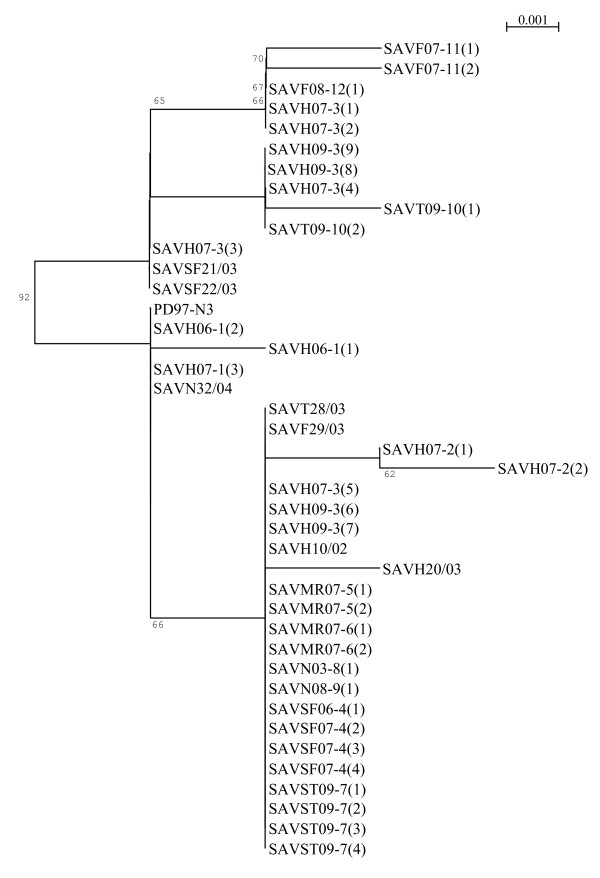
The nucleotide divergence for all gene fragments ranged from total identity (0.0% divergence) to 0.45% (1103 nt fragment of E2), 1.11% (451 nt fragment of E2), 0.94% (6 K) and 0.28% (nsP3). This low nucleotide divergence corresponded well to previous reports on SAV 3 sequences; however the observed divergence for the short E2 fragment was higher than that previously reported. When compared to SAVH20/03 (AY604235), amino acid substitutions were detected in all assessed gene fragments however the in vivo significance of these on for example disease outbreak mortality could not be concluded on. The phylogenetic tree based on the 451 nt E2 fragment showed that the sequences divided into two clusters with low genetic divergence, representing only a single SAV subtype.
The analysed sequences represented two clusters of a single SAV subtype; however some of the observed sequence divergence was higher than that previously reported by other researchers. Larger scale, full length sequence analyses should be instigated to allow further phylogenetic and molecular epidemiology investigations of SAV subtype 3.
胰腺疾病(PD)是一种病毒性鱼类疾病,近年来对挪威鲑鱼养殖业造成了重大影响。在挪威,已发现鲑鱼甲病毒(SAV)的病原体仅代表亚型 3。在之前的分析中,SAV 亚型 3 显示出比在爱尔兰和苏格兰引起 PD 的亚型更低的遗传差异。本研究的目的是评估 33 个最近的 SAV 亚型 3 序列的核苷酸(nt)和氨基酸差异以及系统发育关系。获得序列的样本来自 PD 流行地区和非流行地区,试图调查病原体的起源/传播。从几个鲑鱼种群的海水生产阶段中采集了多个样本,以调查爆发期间的遗传变异。分析主要基于 E2 基因的部分序列。对于一些样本,还可以获得额外的部分 6 K 和 nsP3 基因序列。
所有基因片段的核苷酸差异范围从完全一致(0.0%差异)到 0.45%(E2 的 1103 个核苷酸片段),1.11%(E2 的 451 个核苷酸片段),0.94%(6 K)和 0.28%(nsP3)。这种低核苷酸差异与之前关于 SAV 3 序列的报告非常吻合;然而,观察到的短 E2 片段的差异高于之前的报告。与 SAVH20/03(AY604235)相比,在所有评估的基因片段中均检测到氨基酸取代,但不能得出这些取代对例如疾病爆发死亡率的体内意义。基于 451 个核苷酸 E2 片段的系统发育树表明,序列分为两个遗传分化较小的簇,仅代表单一的 SAV 亚型。
分析的序列代表了单一 SAV 亚型的两个簇;然而,观察到的一些序列差异高于其他研究人员之前的报告。应进行更大规模的全长序列分析,以进一步对 SAV 亚型 3 进行系统发育和分子流行病学研究。