Department of Community Health Sciences, Faculty of Medicine, University of Calgary, 1215-39 Ave, SW, Calgary, AB T2T2K6, Canada.
Health Qual Life Outcomes. 2010 Aug 11;8:83. doi: 10.1186/1477-7525-8-83.
In eating disorders (EDs), treatment outcome measurement has traditionally focused on symptom reduction rather than functioning or quality of life (QoL). The Eating Disorders Quality of Life Scale (EDQLS) was recently developed to allow for measurement of broader outcomes. We examined responsiveness of the EDQLS in a longitudinal multi-site study.
The EDQLS and comparator generic QoL scales were collected in person at baseline, and 3 and 6 months from 130 participants (mean age 25.6 years; range 14-60) in 12 treatment programs in four Canadian provinces. Total score differences across the time points and responsiveness were examined using both anchor- and distribution-based methods.
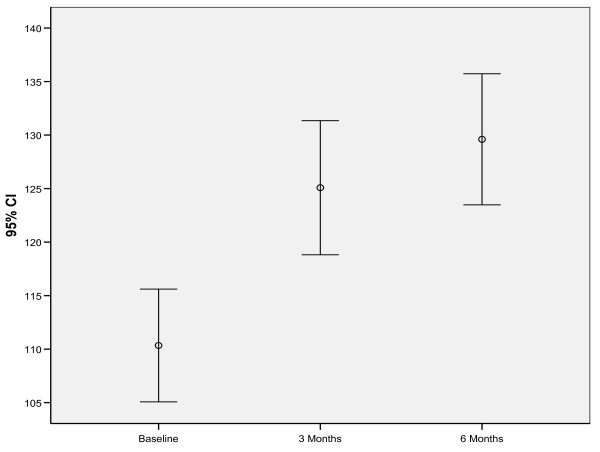
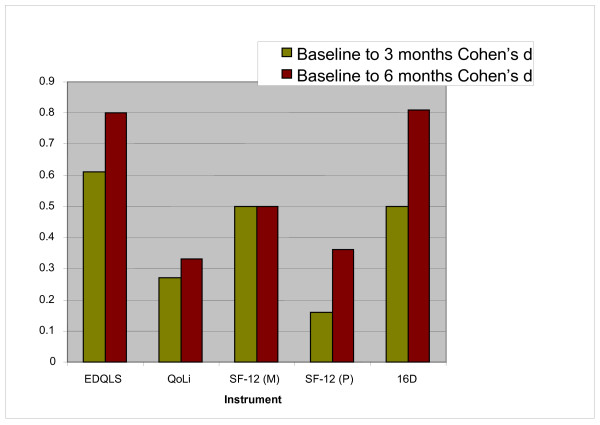
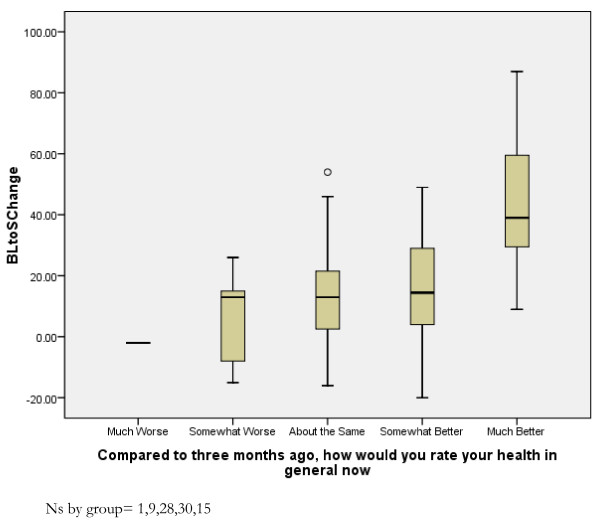
98 (75%) and 85 (65%) responses were received at 3 and 6 months respectively. No statistically significant differences were found between the baseline sample and those lost to follow-up on any measured characteristic. Mean EDQLS total scores increased from 110 (SD = 24) to 124.5 (SD = 29) at 3 months and 129 (SD = 28) at 6 months, and the difference by time was tested using a general linear model (GLM) to account for repeated measurement (p < .001). Responsiveness was good overall (Cohen's d = .61 and .80), and confirmed using anchor methods across 5 levels of self-reported improvement in health status (p < .001). Effect sizes across time were moderate or large for for all age groups. Internal consistency (Chronbach's alpha=.96) held across measurement points and patterns of responsiveness held across subscales. EDQLS responsiveness exceeded that of the Quality of Life Inventory, the Short Form-12 (mental and physical subscales) and was similar to the 16-dimension quality of life scale.
The EDQLS is responsive to change in geographically diverse and clinically heterogeneous programs over a relatively short time period in adolescents and adults. It shows promise as an outcome measure for both research and clinical practice.
在饮食失调症(EDs)中,治疗效果的衡量标准历来侧重于症状的减轻,而不是功能或生活质量(QoL)。最近开发了饮食失调症生活质量量表(EDQLS),以允许衡量更广泛的结果。我们在一项纵向多地点研究中检查了 EDQLS 的反应能力。
在加拿大四个省的 12 个治疗计划中,对 130 名参与者(平均年龄 25.6 岁;范围 14-60 岁)进行了 EDQLS 和比较通用 QoL 量表的个人评估,在基线时以及 3 个月和 6 个月时进行了评估。使用基于锚点和分布的方法检查了各个时间点的总分差异和反应能力。
分别在 3 个月和 6 个月时收到了 98(75%)和 85(65%)的响应。在任何测量特征方面,基线样本与失访者之间没有发现统计学上的显著差异。EDQLS 总分平均值从 110(SD = 24)增加到 3 个月时的 124.5(SD = 29)和 6 个月时的 129(SD = 28),并且使用广义线性模型(GLM)进行时间差异测试,以考虑重复测量(p <.001)。总体而言,反应能力良好(Cohen's d =.61 和.80),并通过 5 个健康状况自我报告改善水平的锚点方法进行了确认(p <.001)。对于所有年龄组,时间跨度的效应大小均为中等或较大。在整个测量点的内部一致性(Chronbach 的 alpha=.96)和在整个子量表的反应模式均保持一致。EDQLS 的反应能力超过了生活质量量表,16 维度生活质量量表和健康状况问卷的反应能力。
EDQLS 在地理上多样化和临床上异质的计划中,在相对较短的时间内对青少年和成年人的变化具有反应能力。它有望成为研究和临床实践的一种结果衡量标准。