Department of Chemistry, The University of Chicago, Chicago, Illinois 60637, USA.
Nature. 2010 Aug 12;466(7308):883-6. doi: 10.1038/nature09200.
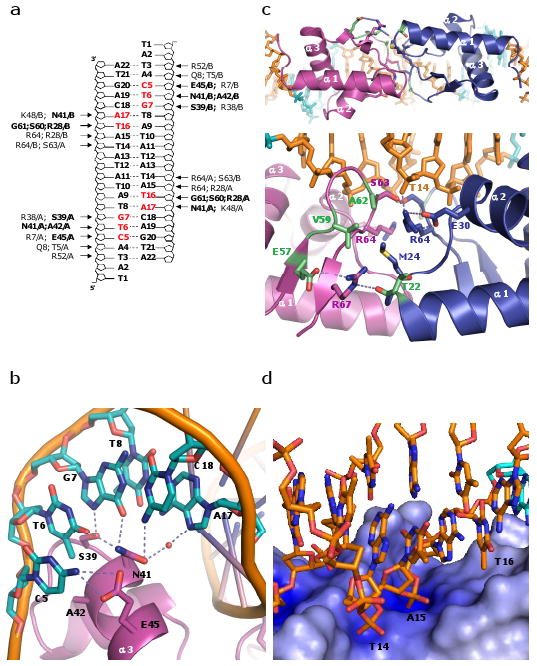
The eubacterial SOS system is a paradigm of cellular DNA damage and repair, and its activation can contribute to antibiotic resistance. Under normal conditions, LexA represses the transcription of many DNA repair proteins by binding to SOS 'boxes' in their operators. Under genotoxic stress, accumulating complexes of RecA, ATP and single-stranded DNA (ssDNA) activate LexA for autocleavage. To address how LexA recognizes its binding sites, we determined three crystal structures of Escherichia coli LexA in complex with SOS boxes. Here we report the structure of these LexA-DNA complexes. The DNA-binding domains of the LexA dimer interact with the DNA in the classical fashion of a winged helix-turn-helix motif. However, the wings of these two DNA-binding domains bind to the same minor groove of the DNA. These wing-wing contacts may explain why the spacing between the two half-sites of E. coli SOS boxes is invariant.
细菌 SOS 系统是细胞 DNA 损伤和修复的典范,其激活可导致抗生素耐药性的产生。在正常情况下,LexA 通过与操纵子中 SOS“盒”的结合来抑制许多 DNA 修复蛋白的转录。在遗传毒性应激下,RecA、ATP 和单链 DNA(ssDNA)的积累复合物激活 LexA 进行自身切割。为了解析 LexA 如何识别其结合位点,我们确定了三种与 SOS 盒结合的大肠杆菌 LexA 的晶体结构。在此,我们报告这些 LexA-DNA 复合物的结构。LexA 二聚体的 DNA 结合结构域以经典的翼型螺旋-转角-螺旋基序与 DNA 相互作用。然而,这两个 DNA 结合结构域的翼部结合到 DNA 的同一小沟中。这些翼-翼接触可能解释了为什么大肠杆菌 SOS 盒的两个半位点之间的间隔是不变的。