Department of Plant Sciences, One Shields Ave, University of California, Davis, CA 95616-8780, USA.
Theor Appl Genet. 2011 Jan;122(1):95-108. doi: 10.1007/s00122-010-1425-3. Epub 2010 Aug 12.
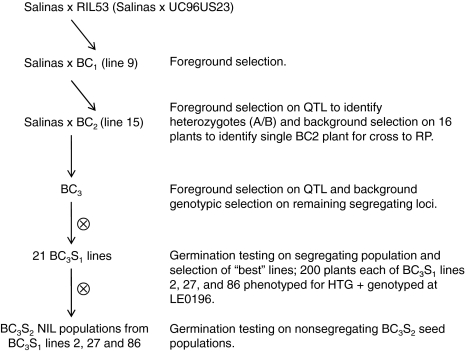
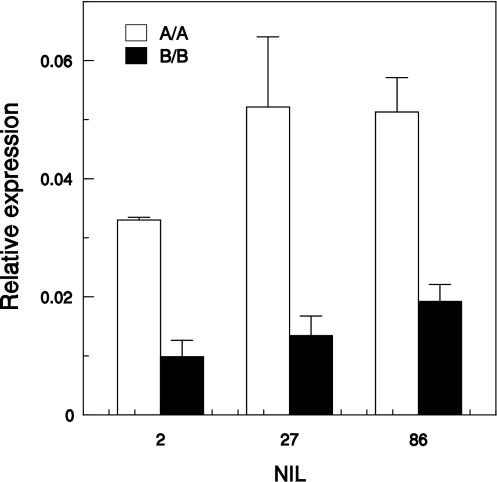
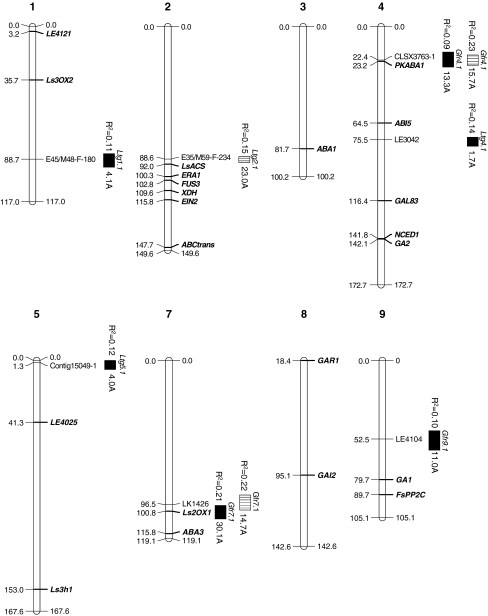
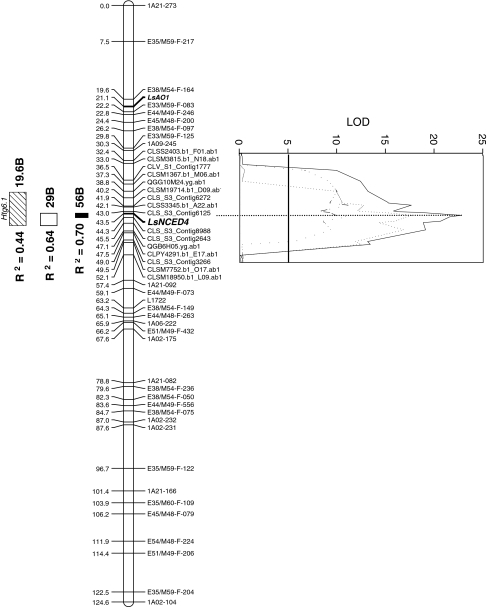
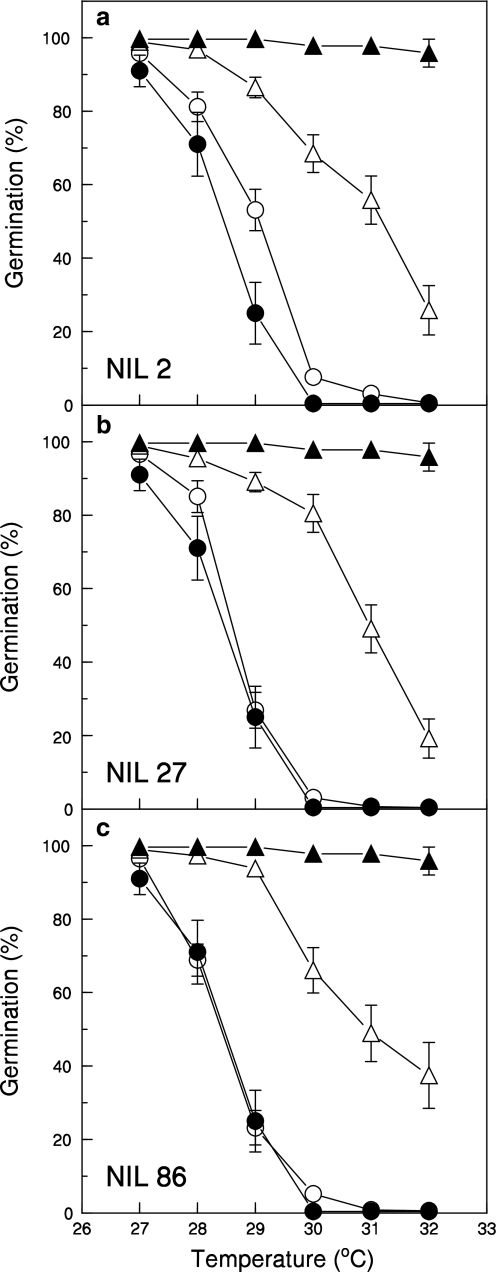
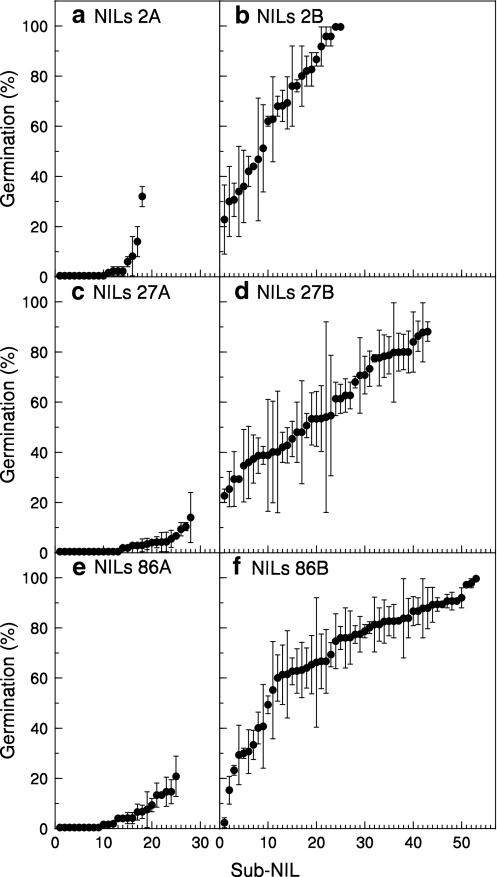
Thermoinhibition, or failure of seeds to germinate when imbibed at warm temperatures, can be a significant problem in lettuce (Lactuca sativa L.) production. The reliability of stand establishment would be improved by increasing the ability of lettuce seeds to germinate at high temperatures. Genes encoding germination- or dormancy-related proteins were mapped in a recombinant inbred line population derived from a cross between L. sativa cv. Salinas and L. serriola accession UC96US23. This revealed several candidate genes that are located in the genomic regions containing quantitative trait loci (QTLs) associated with temperature and light requirements for germination. In particular, LsNCED4, a temperature-regulated gene in the biosynthetic pathway for abscisic acid (ABA), a germination inhibitor, mapped to the center of a previously detected QTL for high temperature germination (Htg6.1) from UC96US23. Three sets of sister BC(3)S(2) near-isogenic lines (NILs) that were homozygous for the UC96US23 allele of LsNCED4 at Htg6.1 were developed by backcrossing to cv. Salinas and marker-assisted selection followed by selfing. The maximum temperature for germination of NIL seed lots with the UC96US23 allele at LsNCED4 was increased by 2-3°C when compared with sister NIL seed lots lacking the introgression. In addition, the expression of LsNCED4 was two- to threefold lower in the former NIL lines as compared to expression in the latter. Together, these data strongly implicate LsNCED4 as the candidate gene responsible for the Htg6.1 phenotype and indicate that decreased ABA biosynthesis at high imbibition temperatures is a major factor responsible for the increased germination thermotolerance of UC96US23 seeds.
热抑制,即在温暖条件下吸胀时种子不发芽,可能是生菜(Lactuca sativa L.)生产中的一个重大问题。通过提高生菜种子在高温下发芽的能力,可以提高出苗的可靠性。在生菜品种 Salinas 和 L. serriola 品系 UC96US23 杂交衍生的重组自交系群体中,对编码与萌发或休眠相关蛋白的基因进行了作图。这揭示了几个候选基因,它们位于包含与萌发的温度和光照要求相关的数量性状位点(QTL)的基因组区域内。特别是,温度调节基因 LsNCED4,位于脱落酸(ABA)生物合成途径中,ABA 是一种萌发抑制剂,它映射到先前检测到的 UC96US23 高温萌发(Htg6.1)QTL 的中心。通过回交和标记辅助选择以及自交,从 Salinas 品种中开发了 3 组姊妹 BC(3)S(2)近等基因系(NIL),它们在 Htg6.1 处是 UC96US23 等位基因的 LsNCED4 纯合子。与缺乏导入的姊妹 NIL 种子相比,具有 UC96US23 等位基因的 NIL 种子批的最大萌发温度提高了 2-3°C。此外,与后者相比,前 NIL 系中 LsNCED4 的表达低了两到三倍。这些数据强烈表明 LsNCED4 是导致 Htg6.1 表型的候选基因,并表明在高吸胀温度下 ABA 生物合成减少是 UC96US23 种子萌发耐热性增加的主要因素。