Prevention of Metabolic Disorders Research Center, Research Institute for Endocrine Sciences, Shahid Beheshti University of Medical Sciences, Yaman street, Velenjak, Tehran, Iran.
Lipids Health Dis. 2010 Aug 17;9:85. doi: 10.1186/1476-511X-9-85.
Dyslipidemia is a risk factor for incident type 2 diabetes; however, no study has specifically assessed the lipid ratios (i.e. total cholesterol (TC)/high density lipoprotein cholesterol (HDL-C) and triglyceride (TG)/HDL-C) as predictors of diabetes. We aimed to compare the independent association between the different lipid measures with incident diabetes over a median follow up of 6.4 years in Iranian men and women.
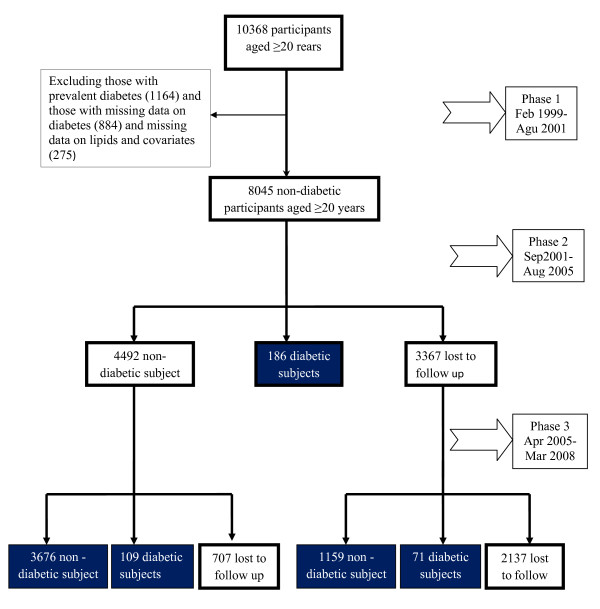
The study population consisted of 5201 non diabetic (men = 2173, women = 3028) subjects, aged > or =20 years. The risk factor adjusted odds ratios (ORs) for diabetes were calculated for every 1 standard deviation (SD) change in TC, log-transformed TG, HDL-C, non-HDL-C, TC/HDL-C and log-transformed TG/HDL-C using multivariate logistic regression analysis. Receiver operator characteristic (ROC) curve analysis was used to define the points of the maximum sum of sensitivity and specificity (MAXss) of each lipid measure as a predictor of diabetes.
We found 366 (146 men and 220 women) new diabetes cases during follow-up. The risk-factor-adjusted ORs for a 1 SD increase in TG, TC/HDL-C and TG/HDL-C were 1.23, 1.27 and 1.25 in men; the corresponding risks in females were 1.36, 1.14, 1.39 respectively (all p < 0.05, except TC/HDL-C in females which was marginally significant, p = 0.07). A 1 SD increase of HDL-C only in women decreased the risk of diabetes by 25% [0.75(0.64-0.89)]. In both genders, there was no difference in the discriminatory power of different lipid measures to predict incident diabetes in the risk factor adjusted models (ROC approximately 82%). TG cutoff values of 1.98 and 1.66 mmol/l; TG/HDL-C cutoff values of 4.7 and 3.7, in men and women, respectively, TC/HDL-C cutoff value of 5.3 in both genders and HDL-C cutoff value of 1.18 mmol/l in women yielded the MAXss for defining the incidence of diabetes.
TC/HDL-C and TG/HDL-C showed similar performance for diabetes prediction in men population however; among women TG/HDL-C highlighted higher risk than did TC/HDL-C, although there was no difference in discriminatory power. Importantly, HDL-C had a protective effect for incident diabetes only among women.
血脂异常是 2 型糖尿病发病的一个危险因素;然而,尚无研究专门评估血脂比值(即总胆固醇(TC)/高密度脂蛋白胆固醇(HDL-C)和甘油三酯(TG)/HDL-C)作为糖尿病的预测指标。我们旨在比较不同血脂指标与伊朗男女患者中位随访 6.4 年期间糖尿病发病的独立相关性。
研究人群由 5201 例非糖尿病患者(男性=2173 例,女性=3028 例)组成,年龄≥20 岁。采用多元逻辑回归分析计算 TC、log 转换 TG、HDL-C、非 HDL-C、TC/HDL-C 和 log 转换 TG/HDL-C 每标准差(SD)变化的糖尿病风险校正比值比(OR)。采用接收者操作特征(ROC)曲线分析确定每个血脂指标作为糖尿病预测指标的最大敏感度和特异度之和(MAXss)的切点。
在随访期间发现 366 例(男性 146 例,女性 220 例)新的糖尿病病例。男性中 TG、TC/HDL-C 和 TG/HDL-C 每 SD 增加的风险校正 OR 分别为 1.23、1.27 和 1.25;女性相应风险分别为 1.36、1.14 和 1.39(均 P<0.05,除女性 TC/HDL-C 接近显著,P=0.07)。女性中 HDL-C 每 SD 增加仅降低糖尿病风险 25%[0.75(0.64-0.89)]。在两性中,调整风险因素后的不同血脂指标预测新发糖尿病的判别能力无差异(ROC 约 82%)。男性和女性 TG 截断值分别为 1.98 和 1.66 mmol/L,TG/HDL-C 截断值分别为 4.7 和 3.7,TC/HDL-C 截断值为 5.3,女性 HDL-C 截断值为 1.18 mmol/L,可得出最大 MAXss 以确定糖尿病的发病情况。
TC/HDL-C 和 TG/HDL-C 在男性人群中对糖尿病预测具有相似的表现;然而,在女性人群中,TG/HDL-C 比 TC/HDL-C 显示出更高的风险,尽管判别能力没有差异。重要的是,HDL-C 对女性的糖尿病发病仅有保护作用。