Artha I Made Junior Rina, Bhargah Agha, Dharmawan Nyoman Khrisna, Pande Utami Wijayaswari, Triyana Komang Agus, Mahariski Pande Agung, Yuwono Jessica, Bhargah Varennia, Prabawa I Putu Yuda, Manuaba Ida Bagus Amertha Putra, Rina I Ketut
Department of Cardiology and Vascular Medicine, Faculty of Medicine, Udayana University, Sanglah General Hospital, Denpasar, Bali, Indonesia.
Faculty of Medicine, Udayana University, Denpasar, Bali, Indonesia.
Vasc Health Risk Manag. 2019 Jun 5;15:149-157. doi: 10.2147/VHRM.S209830. eCollection 2019.
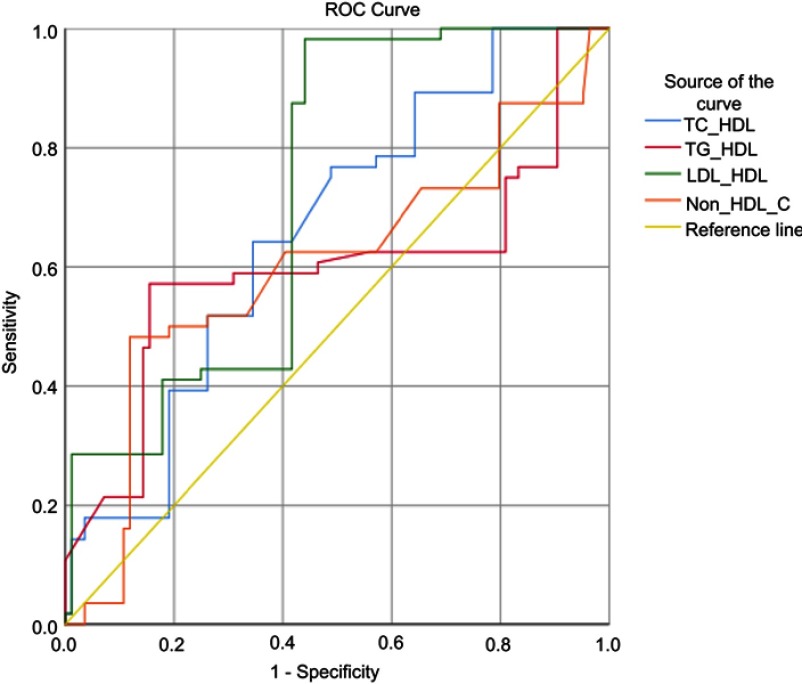
Diabetes is often accompanied by undiagnosed dyslipidemia. The aim of the study is to investigate the clinical relevance of lipid profiles and lipid ratios as predictive biochemical models for glycemic control in patients with type 2 diabetes mellitus (T2DM). This is a retrospective study recruiting 140 patients with T2DM during a one-year period, 2018-2019, at the Diabetic Center Sanglah General Hospital and Internal Medicine Polyclinic Puri Raharja General Hospital. Demographic characteristics, glycosylated hemoglobin (HBA1c) , and lipid profile were recorded and analyzed using SPSS version 25.0 for Windows. The sample is then classified into good (HBA1c≤7) and poor (HBA1c>7) glycemic control. Risk analysis model, receiver operator characteristics (ROC) analysis, and correlation test were used to evaluate the association of HBA1c level with lipid profile and lipid ratio parameters. Lipid profile findings such as total cholesterol (TC), low-density lipoprotein cholesterol (LDL-C) , triglycerides (TG), and lipid ratio parameter (LDL-C to high-density lipoprotein cholesterol (HDL-C) ratio) were higher in patients in the poor glycemic control group (<0.05) and HDL-C was significantly lower in patients with poor glycemic control (=0.001). There is a significant positive correlation between LDL, total cholesterol, LDL-C, TG, and TC to HDL-C ratio, triglycerides, and TC/HDL-C ratio with HBA1c level. Meanwhile, a negative correlation was observed on HDL-C with the HBA1c level. Only TC/HDL-C ratio and LDL-C/HDL-C ratio parameters may be used as predictive models (AUC>0.7), with cutoff point, sensitivity, and specificity of 4.68 (77%; 52%) and 3.06 (98%; 56%) respectively. A risk analysis model shows that the LDL-C/HDL-C ratio parameter is the most influential risk factor in the occurrence of poor glycemic control (adjusted OR =38.76; 95% CI: 27.32-56.64; <0.001). Lipid profiles (LDL-C) and lipid ratios (LDL-C/HDL-C and TC/HDL-C ratio) show potential markers that can be used in predicting glycemic control in patients with T2DM.
糖尿病常伴有未被诊断出的血脂异常。本研究旨在探讨血脂谱和血脂比值作为2型糖尿病(T2DM)患者血糖控制预测生化模型的临床相关性。这是一项回顾性研究,在2018 - 2019年的一年时间里,招募了桑格拉总医院糖尿病中心和普里拉哈尔贾总医院内科门诊的140例T2DM患者。记录人口统计学特征、糖化血红蛋白(HBA1c)和血脂谱,并使用Windows版SPSS 25.0进行分析。然后将样本分为血糖控制良好(HBA1c≤7)和血糖控制不佳(HBA1c>7)两组。采用风险分析模型、受试者工作特征(ROC)分析和相关性检验来评估HBA1c水平与血脂谱及血脂比值参数之间的关联。血糖控制不佳组患者的血脂谱结果,如总胆固醇(TC)、低密度脂蛋白胆固醇(LDL - C)、甘油三酯(TG)以及血脂比值参数(LDL - C与高密度脂蛋白胆固醇(HDL - C)的比值)更高(<0.05),而血糖控制不佳患者的HDL - C显著更低(=0.001)。LDL、总胆固醇、LDL - C、TG以及TC与HDL - C的比值、甘油三酯和TC/HDL - C比值与HBA1c水平之间存在显著正相关。同时,观察到HDL - C与HBA1c水平呈负相关。只有TC/HDL - C比值和LDL - C/HDL - C比值参数可作为预测模型(AUC>0.7), 其截断点、敏感性和特异性分别为4.68(77%;52%)和3.06(98%;56%)。风险分析模型表明,LDL - C/HDL - C比值参数是血糖控制不佳发生的最具影响力的危险因素(调整后的OR =38.76;95% CI:27.32 - 56.64;<0.001)。血脂谱(LDL - C)和血脂比值(LDL - C/HDL - C和TC/HDL - C比值)显示出可用于预测T2DM患者血糖控制的潜在标志物。