Gao Yan-Song, Su Jing-Tan, Yan Yong-Bin
State Key Laboratory of Biomembrane and Membrane Biotechnology, School of Life Sciences, Tsinghua University, Beijing 100084, China.
Int J Mol Sci. 2010 Jun 25;11(7):2584-96. doi: 10.3390/ijms11072584.
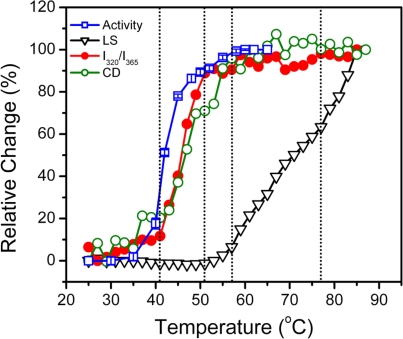
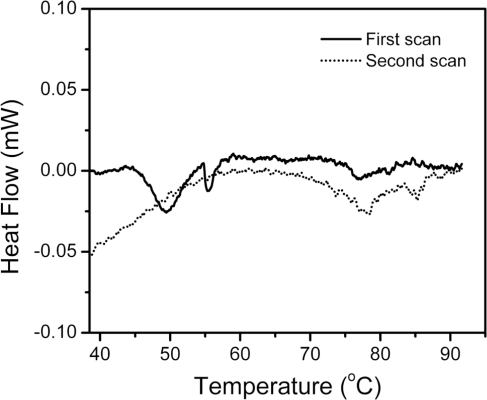
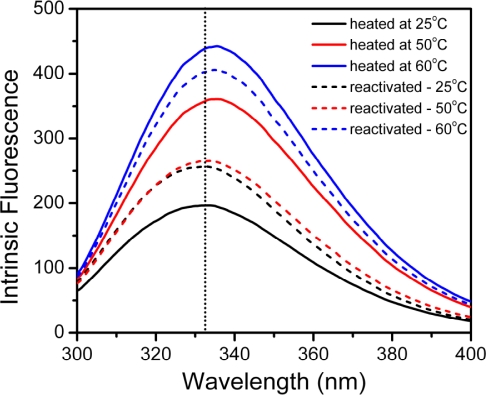
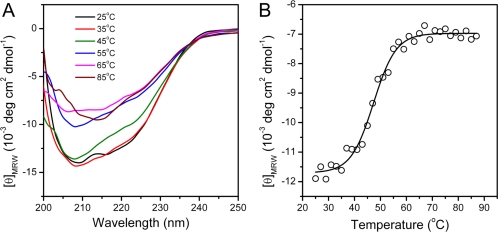
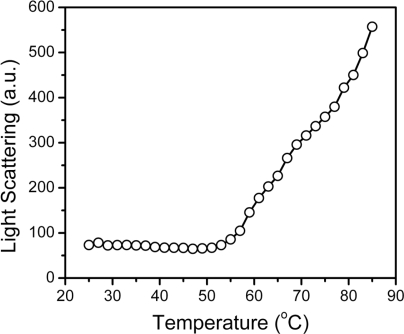
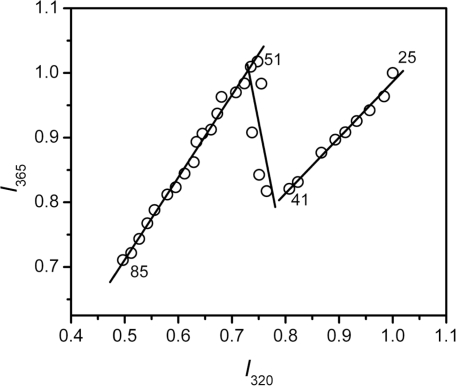
The non-cooperative or sequential events which occur during protein thermal denaturation are closely correlated with protein folding, stability, and physiological functions. In this research, the sequential events of human brain-type creatine kinase (hBBCK) thermal denaturation were studied by differential scanning calorimetry (DSC), CD, and intrinsic fluorescence spectroscopy. DSC experiments revealed that the thermal denaturation of hBBCK was calorimetrically irreversible. The existence of several endothermic peaks suggested that the denaturation involved stepwise conformational changes, which were further verified by the discrepancy in the transition curves obtained from various spectroscopic probes. During heating, the disruption of the active site structure occurred prior to the secondary and tertiary structural changes. The thermal unfolding and aggregation of hBBCK was found to occur through sequential events. This is quite different from that of muscle-type CK (MMCK). The results herein suggest that BBCK and MMCK undergo quite dissimilar thermal unfolding pathways, although they are highly conserved in the primary and tertiary structures. A minor difference in structure might endow the isoenzymes dissimilar local stabilities in structure, which further contribute to isoenzyme-specific thermal stabilities.
蛋白质热变性过程中发生的非协同或连续事件与蛋白质折叠、稳定性及生理功能密切相关。本研究采用差示扫描量热法(DSC)、圆二色光谱(CD)和内源荧光光谱,研究了人脑型肌酸激酶(hBBCK)热变性的连续事件。DSC实验表明,hBBCK的热变性在量热学上是不可逆的。多个吸热峰的存在表明变性涉及逐步的构象变化,这通过各种光谱探针获得的转变曲线差异得到进一步验证。加热过程中,活性位点结构的破坏先于二级和三级结构的变化。发现hBBCK的热解折叠和聚集是通过连续事件发生的。这与肌肉型肌酸激酶(MMCK)的情况有很大不同。本文结果表明,尽管BBCK和MMCK在一级和三级结构上高度保守,但它们经历的热解折叠途径截然不同。结构上的微小差异可能赋予同工酶不同的局部结构稳定性,这进一步导致了同工酶特异性的热稳定性。