State Key Laboratory of Biomembrane and Membrane Biotechnology, School of Life Sciences, Tsinghua University, Beijing, China.
PLoS One. 2011;6(9):e24681. doi: 10.1371/journal.pone.0024681. Epub 2011 Sep 9.
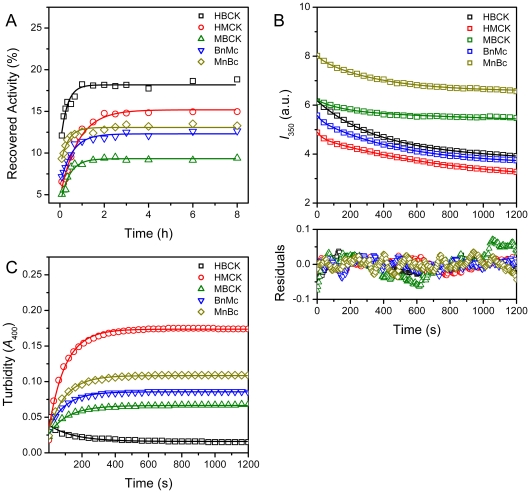
Creatine kinase (CK, EC 2.7.3.2) plays a key role in the energy homeostasis of excitable cells. The cytosolic human CK isoenzymes exist as homodimers (HMCK and HBCK) or a heterodimer (MBCK) formed by the muscle CK subunit (M) and/or brain CK subunit (B) with highly conserved three-dimensional structures composed of a small N-terminal domain (NTD) and a large C-terminal domain (CTD). The isoforms of CK provide a novel system to investigate the sequence/structural determinants of multimeric/multidomain protein folding. In this research, the role of NTD and CTD as well as the domain interactions in CK folding was investigated by comparing the equilibrium and kinetic folding parameters of HMCK, HBCK, MBCK and two domain-swapped chimeric forms (BnMc and MnBc). Spectroscopic results indicated that the five proteins had distinct structural features depending on the domain organizations. MBCK BnMc had the smallest CD signals and the lowest stability against guanidine chloride-induced denaturation. During the biphasic kinetic refolding, three proteins (HMCK, BnMc and MnBc), which contained either the NTD or CTD of the M subunit and similar microenvironments of the Trp fluorophores, refolded about 10-fold faster than HBCK for both the fast and slow phase. The fast folding of these three proteins led to an accumulation of the aggregation-prone intermediate and slowed down the reactivation rate thereby during the kinetic refolding. Our results suggested that the intra- and inter-subunit domain interactions modified the behavior of kinetic refolding. The alternation of domain interactions based on isoenzymes also provides a valuable strategy to improve the properties of multidomain enzymes in biotechnology.
肌酸激酶(CK,EC 2.7.3.2)在兴奋细胞的能量稳态中发挥关键作用。细胞质人 CK 同工酶以同源二聚体(HMCK 和 HBCK)或异源二聚体(MBCK)的形式存在,由肌肉 CK 亚基(M)和/或脑 CK 亚基(B)形成,具有高度保守的三维结构,由小 N 端结构域(NTD)和大 C 端结构域(CTD)组成。CK 的同工酶为研究多聚体/多结构域蛋白折叠的序列/结构决定因素提供了一个新系统。在这项研究中,通过比较 HMCK、HBCK、MBCK 和两种结构域交换嵌合形式(BnMc 和 MnBc)的平衡和动力学折叠参数,研究了 NTD 和 CTD 以及 CK 折叠中的结构域相互作用。光谱结果表明,五种蛋白质具有不同的结构特征,取决于结构域的组织。MBCK BnMc 的 CD 信号最小,对盐酸胍诱导的变性的稳定性最低。在两相动力学复性过程中,三种含有 M 亚基的 NTD 或 CTD 且色氨酸荧光团的微环境相似的蛋白质(HMCK、BnMc 和 MnBc)的复性速度比 HBCK 快约 10 倍,无论是快速相还是慢速相。这三种蛋白质的快速折叠导致了易于聚集的中间产物的积累,并减慢了再激活速率,从而在动力学复性过程中减慢了再激活速率。我们的结果表明,结构域内和结构域间的相互作用改变了动力学复性的行为。基于同工酶的结构域相互作用的改变也为生物技术中改善多结构域酶的性质提供了一种有价值的策略。