Division of Health Economics, Centre for Evaluation Research & Surveys, National Institute of Public Health, Mexico.
BMC Public Health. 2010 Aug 18;10:497. doi: 10.1186/1471-2458-10-497.
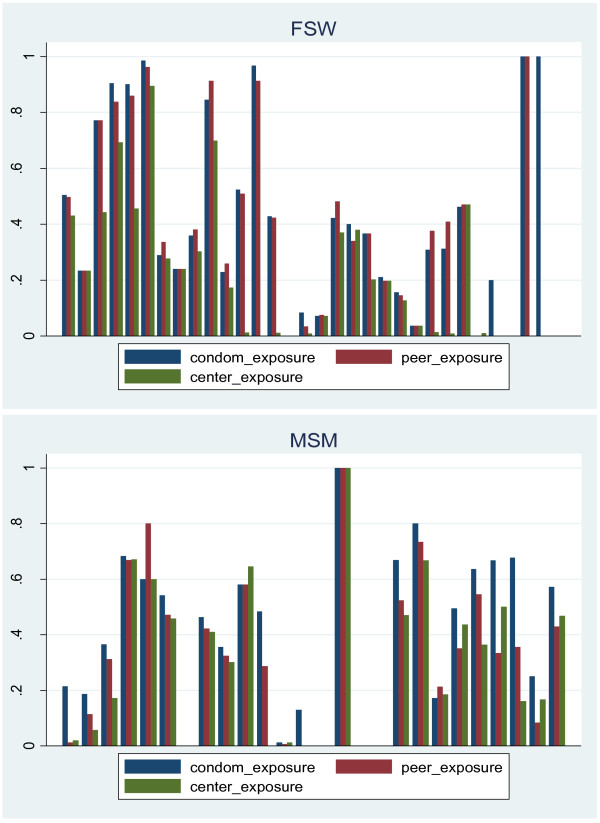
India has an estimated 2.0 million to 3.1 million people living with HIV; it has the highest number of HIV-positive people in Asia and ranks third in the world. The Frontiers Prevention Project (FPP) was implemented in 2002 to conduct targeted prevention intervention geared towards female sex workers (FSW) and men who have sex with men (MSM) in the state of Andhra Pradesh (AP). This paper reports the overall changes in behaviour and STI outcomes between 2003/4 and 2007 and also describes the changes attributed to the FPP.
The evaluation used two cross-sectional surveys among MSM and FSW at 24 sites in AP. Surveys were implemented using a similar methodology. Univariate analyses were conducted by comparing means: baseline vs. four-year follow-up and FPP vs. non-FPP. For both MSM and FSW, random and fixed-effects logit regression models at the site level were estimated for condom use with last partner, syphilis sero-positivity and HSV 2 sero-positivity. In addition, for FSW we estimated models for condom use with regular partner, and for MSM we estimated models for condom use with last female partner.
Among MSM, fixed-effects analysis revealed that FPP was positively correlated with the probability of condom use with last female sexual partner and negatively correlated with the individual probability of sero-positivity to syphilis and HSV 2. Among FSW, the FPP intervention was significantly correlated with increased condom use with regular partners and with lower probability of STI sero-positivity.
Important changes in behaviours related to an increase in prevention activities translated to reductions in STI sero-prevalence in AP, India. In contrast with non-FPP sites, the FPP sites experienced an intense community approach as part of the FPP intervention, and the general increase in condom use and its effect on STI sero-prevalence reflected the efficacy of these intense prevention activities focused on key populations in AP.
印度约有 200 万至 310 万人感染艾滋病毒;它是亚洲艾滋病毒阳性人数最多的国家,在全球排名第三。前沿预防项目(FPP)于 2002 年实施,旨在针对安得拉邦(AP)的性工作者(FSW)和男男性接触者(MSM)开展有针对性的预防干预。本文报告了 2003/4 年至 2007 年间行为和性传播感染(STI)结果的总体变化,并描述了归因于 FPP 的变化。
该评估在 AP 的 24 个地点使用两项 MSM 和 FSW 的横断面调查。调查采用类似的方法进行。通过比较均值进行单变量分析:基线与四年随访以及 FPP 与非 FPP。对于 MSM 和 FSW,在地点层面使用随机和固定效应逻辑回归模型估计与最近性伴侣使用安全套、梅毒血清阳性和单纯疱疹病毒 2 血清阳性的关系。此外,我们还为 FSW 估计了与固定性伴侣使用安全套的模型,为 MSM 估计了与最近女性性伴侣使用安全套的模型。
在 MSM 中,固定效应分析显示 FPP 与与最近女性性伴侣使用安全套的概率呈正相关,与梅毒和单纯疱疹病毒 2 的个体血清阳性概率呈负相关。在 FSW 中,FPP 干预与定期伴侣使用安全套的增加显著相关,与性传播感染血清阳性率的降低相关。
与非 FPP 地点相比,AP 中与预防活动增加相关的行为的重要变化导致性传播感染血清流行率降低。FPP 地点经历了作为 FPP 干预一部分的密集社区方法,普遍增加使用安全套及其对 STI 血清流行率的影响反映了这些针对 AP 重点人群的密集预防活动的效果。