Subramanian Thilakavathi, Ramakrishnan Lakshmi, Aridoss Santhakumar, Goswami Prabuddhagopal, Kanguswami Boopathi, Shajan Mathew, Adhikary Rajat, Purushothaman Girish Kumar Chethrapilly, Ramamoorthy Senthil Kumar, Chinnaswamy Eswaramurthy, Veeramani Ilaya Bharathy, Paranjape Ramesh Shivram
National Institute of Epidemiology, ICMR, Chennai, India.
BMC Public Health. 2013 Sep 17;13:857. doi: 10.1186/1471-2458-13-857.
This paper presents an evaluation of Avahan, a large scale HIV prevention program that was implemented using peer-mediated strategies, condom distribution and sexually transmitted infection (STI) clinical services among high-risk men who have sex with men (HR-MSM) and male to female transgender persons (TGs) in six high-prevalence state of Tamil Nadu, in southern India.
Two rounds of large scale cross-sectional bio-behavioural surveys among HR-MSM and TGs and routine program monitoring data were used to assess changes in program coverage, condom use and prevalence of STIs (including HIV) and their association to program exposure.
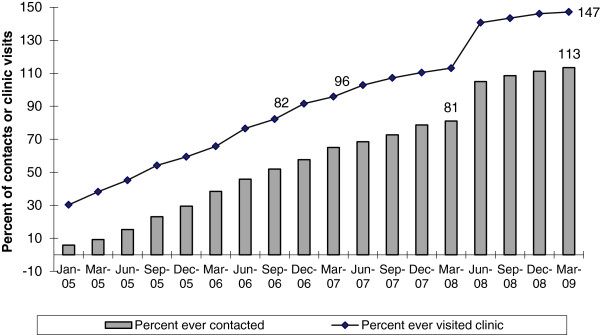
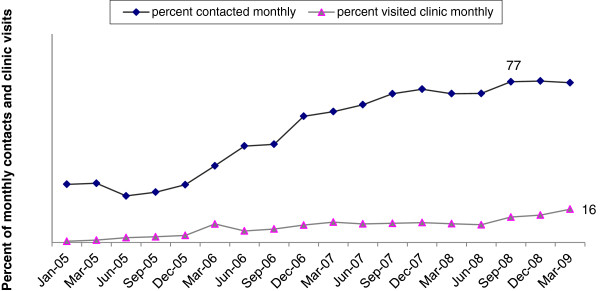
The Avahan program for HR-MSM and TGs in Tamil Nadu was significantly scaled up and contacts by peer educators reached 77 percent of the estimated denominator by the end of the program's fourth year. Exposure to the program increased between the two rounds of surveys for both HR-MSM (from 66 percent to 90 percent; AOR = 4.6; p < 0.001) and TGs (from 74.5 percent to 83 percent; AOR = 1.82; p < 0.06). There was an increase in consistent condom use by HR-MSM with their regular male partners (from 33 percent to 46 percent; AOR = 1.9; p < 0.01). Last time condom use with paying male partners (up from 81 percent to 94 percent; AOR = 3.6; p < 0.001) also showed an increase. Among TGs, the increase in condom use with casual male partners (18 percent to 52 percent; AOR = 1.8; p < 0.27) was not significant, and last time condom use declined significantly with paying male partners (93 percent to 80 percent; AOR = 0.32; p < 0.015). Syphilis declined significantly among both HR-MSM (14.3 percent to 6.8 percent; AOR = 0.37; p < 0.001) and TGs (16.6 percent to 4.2 percent; AOR = 0.34; p < 0.012), while change in HIV prevalence was not found to be significant for HR-MSM (9.7 percent to 10.9 percent) and TGs (12 percent to 9.8 percent). For both groups, change in condom use with commercial and non-commercial partners was found to be strongly linked with exposure to the Avahan program.
The Avahan program for HR-MSM and TGs in Tamil Nadu achieved a high coverage, resulting in improved condom use by HR-MSM with their regular and commercial male partners. Declining STI prevalence and stable HIV prevalence reflect the positive effects of the prevention strategy. Outcomes from the program logic model indiacte the effectiveness of the program for HR-MSM and TGs in Tamil Nadu.
本文介绍了对阿瓦汉项目的评估,该项目是一项大规模的艾滋病预防项目,在印度南部泰米尔纳德邦的六个高流行率地区,针对与男性发生性关系的高危男性(HR-MSM)和男变女跨性别者(TGs),采用同伴介导策略、避孕套发放和性传播感染(STI)临床服务来实施。
对HR-MSM和TGs进行两轮大规模横断面生物行为调查,并利用项目常规监测数据,以评估项目覆盖范围、避孕套使用情况以及性传播感染(包括艾滋病)的流行率变化,及其与项目接触的关联。
泰米尔纳德邦针对HR-MSM和TGs的阿瓦汉项目规模显著扩大,到项目第四年年底,同伴教育者的接触人数达到了估计分母的77%。在两轮调查之间,HR-MSM(从66%增至90%;调整后比值比[AOR]=4.6;p<0.001)和TGs(从74.5%增至83%;AOR=1.82;p<0.06)的项目接触率均有所上升。HR-MSM与固定男性伴侣始终坚持使用避孕套的比例有所增加(从33%增至46%;AOR=1.9;p<0.01)。与付费男性伴侣最近一次使用避孕套的比例(从81%增至94%;AOR=3.6;p<0.001)也有所上升。在TGs中,与临时男性伴侣使用避孕套的比例增加(从18%增至52%;AOR=1.8;p<0.27)并不显著,而与付费男性伴侣最近一次使用避孕套的比例则显著下降(从93%降至80%;AOR=0.32;p<0.015)。HR-MSM(从14.3%降至6.8%;AOR=0.37;p<0.001)和TGs(从16.6%降至4.2%;AOR=0.34;p<0.012)中的梅毒感染率均显著下降,但未发现HR-MSM(从9.7%增至10.9%)和TGs(从12%降至9.8%)的艾滋病流行率有显著变化。对于两组人群,与商业和非商业伴侣使用避孕套情况的变化均与参与阿瓦汉项目密切相关。
泰米尔纳德邦针对HR-MSM和TGs的阿瓦汉项目实现了高覆盖率,使得HR-MSM与固定及商业男性伴侣使用避孕套的情况有所改善。性传播感染率下降和艾滋病流行率稳定反映了预防策略的积极效果。项目逻辑模型的结果表明该项目对泰米尔纳德邦的HR-MSM和TGs有效。