• 文献检索
  • 文档翻译
  • 深度研究
  • 学术资讯
  • Suppr Zotero 插件Zotero 插件
  • 邀请有礼
  • 套餐&价格
  • 历史记录
应用&插件
Suppr Zotero 插件Zotero 插件浏览器插件Mac 客户端Windows 客户端微信小程序
定价
高级版会员购买积分包购买API积分包
服务
文献检索文档翻译深度研究API 文档MCP 服务
关于我们
关于 Suppr公司介绍联系我们用户协议隐私条款
关注我们

Suppr 超能文献

核心技术专利:CN118964589B侵权必究
粤ICP备2023148730 号-1Suppr @ 2026

文献检索

告别复杂PubMed语法,用中文像聊天一样搜索,搜遍4000万医学文献。AI智能推荐,让科研检索更轻松。

立即免费搜索

文件翻译

保留排版,准确专业,支持PDF/Word/PPT等文件格式,支持 12+语言互译。

免费翻译文档

深度研究

AI帮你快速写综述,25分钟生成高质量综述,智能提取关键信息,辅助科研写作。

立即免费体验

在大型患者队列中基于互联网收集健康相关生活质量数据的可行性。

Feasibility of internet-based health-related quality of life data collection in a large patient cohort.

作者信息

Bhinder Sacha, Chowdhury Noori, Granton John, Krahn Murray, Tullis D Elizabeth, Waddell Thomas K, Singer Lianne G

机构信息

Faculty of Medicine, University of Toronto, Toronto, Canada.

出版信息

J Med Internet Res. 2010 Aug 19;12(3):e35. doi: 10.2196/jmir.1214.

DOI:10.2196/jmir.1214
PMID:20719740
原文链接:https://pmc.ncbi.nlm.nih.gov/articles/PMC2956333/
Abstract

BACKGROUND

Patient registries are commonly used to track survival and medical outcomes in large cohorts. However, large-scale collection of health-related quality of life (HRQOL) data is more challenging because such data must be collected directly from patients. Internet-based HRQOL questionnaires are a potential solution, allowing home data collection with immediate storage in a central database.

OBJECTIVES

Our objectives were to investigate the sociodemographic predictors of Internet use and willingness to convey HRQOL information over the Internet in a Canadian tertiary care patient population and to determine whether Internet use patterns of tertiary care patients differ from those of the general Canadian population. Additionally, we sought to identify the success of home completion of Internet-based HRQOL questionnaires, as well as factors hindering home completion.

METHODS

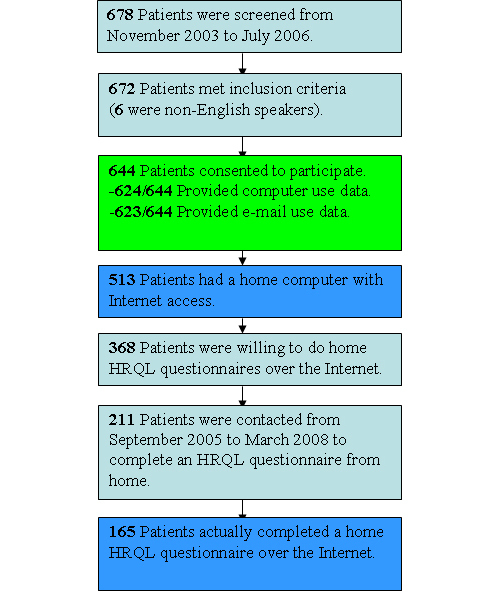
We surveyed 644 patients at the Toronto General and St. Michael's Hospitals from November 2003 through July 2006 within a prospective, longitudinal cohort study of HRQOL in patients with lung disease or lung transplants. Using multiple logistic regression, we assessed patient age, gender, rurality, marital status, and employment or education status as potential sociodemographic predictors of having an Internet-accessible home computer, using email at least weekly, and willingness to complete a quality of life questionnaire over the Internet. Patients electing to complete questionnaires over the Internet were followed from September 2005 through March 2008 to assess completion of HRQOL questionnaires from home, identify barriers for noncompletion, and determine sociodemographic predictors for home completion.

RESULTS

Of the 644 patients, the median age was 51 years, with a similar number of males and females. Most were urban Ontario residents, were unemployed, and were married or in a common-law relationship. Having an Internet-accessible home computer was reported by 79.7% (513/644) of patients and use of email at least weekly by 66.5% (414/623) of patients. A majority of patients (57.1% 368/644) were willing to complete HRQOL questionnaires over the Internet via an emailed link. Of the participating 644 patients, 368 elected to complete future questionnaires from home and, as part of a gradual roll-out of the home HRQOL questionnaire, 211 were sent emails inviting them to do so. Of the invited patients, 78% (165/211) completed at least one questionnaire from home. The most common reason for noncompletion was a lack of or an inability to find time to complete the questionnaire. No statistically significant sociodemographic predictors of Internet use were associated with completion or noncompletion of questionnaires from home.

CONCLUSIONS

Home, Internet-based HRQOL assessment is feasible in tertiary care patient populations with a high predicted rate of Internet usage based on sociodemographic parameters. A large minority of patients were unwilling or unable to take part in home HRQOL assessments indicating that alternative methods of data collection are still required. However, the majority of patients electing to complete home HRQOL assessments went on to do so over the Internet.
https://cdn.ncbi.nlm.nih.gov/pmc/blobs/c653/2956333/639d01a0d99f/jmir_v12i3e35_fig1.jpg
摘要

背景

患者登记系统常用于追踪大型队列中的生存率和医疗结局。然而,大规模收集与健康相关的生活质量(HRQOL)数据更具挑战性,因为此类数据必须直接从患者处收集。基于互联网的HRQOL问卷是一种潜在的解决方案,它允许在家中收集数据并立即存储在中央数据库中。

目的

我们的目的是调查加拿大三级护理患者群体中互联网使用情况以及通过互联网传达HRQOL信息意愿的社会人口学预测因素,并确定三级护理患者的互联网使用模式是否与加拿大普通人群不同。此外,我们试图确定基于互联网的HRQOL问卷在家中完成的成功率以及阻碍在家中完成问卷的因素。

方法

在2003年11月至2006年7月期间,我们在多伦多综合医院和圣迈克尔医院对644名患者进行了调查,这是一项关于肺病或肺移植患者HRQOL的前瞻性纵向队列研究。我们使用多元逻辑回归评估患者的年龄、性别、居住在农村还是城市、婚姻状况以及就业或教育状况,将其作为拥有可联网家用电脑、至少每周使用电子邮件以及愿意通过互联网完成生活质量问卷的潜在社会人口学预测因素。从2005年9月至2008年3月,对选择通过互联网完成问卷的患者进行跟踪,以评估在家中完成HRQOL问卷的情况,确定未完成问卷的障碍,并确定在家中完成问卷的社会人口学预测因素。

结果

644名患者的年龄中位数为51岁,男性和女性数量相近。大多数患者是安大略省城市居民,失业,已婚或处于同居关系。79.7%(513/644)的患者报告家中有可联网的家用电脑,66.5%(414/623)的患者至少每周使用电子邮件。大多数患者(57.1%,368/644)愿意通过电子邮件链接在互联网上完成HRQOL问卷。在参与调查的644名患者中,368人选择在家中完成未来的问卷,作为家庭HRQOL问卷逐步推广的一部分,向211人发送了电子邮件邀请他们这样做。在受邀患者中,78%(165/211)至少在家中完成了一份问卷。未完成问卷最常见的原因是没有时间或无法找到时间完成问卷。在家中完成或未完成问卷与互联网使用的社会人口学预测因素之间没有统计学上的显著关联。

结论

基于社会人口学参数预测互联网使用率较高的三级护理患者群体中,在家中通过互联网进行HRQOL评估是可行的。少数患者不愿意或无法参与家庭HRQOL评估,这表明仍需要其他数据收集方法。然而,大多数选择完成家庭HRQOL评估的患者随后通过互联网完成了评估。

相似文献

1
Feasibility of internet-based health-related quality of life data collection in a large patient cohort.在大型患者队列中基于互联网收集健康相关生活质量数据的可行性。
J Med Internet Res. 2010 Aug 19;12(3):e35. doi: 10.2196/jmir.1214.
2
Logistic feasibility of health related quality of life measurement in clinical practice: results of a prospective study in a large population of chronic liver patients.临床实践中健康相关生活质量测量的逻辑可行性:一项针对大量慢性肝病患者的前瞻性研究结果
Health Qual Life Outcomes. 2008 Nov 10;6:97. doi: 10.1186/1477-7525-6-97.
3
Feasibility and acceptance of electronic quality of life assessment in general practice: an implementation study.电子生活质量评估在全科医疗中的可行性与可接受性:一项实施研究。
Health Qual Life Outcomes. 2009 Jun 3;7:51. doi: 10.1186/1477-7525-7-51.
4
Health-related quality of life and its determinants among ambulatory patients with epilepsy at Ambo General Hospital, Ethiopia: Using WHOQOL-BREF.在埃塞俄比亚安博综合医院,使用 WHOQOL-BREF 评估门诊癫痫患者的健康相关生活质量及其决定因素。
PLoS One. 2020 Jan 21;15(1):e0227858. doi: 10.1371/journal.pone.0227858. eCollection 2020.
5
Associations between demographic, disease related, and treatment pathway related variables and health related quality of life in primary care patients with coronary heart disease.冠心病初级保健患者的人口统计学、疾病相关和治疗途径相关变量与健康相关生活质量之间的关联。
Health Qual Life Outcomes. 2012 Jul 9;10:78. doi: 10.1186/1477-7525-10-78.
6
Capturing patient reported outcomes and quality of life in routine clinical practice: ready for prime time?在常规临床实践中获取患者报告的结局和生活质量:准备好迎接黄金时代了吗?
Minerva Gastroenterol Dietol. 2012 Mar;58(1):19-24.
7
How Feasible is Multiple Time Point Web-Based Data Collection with Individuals Experiencing Street Homelessness?对于经历街头无家可归的个体而言,基于网络的多时间点数据收集的可行性如何?
J Urban Health. 2017 Feb;94(1):64-74. doi: 10.1007/s11524-016-0109-y.
8
Feasibility of health-related quality of life (HRQoL) assessment for cancer patients using electronic patient-reported outcome (ePRO) in daily clinical practice.使用电子患者报告结局(ePRO)在日常临床实践中评估癌症患者健康相关生活质量(HRQoL)的可行性。
Qual Life Res. 2021 Nov;30(11):3255-3266. doi: 10.1007/s11136-020-02721-0. Epub 2021 Jan 2.
9
Adherence to Web-Based Self-Assessments in Long-Term Direct-to-Patient Research: Two-Year Study of Multiple Sclerosis Patients.长期直接面向患者的研究中对基于网络的自我评估的依从性:对多发性硬化症患者的两年研究
J Med Internet Res. 2017 Jul 21;19(7):e249. doi: 10.2196/jmir.6729.
10
Pain, health-related quality of life and health care utilization after inpatient surgery: a pilot study.住院手术后的疼痛、健康相关生活质量及医疗保健利用情况:一项试点研究。
Pain Res Manag. 2006 Spring;11(1):41-7. doi: 10.1155/2006/320461.

引用本文的文献

1
Response rate and costs for automated patient-reported outcomes collection alone compared to combined automated and manual collection.仅自动收集患者报告结局与自动和手动联合收集的反应率及成本比较。
J Patient Rep Outcomes. 2019 Jun 3;3(1):31. doi: 10.1186/s41687-019-0121-6.
2
Opioid-induced constipation in patients with chronic noncancer pain in the USA, Canada, Germany, and the UK: descriptive analysis of baseline patient-reported outcomes and retrospective chart review.美国、加拿大、德国和英国慢性非癌性疼痛患者的阿片类药物所致便秘:患者报告的基线结局描述性分析及回顾性病历审查
Clinicoecon Outcomes Res. 2014 May 23;6:269-81. doi: 10.2147/CEOR.S61602. eCollection 2014.
3

本文引用的文献

1
Lung transplantation outcomes: the importance and inadequacies of assessing survival.肺移植结果:评估生存率的重要性与不足之处
Am J Transplant. 2009 Jul;9(7):1493-4. doi: 10.1111/j.1600-6143.2009.02698.x.
2
Feasibility and acceptance of electronic quality of life assessment in general practice: an implementation study.电子生活质量评估在全科医疗中的可行性与可接受性:一项实施研究。
Health Qual Life Outcomes. 2009 Jun 3;7:51. doi: 10.1186/1477-7525-7-51.
3
Rationale for the study methods and design of the epidemiology of lower urinary tract symptoms (EpiLUTS) study.
Validation of the SF-6D Health State Utilities Measure in Lower Extremity Sarcoma.
SF-6D健康状态效用测量法在下肢肉瘤中的验证
Sarcoma. 2014;2014:450902. doi: 10.1155/2014/450902. Epub 2014 Mar 19.
4
Severity of chronic Lyme disease compared to other chronic conditions: a quality of life survey.慢性莱姆病的严重程度与其他慢性疾病相比:一项生活质量调查。
PeerJ. 2014 Mar 27;2:e322. doi: 10.7717/peerj.322. eCollection 2014.
5
Integrating patient reported outcomes with clinical cancer registry data: a feasibility study of the electronic Patient-Reported Outcomes From Cancer Survivors (ePOCS) system.将患者报告结局与临床癌症登记数据相结合:癌症幸存者电子患者报告结局(ePOCS)系统的可行性研究。
J Med Internet Res. 2013 Oct 25;15(10):e230. doi: 10.2196/jmir.2764.
6
Quality of life in lung transplantation.肺移植中的生活质量。
Semin Respir Crit Care Med. 2013 Jun;34(3):421-30. doi: 10.1055/s-0033-1348470. Epub 2013 Jul 2.
7
Adherence to monthly online self-assessments for short-term monitoring: a 1-year study in relapsing-remitting multiple sclerosis patients after start of disease modifying treatment.坚持每月进行在线自我评估以进行短期监测:对疾病修饰治疗开始后复发缓解型多发性硬化症患者的一项为期1年的研究。
Patient Prefer Adherence. 2013 Apr 9;7:293-300. doi: 10.2147/PPA.S40173. Print 2013.
8
Can online consumers contribute to drug knowledge? A mixed-methods comparison of consumer-generated and professionally controlled psychotropic medication information on the internet.在线消费者能为药物知识做出贡献吗?互联网上消费者生成的与专业控制的精神药物信息的混合方法比较。
J Med Internet Res. 2011 Jul 29;13(3):e53. doi: 10.2196/jmir.1716.
下尿路症状流行病学(EpiLUTS)研究的研究方法及设计原理。
BJU Int. 2009 Aug;104(3):348-51. doi: 10.1111/j.1464-410X.2009.08425.x. Epub 2009 Mar 9.
4
Logistic feasibility of health related quality of life measurement in clinical practice: results of a prospective study in a large population of chronic liver patients.临床实践中健康相关生活质量测量的逻辑可行性:一项针对大量慢性肝病患者的前瞻性研究结果
Health Qual Life Outcomes. 2008 Nov 10;6:97. doi: 10.1186/1477-7525-6-97.
5
Prepared patients: internet information seeking by new rheumatology patients.有备而来的患者:新诊断的风湿病患者对互联网信息的搜寻
Arthritis Rheum. 2008 Apr 15;59(4):575-82. doi: 10.1002/art.23533.
6
Health information seeking on the Internet: a double divide? Results from a representative survey in the Paris metropolitan area, France, 2005-2006.互联网上的健康信息搜索:双重差距?2005 - 2006年法国巴黎大都市区代表性调查结果
BMC Public Health. 2008 Feb 21;8:69. doi: 10.1186/1471-2458-8-69.
7
Users and non-users of web-based health advice service among Finnish university students - chronic conditions and self-reported health status (a cross-sectional study).芬兰大学生中基于网络的健康咨询服务的使用者与非使用者——慢性病与自我报告的健康状况(一项横断面研究)
BMC Med Inform Decis Mak. 2008 Jan 31;8:8. doi: 10.1186/1472-6947-8-8.
8
Relations between Internet use, socio-economic status (SES), social support and subjective health.互联网使用、社会经济地位(SES)、社会支持与主观健康之间的关系。
Health Promot Int. 2008 Mar;23(1):70-7. doi: 10.1093/heapro/dam039. Epub 2007 Dec 13.
9
Assessment of quality of life among patients with sinonasal disease as determined by an Internet survey based on the Rhinosinusitis Disability Index.
Ear Nose Throat J. 2007 Aug;86(8):482, 484-6.
10
Long-term health-related quality of life after lung transplantation: different predictors for different dimensions.肺移植术后与健康相关的长期生活质量:不同维度的不同预测因素。
J Heart Lung Transplant. 2007 Feb;26(2):188-93. doi: 10.1016/j.healun.2006.11.006.