Jongen Peter Joseph, Sanders Evert, Zwanikken Cees, Koeman Jan, Visser Leo H, Koopmans Petra, Lehnick Dirk
MS4 Research Institute, Nijmegen.
Patient Prefer Adherence. 2013 Apr 9;7:293-300. doi: 10.2147/PPA.S40173. Print 2013.
The participation of neurologists and patients in studies on the effectiveness and safety of newly authorized drugs in multiple sclerosis (MS) is insufficient. Monthly online self-assessments using patient-reported outcomes may help in short-term monitoring of neurological changes and side effects.
Investigate in relapsing-remitting (RR) MS patients the adherence to monthly online self-assessments after the start of disease modifying treatment.
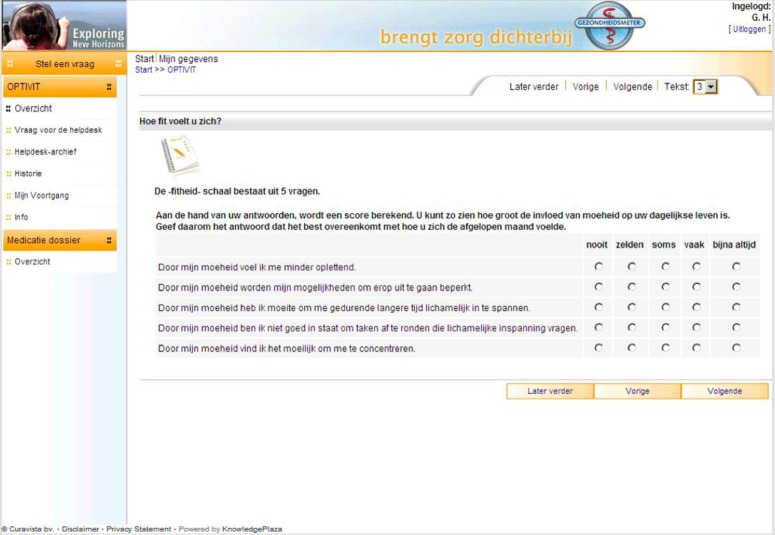
Observational study in 39 neurological departments in The Netherlands. Patients starting glatiramer acetate treatment were instructed to complete online the Modified Fatigue Impact Scale 5-item version and the 8-item Leeds Multiple Sclerosis Quality of Life scale every month during 1 year (T0 toT12).
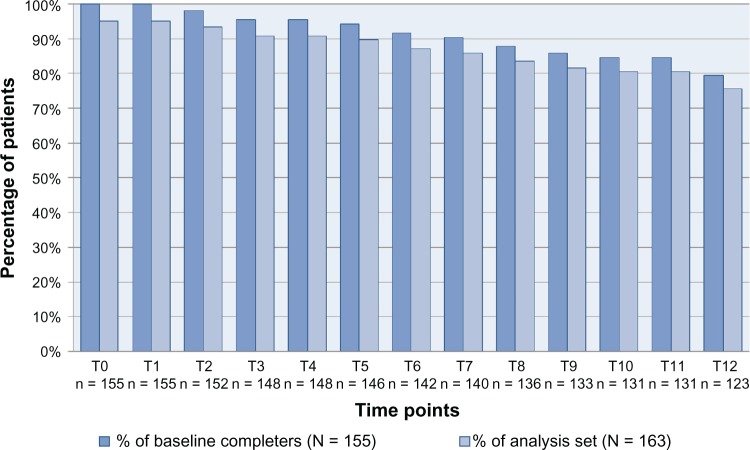
Sixty-three investigators included 163 analyzable patients. At T3, 148 (90.8%) patients had completed all questionnaires; at T6, 142 (87.1%); at T9, 133 (81.6%); and at T12, 123 (75.5%). Eight (4.9%) patients did not complete any questionnaire. Median values for inter-assessment intervals ranged from 32 to 34 days (first quartile [Q1] 30 days, third quartile [Q3] 41 days), and the final assessment was at 417 days (median: Q1 385 days, Q3 480 days). Forty-three (26.3%) patients completed the questionnaires at all time points (completion adherent) with their final assessment within 30 days after the scheduled T12 (interval adherent). Eighty (49.1%) patients were completion adherent, but not interval adherent. Forty (24.5%) patients were not completion adherent, as they discontinued assessments prematurely. Men were more interval adherent than women (47.5% vs 20.0%; P = 0.001).
The observation that three out of four (75.5%) RRMS patients completed two short questionnaires at all monthly time points during 1 year after the start of disease modifying treatment suggests that intensive online monitoring in this patient group is feasible. As only one in five (19.6%) patients adhered to the time intervals between self-assessments, measures are needed that improve the timely completion of questionnaires.
神经科医生和患者对新批准药物治疗多发性硬化症(MS)的有效性和安全性研究的参与度不足。使用患者报告结局进行每月一次的在线自我评估可能有助于短期监测神经功能变化和副作用。
调查复发缓解型(RR)MS患者在开始疾病修饰治疗后对每月在线自我评估的依从性。
在荷兰39个神经科进行的观察性研究。开始接受醋酸格拉替雷治疗的患者被要求在1年(T0至T12)内每月在线完成5项版本的改良疲劳影响量表和8项利兹多发性硬化症生活质量量表。
63名研究者纳入了163例可分析患者。在T3时,148例(90.8%)患者完成了所有问卷;在T6时,142例(87.1%);在T9时,133例(81.6%);在T12时,123例(75.5%)。8例(4.9%)患者未完成任何问卷。评估间隔的中位数为32至34天(第一四分位数[Q1]30天,第三四分位数[Q3]41天),最终评估在417天(中位数:Q1 385天,Q3 480天)。43例(26.3%)患者在所有时间点完成了问卷(完成依从),其最终评估在预定的T12后30天内(间隔依从)。80例(49.1%)患者完成依从,但间隔不依从。40例(24.5%)患者未完成依从,因为他们过早停止了评估。男性比女性更依从评估间隔(47.5%对20.0%;P = 0.001)。
四分之三(75.5%)的RRMS患者在开始疾病修饰治疗后的1年内所有月度时间点都完成了两份简短问卷,这一观察结果表明对该患者群体进行密集的在线监测是可行的。由于只有五分之一(19.6%)的患者遵守自我评估之间的时间间隔,因此需要采取措施提高问卷的及时完成率。