Department of Physics, Harvard University, Cambridge, Massachusetts 02138, USA.
Nature. 2010 Sep 9;467(7312):190-3. doi: 10.1038/nature09379. Epub 2010 Aug 18.
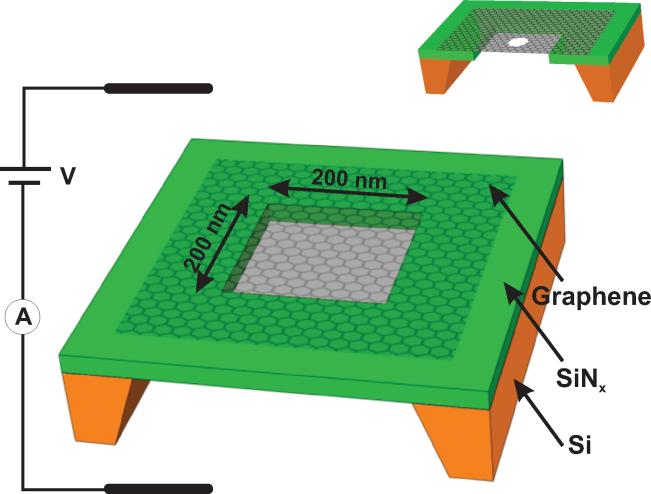
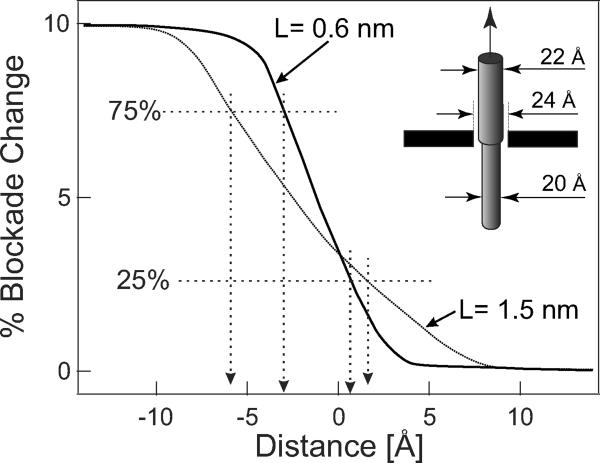
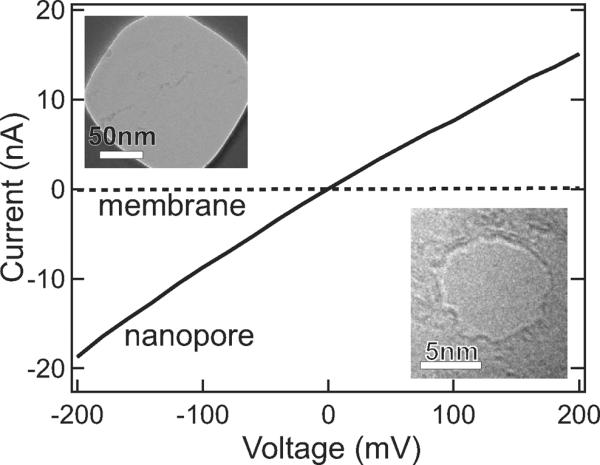
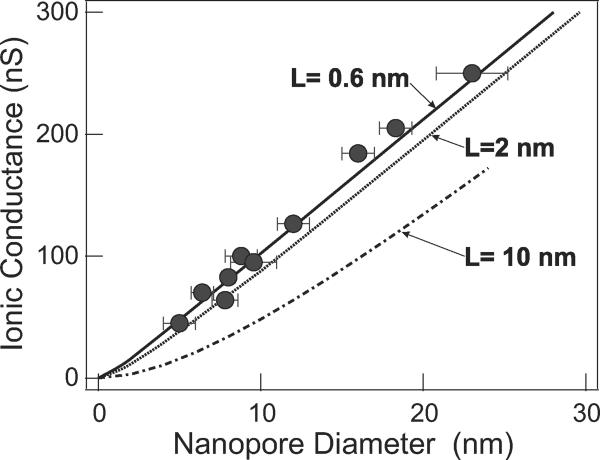
Isolated, atomically thin conducting membranes of graphite, called graphene, have recently been the subject of intense research with the hope that practical applications in fields ranging from electronics to energy science will emerge. The atomic thinness, stability and electrical sensitivity of graphene motivated us to investigate the potential use of graphene membranes and graphene nanopores to characterize single molecules of DNA in ionic solution. Here we show that when immersed in an ionic solution, a layer of graphene becomes a new electrochemical structure that we call a trans-electrode. The trans-electrode's unique properties are the consequence of the atomic-scale proximity of its two opposing liquid-solid interfaces together with graphene's well known in-plane conductivity. We show that several trans-electrode properties are revealed by ionic conductance measurements on a graphene membrane that separates two aqueous ionic solutions. Although our membranes are only one to two atomic layers thick, we find they are remarkable ionic insulators with a very small stable conductance that depends on the ion species in solution. Electrical measurements on graphene membranes in which a single nanopore has been drilled show that the membrane's effective insulating thickness is less than one nanometre. This small effective thickness makes graphene an ideal substrate for very high resolution, high throughput nanopore-based single-molecule detectors. The sensitivity of graphene's in-plane electronic conductivity to its immediate surface environment and trans-membrane solution potentials will offer new insights into atomic surface processes and sensor development opportunities.
孤立的、原子级薄的石墨导电膜,称为石墨烯,最近成为了研究的热点,人们希望它在从电子学到能源科学等领域的实际应用将会出现。石墨烯的原子级薄、稳定性和电敏感性激发了我们对石墨烯膜和石墨烯纳米孔的潜在应用的研究,以用于在离子溶液中对单个 DNA 分子进行特征分析。在这里,我们展示了当沉浸在离子溶液中时,一层石墨烯会变成我们称之为跨电极的新电化学结构。跨电极的独特性质是其两个相对的固-液界面在原子尺度上接近以及石墨烯众所周知的平面内导电性的结果。我们表明,通过在分离两个水性离子溶液的石墨烯膜上进行离子电导测量,可以揭示出几个跨电极性质。尽管我们的膜只有一到两个原子层厚,但我们发现它们是非常好的离子绝缘体,具有非常小的稳定电导,这取决于溶液中的离子种类。在其中钻有单个纳米孔的石墨烯膜上进行的电测量表明,膜的有效绝缘厚度小于一纳米。这种小的有效厚度使石墨烯成为非常高分辨率、高通量基于纳米孔的单分子探测器的理想衬底。石墨烯平面内电子电导率对其表面环境和跨膜溶液电势的敏感性将为原子表面过程和传感器开发提供新的见解。