Bernstein Center Freiburg and Faculty of Biology, Albert-Ludwig University Freiburg, Germany.
Front Comput Neurosci. 2010 Jul 2;4. doi: 10.3389/fncom.2010.00016. eCollection 2010.
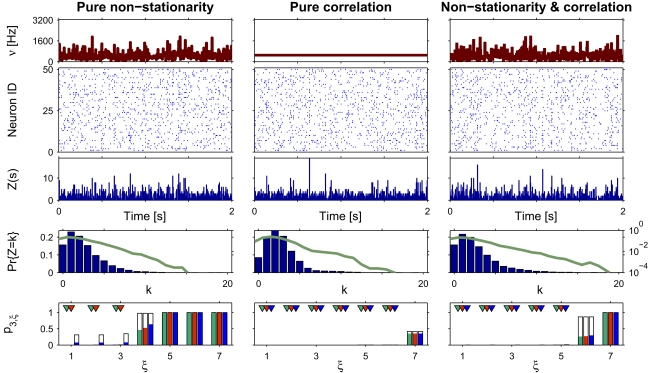
The extent to which groups of neurons exhibit higher-order correlations in their spiking activity is a controversial issue in current brain research. A major difficulty is that currently available tools for the analysis of massively parallel spike trains (N >10) for higher-order correlations typically require vast sample sizes. While multiple single-cell recordings become increasingly available, experimental approaches to investigate the role of higher-order correlations suffer from the limitations of available analysis techniques. We have recently presented a novel method for cumulant-based inference of higher-order correlations (CuBIC) that detects correlations of higher order even from relatively short data stretches of length T = 10-100 s. CuBIC employs the compound Poisson process (CPP) as a statistical model for the population spike counts, and assumes spike trains to be stationary in the analyzed data stretch. In the present study, we describe a non-stationary version of the CPP by decoupling the correlation structure from the spiking intensity of the population. This allows us to adapt CuBIC to time-varying firing rates. Numerical simulations reveal that the adaptation corrects for false positive inference of correlations in data with pure rate co-variation, while allowing for temporal variations of the firing rates has a surprisingly small effect on CuBICs sensitivity for correlations.
神经元群体在其尖峰活动中表现出高阶相关性的程度是当前脑科学研究中的一个有争议的问题。一个主要的困难是,目前用于分析大规模并行尖峰列车(N>10)的高阶相关性的工具通常需要大量的样本量。虽然越来越多的单细胞记录变得可用,但实验方法研究高阶相关性受到可用分析技术的限制。我们最近提出了一种基于累积量的高阶相关性推断的新方法(CuBIC),即使从相对较短的数据长度 T = 10-100 s 也能检测到高阶相关性。CuBIC 将复合泊松过程(CPP)用作群体尖峰计数的统计模型,并假设在分析的数据段中尖峰列车是静止的。在本研究中,我们通过将相关结构与群体的激发强度解耦来描述 CPP 的非平稳版本。这使我们能够将 CuBIC 适应时变的放电率。数值模拟表明,该适应纠正了在纯率协变数据中相关性的错误阳性推断,而允许放电率的时间变化对 CuBIC 的相关性灵敏度的影响很小。