Fukui Kenji
RIKEN SPring-8 Center, Harima Institute, 1-1-1 Kouto, Sayo-cho, Sayo-gun, Hyogo 679-5148, Japan.
J Nucleic Acids. 2010 Jul 27;2010:260512. doi: 10.4061/2010/260512.
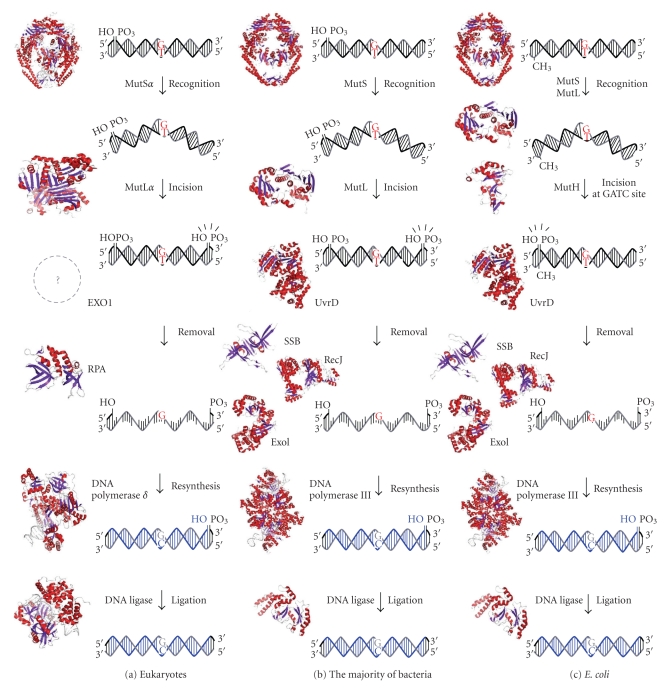
DNA mismatch repair (MMR) corrects mismatched base pairs mainly caused by DNA replication errors. The fundamental mechanisms and proteins involved in the early reactions of MMR are highly conserved in almost all organisms ranging from bacteria to human. The significance of this repair system is also indicated by the fact that defects in MMR cause human hereditary nonpolyposis colon cancers as well as sporadic tumors. To date, 2 types of MMRs are known: the human type and Escherichia coli type. The basic features of the former system are expected to be universal among the vast majority of organisms including most bacteria. Here, I review the molecular mechanisms of eukaryotic and bacterial MMR, emphasizing on the similarities between them.
DNA错配修复(MMR)主要纠正由DNA复制错误引起的错配碱基对。MMR早期反应所涉及的基本机制和蛋白质在从细菌到人类的几乎所有生物体中都高度保守。MMR缺陷会导致人类遗传性非息肉病性结肠癌以及散发性肿瘤,这一事实也表明了该修复系统的重要性。迄今为止,已知两种类型的MMR:人类型和大肠杆菌型。前一种系统的基本特征预计在包括大多数细菌在内的绝大多数生物体中是普遍存在的。在此,我回顾真核生物和细菌MMR的分子机制,重点强调它们之间的相似性。