Department of Psychology and the Center for Integrative and Cognitive Neuroscience, Vanderbilt University, Nashville, Tennessee, United States of America.
PLoS One. 2010 Aug 11;5(8):e12068. doi: 10.1371/journal.pone.0012068.
While much is known about the role of prefrontal cortex (PFC) in working memory (WM) deficits of schizophrenia, the nature of the relationship between cognitive components of WM and brain activation patterns remains unclear. We aimed to elucidate the neural correlates of the maintenance component of verbal WM by examining correct and error trials with event-related fMRI.
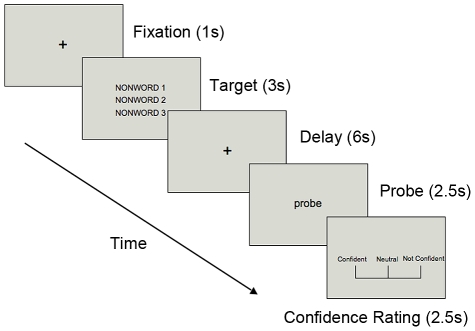
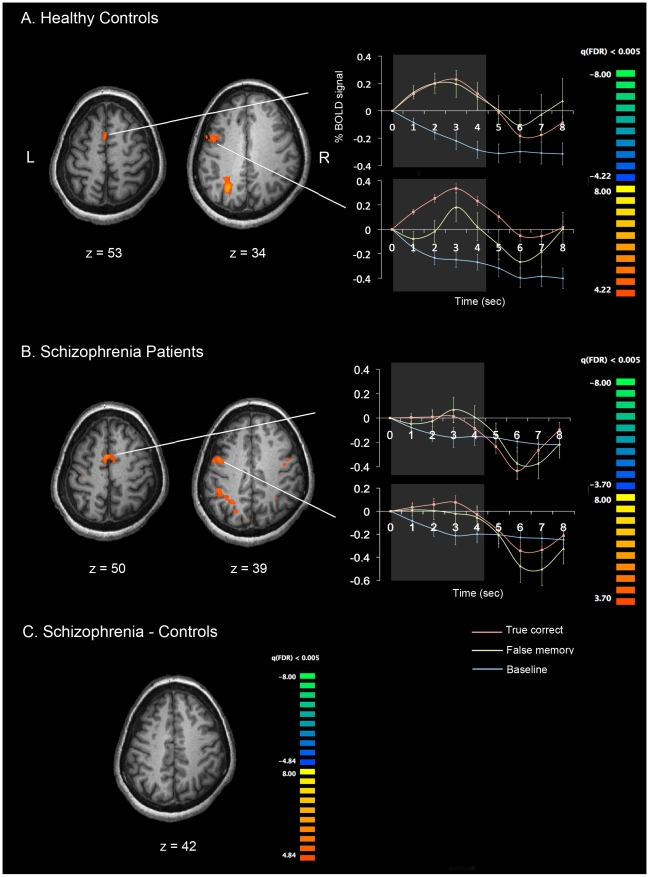
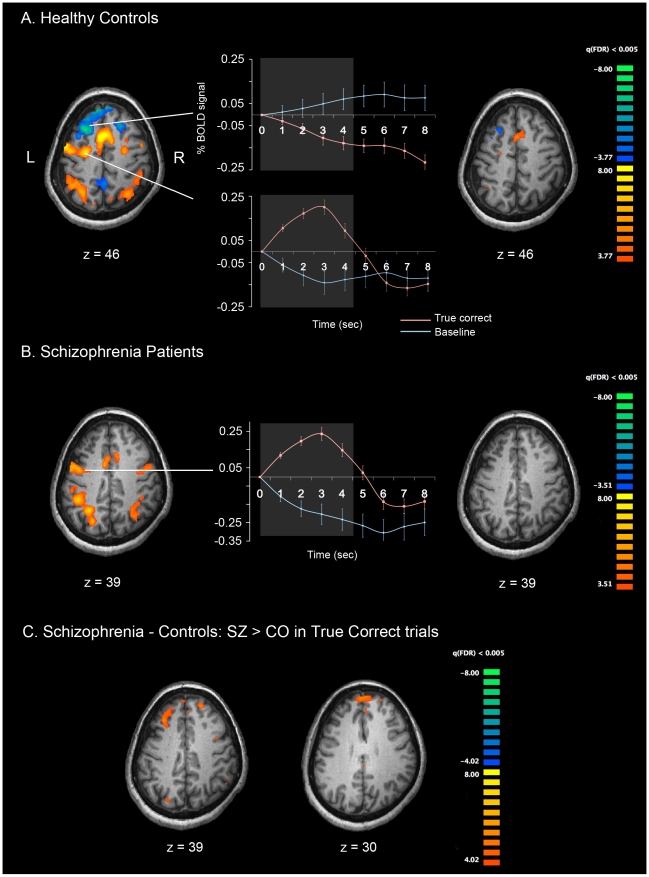
METHODOLOGY/FINDINGS: Twelve schizophrenia patients (SZ) and thirteen healthy control participants (CO) performed a phonological delayed-matching-to-sample-task in which a memory set of three nonsense words was presented, followed by a 6-seconds delay after which a probe nonsense word appeared. Participants decided whether the probe matched one of the targets, and rated the confidence of their decision. Blood-oxygen-level-dependent (BOLD) activity during WM maintenance was analyzed in relation to performance (correct/error) and confidence ratings. Frontal and parietal regions exhibited increased activation on correct trials for both groups. Correct and error trials were further segregated into true memory, false memory, guess, and true error trials. True memory trials were associated with increased bilateral activation of frontal and parietal regions in both groups but only CO showed deactivation in PFC. There was very little maintenance-related cortical activity during guess trials. False memory was associated with increased left frontal and parietal activation in both groups.
These findings suggest that a wider network of frontal and parietal regions support WM maintenance in correct trials compared with error trials in both groups. Furthermore, a more extensive and dynamic pattern of recruitment of the frontal and parietal networks for true memory was observed in healthy controls compared with schizophrenia patients. These results underscore the value of parsing the sources of memory errors in fMRI studies because of the non-linear nature of the brain-behavior relationship, and suggest that group comparisons need to be interpreted in more specific behavioral contexts.
尽管人们对前额叶皮层(PFC)在精神分裂症工作记忆(WM)缺陷中的作用了解很多,但 WM 的认知成分与大脑激活模式之间的关系性质仍不清楚。我们旨在通过事件相关 fMRI 检查言语 WM 的维持成分的正确和错误试验来阐明其神经相关性。
方法/发现:12 名精神分裂症患者(SZ)和 13 名健康对照组(CO)进行了语音延迟匹配样本任务,其中呈现了三个无意义单词的记忆集,之后在出现探针无意义单词后有 6 秒的延迟。参与者决定探针是否与一个目标匹配,并对其决策的信心进行评分。在 WM 维持期间,分析了与表现(正确/错误)和信心评分相关的血氧水平依赖性(BOLD)活动。两组的正确试验均显示额叶和顶叶区域的激活增加。进一步将正确和错误试验分为真实记忆、虚假记忆、猜测和真实错误试验。真实记忆试验与两组双侧额叶和顶叶区域的激活增加有关,但只有 CO 显示 PFC 去激活。猜测试验期间与维持相关的皮质活动很少。虚假记忆与两组左额叶和顶叶激活增加有关。
这些发现表明,与错误试验相比,正确试验中更广泛的额叶和顶叶区域网络支持 WM 维持。此外,与精神分裂症患者相比,健康对照组在真实记忆中观察到更广泛和动态的额叶和顶叶网络募集模式。这些结果强调了在 fMRI 研究中解析记忆错误来源的价值,因为大脑-行为关系的非线性性质,并表明需要在更具体的行为背景下解释组间比较。