Department of Pediatrics, Yale University School of Medicine, New Haven, Connecticut 06520, USA.
J Infect Dis. 2010 Oct 1;202(7):984-90. doi: 10.1086/656212.
We hypothesized that the high prevalence of hepatitis C virus (HCV) among injection drug users might be due to prolonged virus survival in contaminated syringes.
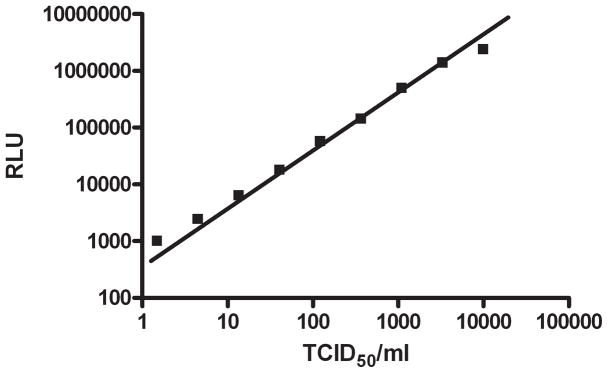
We developed a microculture assay to examine the viability of HCV. Syringes were loaded with blood spiked with HCV reporter virus (Jc1/GLuc2A) to simulate 2 scenarios of residual volumes: low void volume (2 microL) for 1-mL insulin syringes and high void volume (32 microL) for 1-mL tuberculin syringes. Syringes were stored at 4 degrees C, 22 degrees C, and 37 degrees C for up to 63 days before testing for HCV infectivity by using luciferase activity.
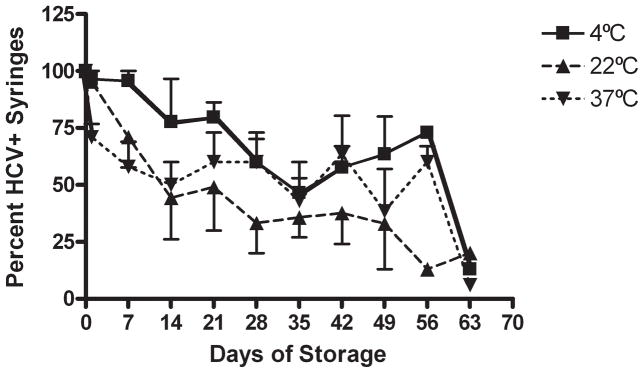
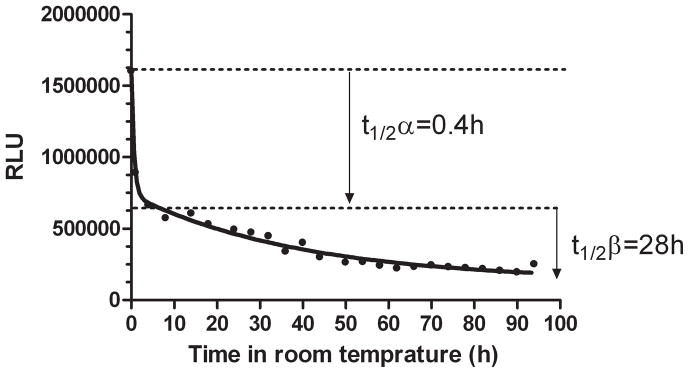
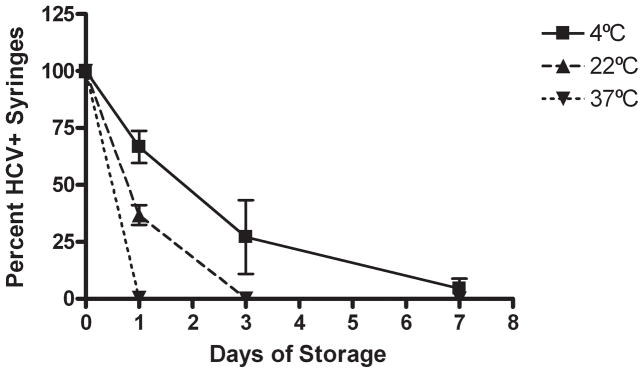
The virus decay rate was biphasic (t1/2alpha= 0.4 h and t1/2beta = 28 hh). Insulin syringes failed to yield viable HCV beyond day 1 at all storage temperatures except 4 degrees , in which 5% of syringes yielded viable virus on day 7. Tuberculin syringes yielded viable virus from 96%, 71%, and 52% of syringes after storage at 4 degrees, 22 degrees, and 37 degrees for 7 days, respectively, and yielded viable virus up to day 63.
The high prevalence of HCV among injection drug users may be partly due to the resilience of the virus and the syringe type. Our findings may be used to guide prevention strategies.
我们假设在注射吸毒者中丙型肝炎病毒(HCV)的高流行率可能是由于污染的注射器中病毒存活时间延长所致。
我们开发了一种微培养测定法来检查 HCV 的活力。将血液与 HCV 报告病毒(Jc1/GLuc2A)混合装入注射器中,模拟两种剩余体积情况:1 毫升胰岛素注射器的低空隙体积(2 微升)和 1 毫升结核菌素注射器的高空隙体积(32 微升)。将注射器在 4°C、22°C 和 37°C 下储存长达 63 天,然后通过荧光素酶活性检测 HCV 的感染性。
病毒衰减呈两相(t1/2alpha=0.4 h 和 t1/2beta=28 hh)。除 4°C 外,所有储存温度下胰岛素注射器在第 1 天之后都未能产生有活力的 HCV,而在 4°C 下,第 7 天有 5%的注射器产生有活力的病毒。结核菌素注射器在 4°C、22°C 和 37°C 下储存 7 天后,分别有 96%、71%和 52%的注射器产生有活力的病毒,并且直到第 63 天仍能产生有活力的病毒。
注射吸毒者中 HCV 的高流行率可能部分归因于病毒和注射器类型的弹性。我们的发现可用于指导预防策略。