Division of Rheumatology, Department of Internal Medicine and Rheumatic Disease Core Center, University of Michigan, Ann Arbor, Michigan 48109, USA.
Best Pract Res Clin Rheumatol. 2010 Aug;24(4):463-77. doi: 10.1016/j.berh.2009.12.015.
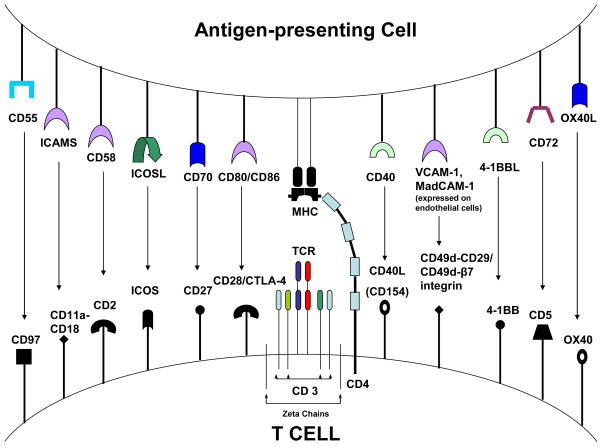
Full activation and differentiation of resting T cells into effector T cells requires at least two signals, the first through engagement of the T cell antigen receptor (TCR) by the antigen-major histocompatibility complex (MHC) on antigen-presenting cells (APCs), and the second by engagement of co-stimulatory molecules such as CD28, on T cells by ligands such as CD80/86 on APCs. Effector T cell differentiation is associated with proliferation, secretion of cytokines and expression of additional surface molecules. These inducible structures may have stimulatory (ICOS, OX40 and 4-1BB) or inhibitory (cytotoxic T-lymphocyte antigen (CTLA)-4) potential. To the extent that T cells have a role in particular immune-mediated diseases, interruption of T cell co-stimulation is a potentially worthwhile approach to the treatment of those conditions. This article summarises the experience in treating rheumatological disease by perturbation of T cell co-stimulation, and also describes structures that could be future targets for this type of therapeutic approach.
静息 T 细胞的完全活化和分化需要至少两个信号,第一个信号是通过 T 细胞抗原受体(TCR)与抗原呈递细胞(APC)上的抗原-主要组织相容性复合体(MHC)结合,第二个信号是通过共刺激分子(如 CD28)与 APC 上的配体(如 CD80/86)结合。效应 T 细胞分化与增殖、细胞因子分泌和表面分子表达有关。这些诱导性结构可能具有刺激作用(ICOS、OX40 和 4-1BB)或抑制作用(细胞毒性 T 淋巴细胞抗原 4(CTLA-4))。在 T 细胞在特定免疫介导疾病中起作用的程度上,阻断 T 细胞共刺激是治疗这些疾病的一种有价值的方法。本文总结了通过干扰 T 细胞共刺激治疗风湿性疾病的经验,并描述了可能成为这种治疗方法的未来靶点的结构。