Dipartimento di Patologia e Clinica Veterinaria, Università degli Studi di Sassari, Sassari, Italy.
BMC Microbiol. 2010 Aug 25;10:225. doi: 10.1186/1471-2180-10-225.
Mycoplasmas are the simplest bacteria capable of autonomous replication. Their evolution proceeded from gram-positive bacteria, with the loss of many biosynthetic pathways and of the cell wall. In this work, the liposoluble protein complement of Mycoplasma agalactiae, a minimal bacterial pathogen causing mastitis, polyarthritis, keratoconjunctivitis, and abortion in small ruminants, was subjected to systematic characterization in order to gain insights into its membrane proteome composition.
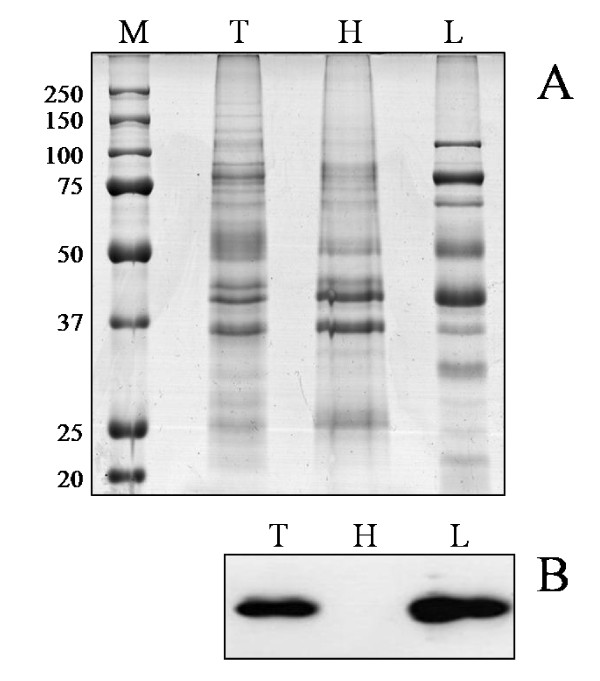
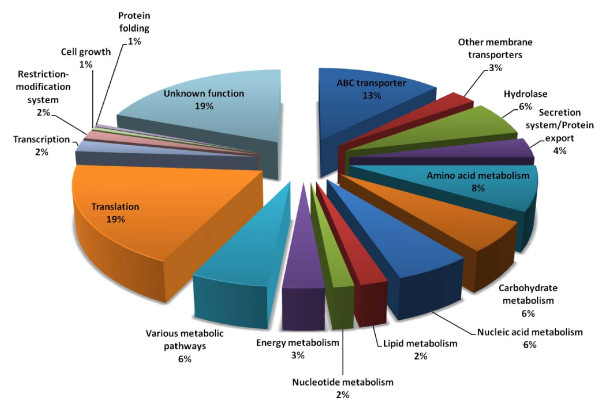
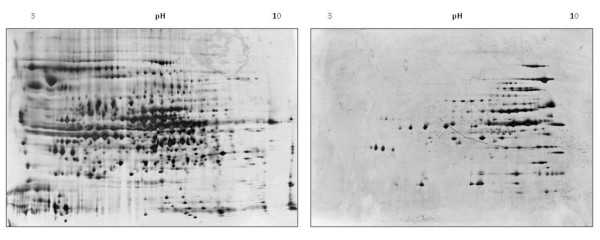
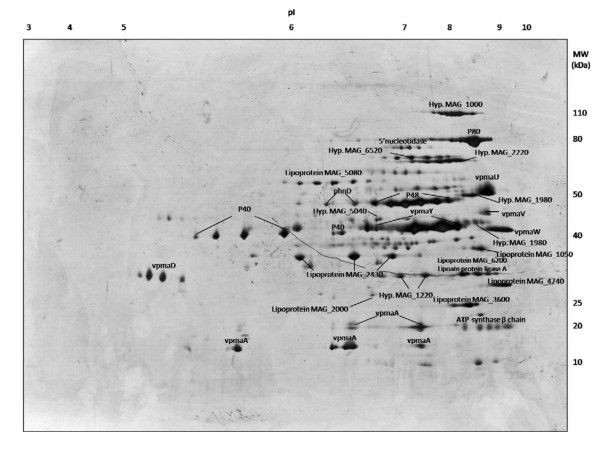
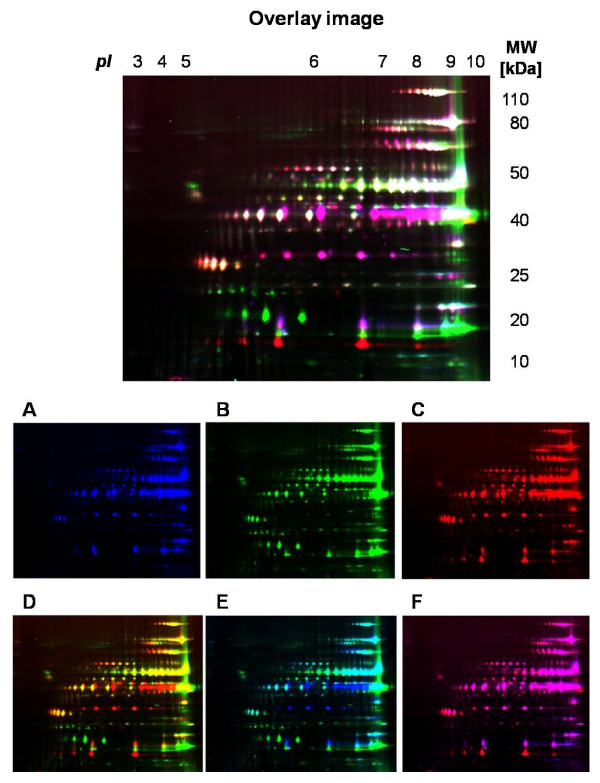
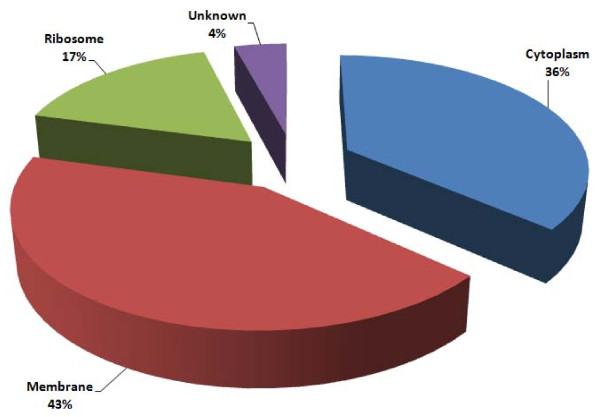
The selective enrichment for M. agalactiae PG2T liposoluble proteins was accomplished by means of Triton X-114 fractionation. Liposoluble proteins were subjected to 2-D PAGE-MS, leading to the identification of 40 unique proteins and to the generation of a reference 2D map of the M. agalactiae liposoluble proteome. Liposoluble proteins from the type strain PG2 and two field isolates were then compared by means of 2D DIGE, revealing reproducible differences in protein expression among isolates. An in-depth analysis was then performed by GeLC-MS/MS in order to achieve a higher coverage of the liposoluble proteome. Using this approach, a total of 194 unique proteins were identified, corresponding to 26% of all M. agalactiae PG2T genes. A gene ontology analysis and classification for localization and function was also carried out on all protein identifications. Interestingly, the 11.5% of expressed membrane proteins derived from putative horizontal gene transfer events.
This study led to the in-depth systematic characterization of the M. agalactiae liposoluble protein component, providing useful insights into its membrane organization.
支原体是能够自主复制的最简单的细菌。它们的进化起源于革兰氏阳性菌,失去了许多生物合成途径和细胞壁。在这项工作中,对最小的细菌病原体——导致乳腺炎、多关节炎、角膜炎和小反刍动物流产的牛支原体的脂溶性蛋白成分进行了系统的特征描述,以便深入了解其膜蛋白组的组成。
通过 Triton X-114 分级分离实现了对 M. agalactiae PG2T 脂溶性蛋白的选择性富集。脂溶性蛋白进行了 2-D PAGE-MS 分析,鉴定出 40 种独特的蛋白质,并生成了 M. agalactiae 脂溶性蛋白质组的参考 2D 图谱。然后通过 2D DIGE 比较了来自参考株 PG2 和两个田间分离株的脂溶性蛋白,揭示了分离株之间蛋白质表达的可重复性差异。然后通过 GeLC-MS/MS 进行了深入分析,以实现对脂溶性蛋白质组的更高覆盖率。通过这种方法,总共鉴定出 194 种独特的蛋白质,占 M. agalactiae PG2T 基因的 26%。还对所有蛋白质鉴定进行了基于功能和定位的基因本体论分析和分类。有趣的是,11.5%的表达膜蛋白来源于可能的水平基因转移事件。
这项研究对 M. agalactiae 脂溶性蛋白质成分进行了深入的系统特征描述,为其膜组织提供了有用的见解。