Yatoo Mohd Iqbal, Parray Oveas Raffiq, Bhat Riyaz Ahmed, Nazir Qurat Un, Haq Abrar Ul, Malik Hamid Ullah, Fazilli Mujeeb Ur Rehman, Gopalakrishnan Arumugam, Bashir Shah Tauseef, Tiwari Ruchi, Khurana Sandip Kumar, Chaicumpa Wanpen, Dhama Kuldeep
Mycoplasma Laboratory, Division of Veterinary Clinical Complex, Faculty of Veterinary Sciences and Animal Husbandry, Jammu and Kashmir, Srinagar 190006, India.
Department of Veterinary Clinical Medicine, Madras Veterinary College, Tamilnadu Veterinary and Animal Sciences University, Vepery 600007, India.
Vaccines (Basel). 2019 Jul 23;7(3):71. doi: 10.3390/vaccines7030071.
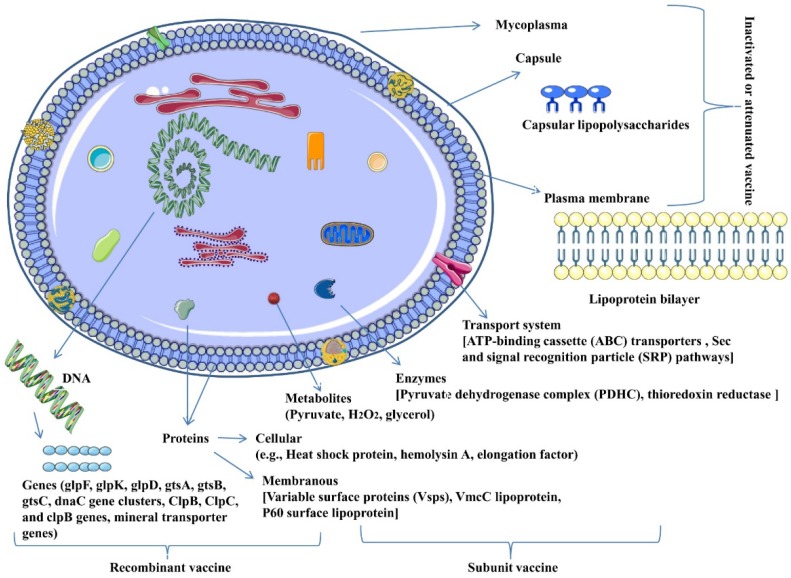
Exploration of novel candidates for vaccine development against subspecies (Mccp), the causative agent of contagious caprine pleuropneumonia (CCPP), has recently gained immense importance due to both the increased number of outbreaks and the alarming risk of transboundary spread of disease. Treatment by antibiotics as the only therapeutic strategy is not a viable option due to pathogen persistence, economic issues, and concerns of antibiotic resistance. Therefore, prophylactics or vaccines are becoming important under the current scenario. For quite some time inactivated, killed, or attenuated vaccines proved to be beneficial and provided good immunity up to a year. However, their adverse effects and requirement for larger doses led to the need for production of large quantities of Mccp. This is challenging because the required culture medium is costly and growth is fastidious and slow. Furthermore, quality control is always an issue with such vaccines. Currently, novel candidate antigens including capsular polysaccharides (CPS), proteins, enzymes, and genes are being evaluated for potential use as vaccines. These have shown potential immunogenicity with promising results in eliciting protective immune responses. Being easy to produce, specific, effective and free from side effects, these novel vaccine candidates can revolutionize vaccination against CCPP. Use of novel proteomic approaches, including sodium dodecyl sulfate polyacrylamide gel electrophoresis (SDS-PAGE), two-dimensional gel electrophoresis, immunoblotting, matrix-assisted laser desorption/ionization-time-of-flight (MALDI-TOF) mass spectrometry, tandem mass spectroscopy, fast protein liquid chromatography (FPLC), bioinformatics, computerized simulation and genomic approaches, including multilocus sequence analysis, next-generation sequencing, basic local alignment search tool (BLAST), gene expression, and recombinant expression, will further enable recognition of ideal antigenic proteins and virulence genes with vaccination potential.
传染性山羊胸膜肺炎(CCPP)的病原体丝状支原体山羊亚种(Mccp)疫苗开发新候选物的探索,近来因疾病暴发数量增加以及疾病跨界传播的惊人风险而变得极为重要。由于病原体的持续性、经济问题以及对抗生素耐药性的担忧,仅用抗生素治疗并非可行选择。因此,在当前情况下,预防性措施或疫苗正变得至关重要。在相当长一段时间内,灭活、杀死或减毒疫苗已证明是有益的,并且能提供长达一年的良好免疫力。然而,它们的不良反应以及需要更大剂量导致需要大量生产Mccp。这具有挑战性,因为所需的培养基成本高昂,而且生长苛求且缓慢。此外,此类疫苗的质量控制始终是个问题。目前,包括荚膜多糖(CPS)、蛋白质、酶和基因在内的新型候选抗原正在评估其作为疫苗的潜在用途。这些已显示出潜在的免疫原性,在引发保护性免疫反应方面取得了有前景的结果。这些新型候选疫苗易于生产、具有特异性、有效且无副作用,能够彻底改变CCPP疫苗接种的现状。使用新型蛋白质组学方法,包括十二烷基硫酸钠聚丙烯酰胺凝胶电泳(SDS-PAGE)、二维凝胶电泳、免疫印迹、基质辅助激光解吸/电离飞行时间(MALDI-TOF)质谱、串联质谱、快速蛋白质液相色谱(FPLC)、生物信息学、计算机模拟以及基因组学方法,包括多位点序列分析、下一代测序、基本局部比对搜索工具(BLAST)、基因表达和重组表达,将进一步有助于识别具有疫苗接种潜力的理想抗原蛋白和毒力基因。