Department of Physics, Simon Fraser University, Burnaby, British Columbia, Canada.
Mol Syst Biol. 2010 Aug 24;6:404. doi: 10.1038/msb.2010.61.
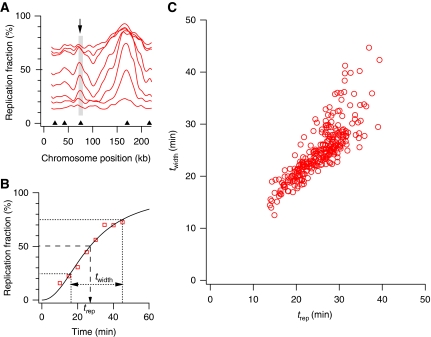
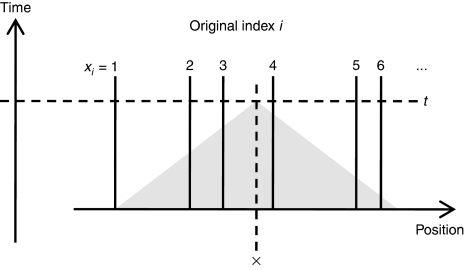
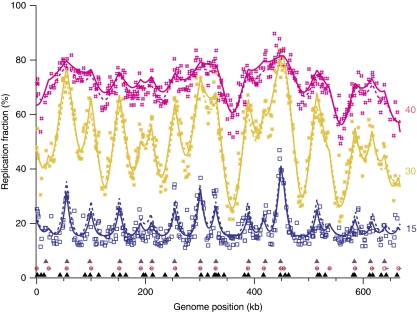
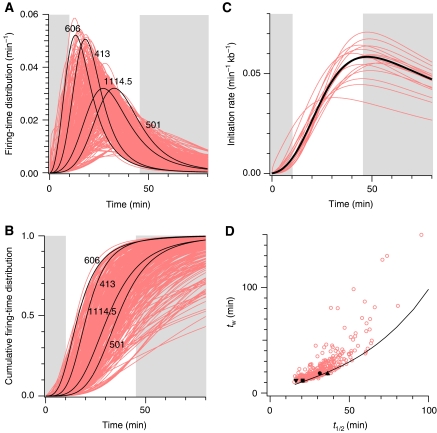
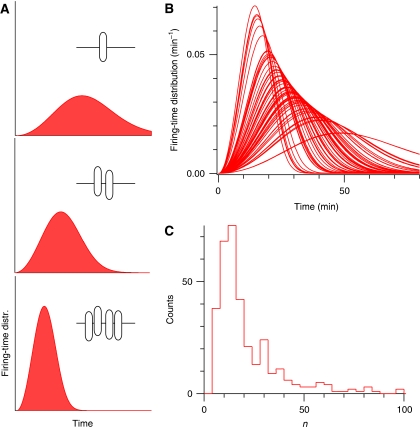
Microarrays are powerful tools to probe genome-wide replication kinetics. The rich data sets that result contain more information than has been extracted by current methods of analysis. In this paper, we present an analytical model that incorporates probabilistic initiation of origins and passive replication. Using the model, we performed least-squares fits to a set of recently published time course microarray data on Saccharomyces cerevisiae. We extracted the distribution of firing times for each origin and found that the later an origin fires on average, the greater the variation in firing times. To explain this trend, we propose a model where earlier-firing origins have more initiator complexes loaded and a more accessible chromatin environment. The model demonstrates how initiation can be stochastic and yet occur at defined times during S phase, without an explicit timing program. Furthermore, we hypothesize that the initiators in this model correspond to loaded minichromosome maintenance complexes. This model is the first to suggest a detailed, testable, biochemically plausible mechanism for the regulation of replication timing in eukaryotes.
微阵列是探测全基因组复制动力学的有力工具。由此产生的丰富数据集包含的信息比当前分析方法提取的信息更多。在本文中,我们提出了一个分析模型,该模型结合了起源的概率启动和被动复制。使用该模型,我们对最近发表的一组关于酿酒酵母的时间过程微阵列数据进行了最小二乘拟合。我们提取了每个起始点的点火时间分布,并发现平均而言,起始点点火时间越晚,点火时间的变化就越大。为了解释这一趋势,我们提出了一个模型,其中较早点火的起始点加载了更多的起始复合物,并且有更多可及的染色质环境。该模型展示了启动如何具有随机性,但在 S 期内仍在特定时间发生,而无需明确的时间安排程序。此外,我们假设该模型中的启动子对应于加载的小型染色体维持复合物。该模型首次提出了一种用于调节真核生物复制时间的详细、可测试、生化上合理的机制。