Institute of Tropical Medicine and International Health, Charité - University Medicine, Berlin, Germany.
Malar J. 2010 Aug 26;9:244. doi: 10.1186/1475-2875-9-244.
Intermittent preventive treatment in infants with sulphadoxine-pyrimethamine (IPTi-SP) reduces malaria morbidity by 20% to 33%. Potentially, however, this intervention may compromise the acquisition of immunity, including the tolerance towards multiple infections with Plasmodium falciparum.
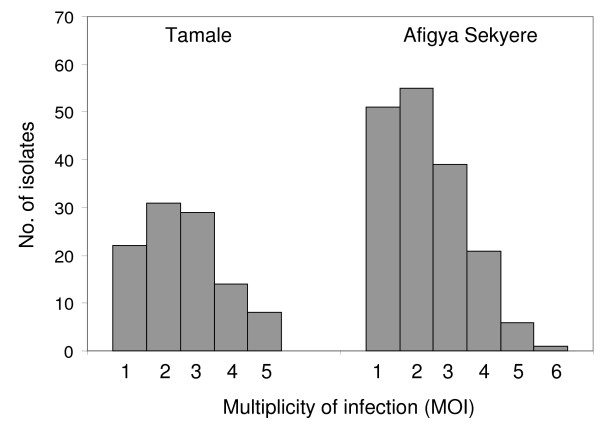
Plasmodium falciparum isolates were obtained from children participating in two Ghanaian IPTi-SP trials (Tamale, Afigya Sekyere) at 15 months of age, i.e., six months after they had received the second dose of IPTi-SP or placebo. By typing the polymorphic merozoite surface protein 1 (msp1) and msp2 genes, multiplicity of infection (MOI) was assessed in 389 isolates. A total of additional 133 samples were collected in Tamale at 3, 6, 9, and 12 months of age. Comparisons of MOI between groups were done by non-parametric statistical tests.
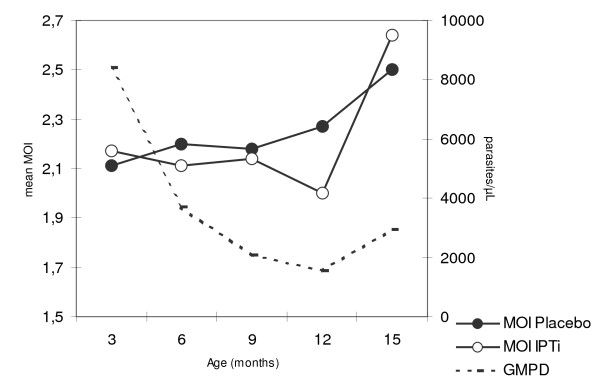
The number of distinguishable P. falciparum clones (MOI) ranged between one and six. Mean MOI in Tamale was stable at 2.13 - 2.17 during the first year of life, and increased to 2.57 at age 15 months (P = 0.01). At no age did MOI differ between the IPTi-SP and placebo groups (each, P ≥ 0.5). At 15 months of age, i.e., six months after the second dose, MOI was very similar for children who had received IPTi or placebo (means, 2.25 vs. 2.33; P = 0.55) as was the proportion of polyclonal infections (69.6% vs. 69.7%; P = 0.99). Adjusting for study site, current and prior malaria, parasite density, and season did not change this finding.
IPTi-SP appears to have no impact on the multiplicity of infection during infancy and thereafter. This suggests that tolerance of multiple infections, a component of protective immunity in highly endemic areas, is not affected by this intervention.
在婴儿中使用磺胺多辛-乙胺嘧啶(IPTi-SP)进行间歇性预防治疗可使疟疾发病率降低 20%至 33%。然而,这种干预措施可能会损害免疫的获得,包括对疟原虫多种感染的耐受。
从参加加纳两项 IPTi-SP 试验(塔马利、阿菲亚塞基耶)的儿童中获得疟原虫分离物,这些儿童在 15 个月大时(即接受 IPTi-SP 或安慰剂第二次剂量后六个月)。通过对多态性裂殖子表面蛋白 1(msp1)和 msp2 基因进行分型,评估了 389 个分离物的感染程度(MOI)。在塔马利还分别于 3、6、9 和 12 个月时收集了总共 133 个额外的样本。通过非参数统计检验比较组间 MOI 的差异。
可区分的疟原虫克隆数量(MOI)范围在 1 到 6 之间。塔马利在生命的第一年,MOI 平均值稳定在 2.13-2.17,15 个月时增加到 2.57(P=0.01)。在任何年龄段,IPTi-SP 组和安慰剂组的 MOI 均无差异(P≥0.5)。在 15 个月大时,即第二次剂量后六个月,接受 IPTi 或安慰剂的儿童的 MOI 非常相似(平均值,2.25 与 2.33;P=0.55),多克隆感染的比例也相似(69.6%与 69.7%;P=0.99)。调整研究地点、当前和既往疟疾、寄生虫密度和季节后,这一发现并未改变。
IPTi-SP 似乎对婴儿期及以后的感染程度没有影响。这表明,在高度流行地区,对多种感染的耐受是保护性免疫的一个组成部分,不会受到这种干预的影响。