Centre for Population Health Sciences, University of Edinburgh,Edinburgh, UK.
Diabetes. 2010 Nov;59(11):2883-9. doi: 10.2337/db10-0752. Epub 2010 Aug 26.
Cerebral microvascular disease associated with type 2 diabetes may exacerbate the effects of aging on cognitive function. A considerable homology exists between the retinal and cerebral microcirculations; a hypothesized association between diabetic retinopathy (DR) and cognitive decline was examined in older people with type 2 diabetes.
In the population-based Edinburgh Type 2 Diabetes Study, 1,046 men and women aged 60-75 years with type 2 diabetes underwent standard seven-field binocular digital retinal photography and a battery of seven cognitive function tests. A general cognitive ability score (g) was generated by principal components analysis. The Mill-Hill Vocabulary Scale was used to estimate premorbid cognitive ability. DR was graded using a modification of the Early Treatment of Diabetic Retinopathy Scale.
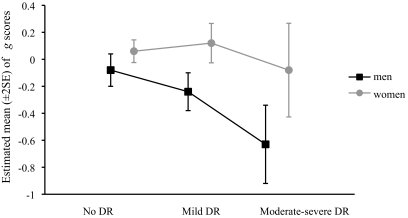
After age and sex adjustment, a significant relationship was observed with increasing severity of DR (none, mild, and moderate to severe) for most cognitive measures. Participants with moderate-to-severe retinopathy had the worst g and the worst performances on the individual tests. There was a significant interaction between sex and retinopathy for g. In male subjects, the associations of retinopathy with g (and with tests of verbal fluency, mental flexibility, and processing speed but not memory and nonverbal reasoning) persisted (P < 0.05) when further adjusted for vocabulary (to estimate lifetime cognitive decline), depression, sociodemographic characteristics, cardiovascular risk factors, and macrovascular disease.
DR was independently associated with estimated lifetime cognitive decline in older men with type 2 diabetes, supporting the hypothesis that cerebral microvascular disease may contribute to their observed accelerated age-related cognitive decline. A sex interaction with stronger findings in men requires further confirmation.
与 2 型糖尿病相关的脑微血管疾病可能会加重衰老对认知功能的影响。视网膜和脑微循环之间存在相当大的同源性;本研究旨在探讨 2 型糖尿病老年患者中糖尿病视网膜病变(DR)与认知能力下降之间的假设关联。
在基于人群的爱丁堡 2 型糖尿病研究中,1046 名年龄在 60-75 岁之间的 2 型糖尿病男性和女性接受了标准的 7 野双眼数字视网膜摄影和 7 项认知功能测试。使用主成分分析生成一般认知能力评分(g)。使用 Mill-Hill 词汇量表估计发病前的认知能力。使用早期糖尿病视网膜病变分级标准的修改版对 DR 进行分级。
在年龄和性别调整后,与 DR 严重程度(无、轻度和中重度)呈显著相关的认知指标较多。中重度视网膜病变患者的 g 最差,单项测试的表现最差。g 与性别和视网膜病变之间存在显著的交互作用。在男性受试者中,当进一步调整词汇量(估计终生认知下降)、抑郁、社会人口统计学特征、心血管危险因素和大血管疾病时,视网膜病变与 g(以及语言流畅性、心理灵活性和处理速度测试,但与记忆和非语言推理无关)的相关性仍然存在(P<0.05)。
DR 与 2 型糖尿病老年男性的估计终生认知下降独立相关,支持脑微血管疾病可能导致其观察到的加速与年龄相关的认知下降的假说。在男性中存在性别交互作用,且在男性中发现的相关性更强,需要进一步证实。